
What Was the Date and Time 4 Days Ago?
Calendar
Same span, other units
The exact date and time 4 days ago is shown in the live widget above, calculated from your own device clock and time zone. To get the same answer by hand, subtract 4 from today’s day number, and if that goes below 1, borrow the length of the previous month. The time of day stays the same.
The arithmetic is easy. The mistakes come from month ends, daylight saving changes, time zones and what “days” means in a given document. This page covers those cases so the number you act on is the right one.
How to Subtract 4 Days by Hand
If today’s day number is 5 or higher, subtract 4 and you are done. Only the first four days of a month need a borrow: take the length of the previous month, add today’s day number, then subtract 4.
Here is a worked example with a made-up starting date of 2 March 2028. Previous month is February, which has 29 days in 2028 because it is a leap year. So 29 + 2 - 4 = 27, and the answer is 27 February 2028. Run the same starting date in 2027 and February has 28 days, so you land on 26 February. A leap day is the one thing that makes the same calendar position give a different answer.
For January starts, the borrow also rolls the year back. 3 January becomes 30 December of the previous year, since December has 31 days: 31 + 3 - 4 = 30.
Try this: Pick any date in the first four days of a month and subtract 4 using the borrow rule. Then check it in the date calculator. Do it for one date in March and one in May, since the months before them differ in length.
The Weekday Shortcut
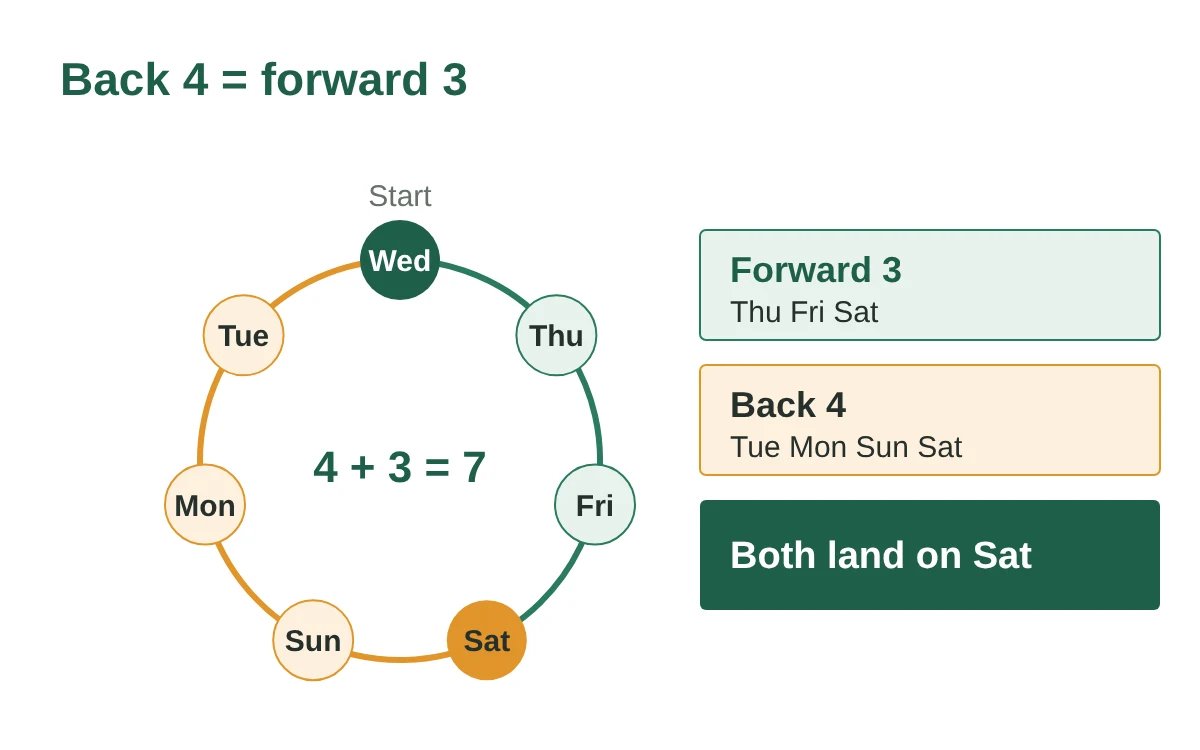
Going back 4 days lands on the same weekday as going forward 3 days. That works because 4 and 3 add up to a full week. So if the starting day is Monday, 4 days ago was Thursday: Monday forward by 3 is Thursday.
This is faster than counting backward on your fingers, and it works for any starting weekday. Check the start of the week: Wednesday forward 3 gives Saturday, so 4 days before a Wednesday is a Saturday.
The same trick scales. Subtracting 5 equals adding 2, subtracting 6 equals adding 1. For a close neighbour of this page, see 2 days ago, where the equivalent move is forward 5.
4 Days vs 96 Hours
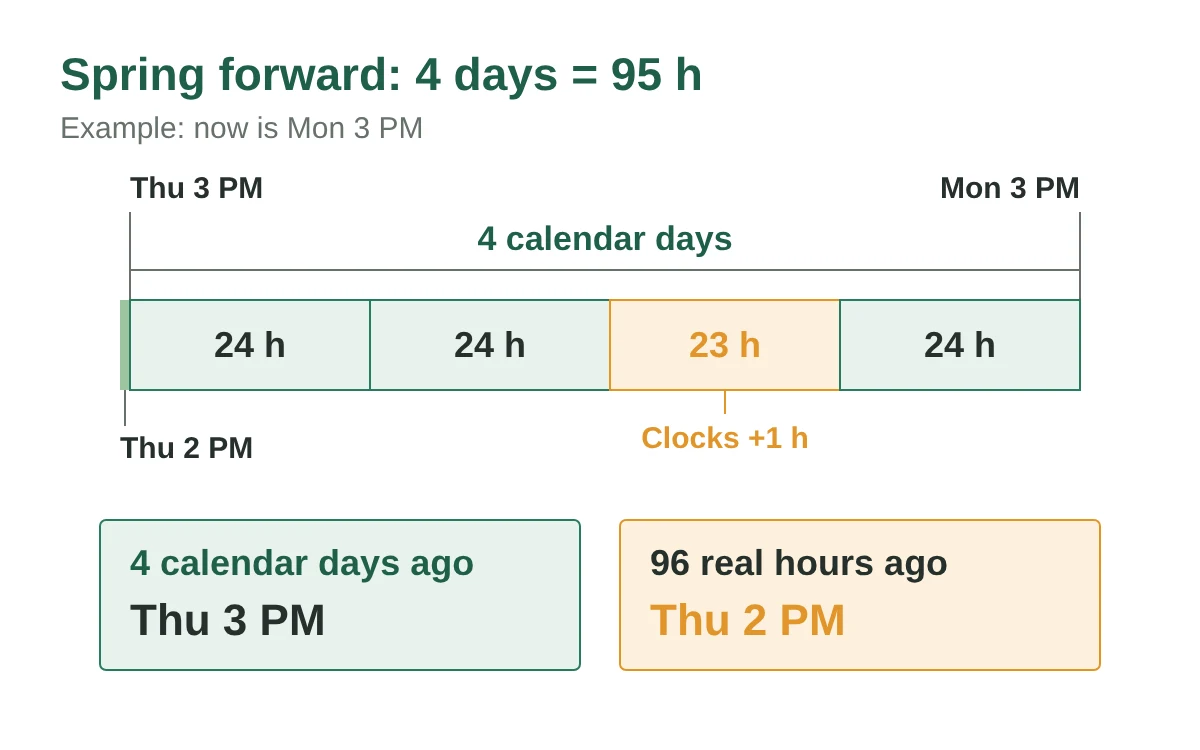
Four calendar days and 96 elapsed hours are the same only when no clock change happens in between. Where daylight saving time applies, one day in spring is 23 hours long and one in autumn is 25.
Take a hypothetical Monday at 3 PM, with clocks springing forward the previous Sunday. Four calendar days earlier is Thursday at 3 PM on the wall clock. But only 95 real hours separate those two moments, so 96 real hours earlier is Thursday at 2 PM. In autumn the gap runs the other way.
Which one you need depends on the task. Calendar-day logic suits things like “4 days ago at lunchtime”. Elapsed-hours logic suits anything measured by the clock, such as a dosing interval or a server log. If you need the hour conversion itself, 5 days in hours shows the plain multiplication.
Time Zones Change the Date
The date 4 days ago depends on where “now” is. A person in Auckland and a person in Los Angeles can be on different calendar dates for part of every day, so their answers to “4 days ago” differ by a full day during those hours.
This matters most near midnight. An event timestamped late evening in one zone may already be the next date in UTC. If you compare a log line, a receipt and a message from different systems, convert all of them to one zone first, ideally UTC, before counting back.
The live widget uses your own zone. If you are checking something recorded elsewhere, work out the event’s local date before comparing.
Calendar Days vs Business Days
“4 business days ago” is a different question. It skips Saturdays and Sundays, so counting back from Monday, Tuesday, Wednesday or Thursday crosses a weekend and lands 6 calendar days back. Friday is the exception: 4 business days before a Friday is the Monday of the same week, which is 4 calendar days.
Public holidays are a second layer. Most simple calculators ignore them, but a delivery promise or bank processing time usually does not. If a Monday holiday sits inside your window, add one more day back.
- Start Monday to Thursday: 6 calendar days back
- Start Friday: 4 calendar days back
- Any holiday in the span: add a day per holiday
Deadlines and Notice Periods
Legal and contractual wording decides whether the start day counts. Many rules say to exclude the day of the triggering event and include the final day. Others count from the moment of an event, so a notice served at 4 PM may not begin until the following day.
To check whether you are inside a window, count back from the deadline rather than forward from the event. If the event date is later than the date 4 days before the deadline, you are inside the window. This avoids off-by-one slips when a period straddles a month end.
When a deadline falls on a weekend, some systems roll it to the next business day. Others do not. Read the exact wording, because the same 4 days can mean two different dates.
Try this: Take a deadline you know about and subtract 4 days. Write both the calendar-day answer and the business-day answer side by side. If they differ, that gap is the margin you should plan around.
Medication and Shipping Windows
For medication, elapsed hours matter more than dates. A dose taken “4 days ago in the evening” is a time, not a date, so use the exact clock reading and not just the calendar day. Follow the label or your pharmacist for any window, and use a calculator only to find the timestamp.
For shipping, a package marked as shipped 4 days ago has been in transit for 4 days only if the carrier counts calendar days. Many carriers quote business days, and they stamp events in the local time of each depot. A parcel scanned late on a Friday evening may show a Saturday date in another region.
If you want to check forward timing, 72 hours from now covers the three-day equivalent, and 10 hours ago helps when the question is about a shorter window.
Quick Sanity Checks
Three checks catch most errors. First, the weekday from the shortcut above should match the weekday on the result. Second, the result should be earlier than today’s date by exactly four squares on a calendar, never five or three. Third, if the month changed, the new day number should be near the end of the previous month.
For other offsets, the from now and ago tools cover many common distances in both directions.
Frequently asked questions
Does 4 days ago include today?
No. Today is day zero, so yesterday is 1 day ago and the date 4 days ago is four calendar squares back. If a contract or form counts the starting day as day one, the same event can look one day different, so check how that document counts.
Is 4 days ago the same as 96 hours ago?
Usually, but not always. If clocks change for daylight saving time inside the window, 4 calendar days and 96 elapsed hours land an hour apart on the wall clock.
How do I find the weekday 4 days ago without a calendar?
Move forward 3 weekdays instead. Going back 4 days and going forward 3 days end on the same weekday, because 4 plus 3 makes a full week.
What is 4 business days ago?
It skips Saturdays and Sundays, so it is often 6 calendar days back. Only when you start on a Friday does it equal 4 calendar days, and public holidays push it back further.