
How Many Hours Is 5 Days?
Conversion table
5 days is exactly 120 hours. You multiply 5 by 24, because a day is defined as 24 hours (86,400 seconds). The live calculator above applies the same idea to your own clock and time zone, so it shows the precise span from this moment.
That 120 is a fixed conversion, but it describes a length of time, not always a pair of wall-clock readings. Daylight saving, working-day counting and fractional days can all shift what “5 days” means in practice, and those cases are covered below.
The working and a mental shortcut
The formula is hours = days × 24, so 5 × 24 = 120. If 24 times a number is awkward in your head, there are two easier routes.
The first is to round up and subtract: 5 × 25 = 125, then take away 5 to get 120. The second is to double and use ten: 24 × 10 = 240, and 5 days is half of 10 days, so 120. Both work for any whole number of days, and the second is handy because 10 days is 240 hours, a figure that is easy to remember.
For any other amount, split the number into whole days and leftover hours. 5 days and 6 hours is 120 + 6 = 126 hours. To go the other way, divide by 24: 120 ÷ 24 = 5. The page on how many days 48 hours is walks through that reverse direction.
Nearby values at a glance
The table below shows the values people most often check next to 5 days, including half days.
| Days | Hours | Minutes |
|---|---|---|
| 4 | 96 | 5,760 |
| 4.5 | 108 | 6,480 |
| 5 | 120 | 7,200 |
| 5.5 | 132 | 7,920 |
| 6 | 144 | 8,640 |
| 7 | 168 | 10,080 |
Half a day adds exactly 12 hours, so every half-day value ends in 0 or 8 in this range and steps by 12. Three days sits at 72 hours, which has its own page: what is 72 hours from now. More unit pairs are collected under time unit conversions.
Try this: Pick any number of days between 1 and 9 and use the ×25 minus the number trick on it. Check the result against the table. After a few rounds, 24 times tables stop needing a calculator.
When 5 days is not 120 hours
The conversion factor itself never changes. What changes is the clock. In places that observe daylight saving, one calendar day each year lasts 23 hours and another lasts 25. If you count 5 calendar days (same time of day, 5 dates later) across one of those changes, the elapsed time is 119 or 121 hours.
A flight, a countdown to a deadline or a rental that runs “5 days” by the calendar can therefore be an hour off from 120. Fixed-length tasks, such as a 120-hour medication schedule, a cooking time or a lab sample, should be counted in elapsed hours, not by looking at the wall clock.
Leap seconds are the other footnote. They can make a day 86,401 seconds long in UTC, but none have been added since 2016, and for everyday planning they are irrelevant.
A worked example with a hypothetical date
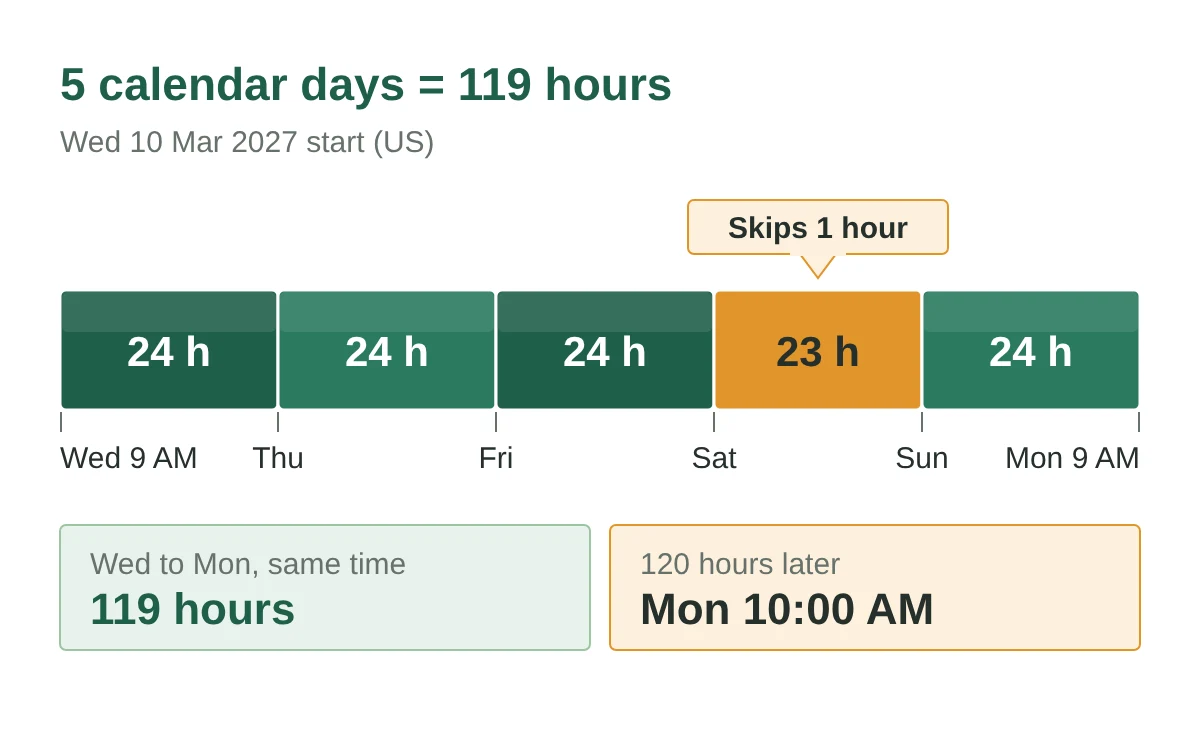
Say a task starts on Wednesday 10 March 2027 at 9:00 AM in a US time zone that observes daylight saving. This date is only an illustration.
Counting on the calendar, 5 days later is Monday 15 March at 9:00 AM. The conversion says 120 hours, but the US clocks go forward on Sunday 14 March 2027, which removes one hour. The true elapsed time between those two clock readings is 119 hours.
To get the exact moment 120 elapsed hours later, add 120 hours to the start. That lands at 10:00 AM on Monday 15 March, because the clock skipped an hour on the way. Whenever the question is “what time will it be after 120 hours?”, the answer depends on whether your region changes its clocks in between. The date calculator handles add-days questions like this, and the page for 3 days from now shows the shorter version.
Working days are not elapsed days
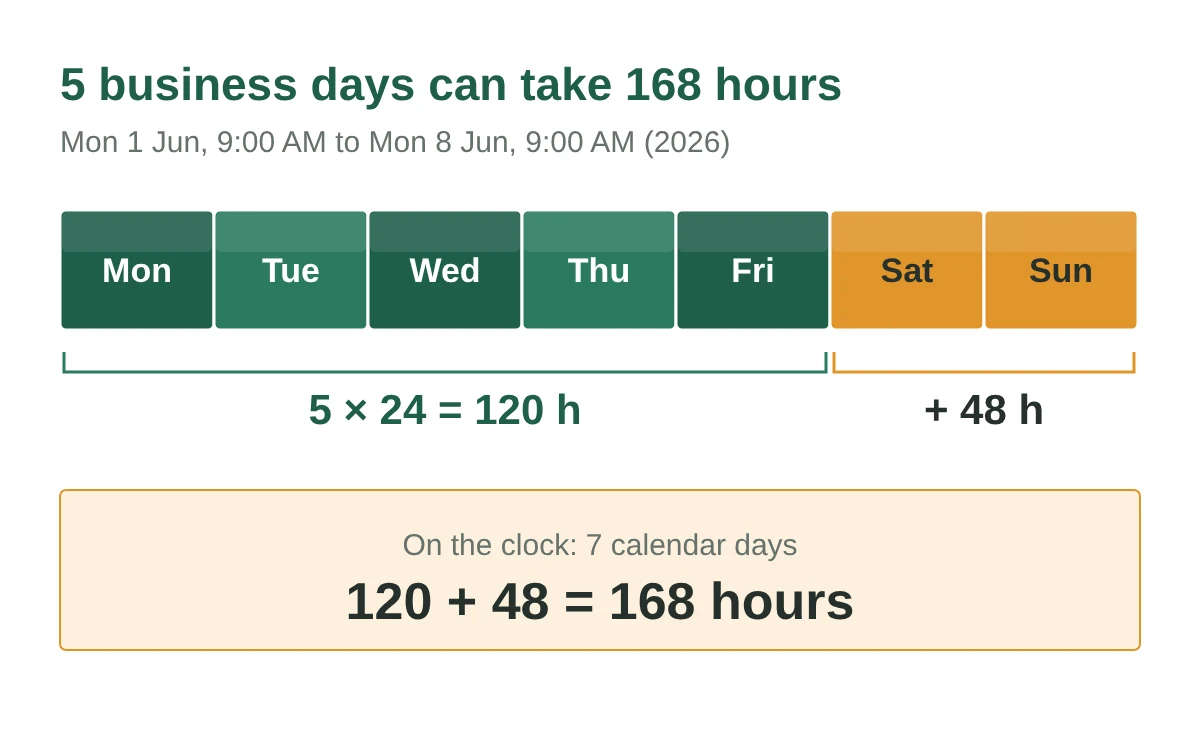
“5 days” in a work context usually means business days. Five working days of 8 hours is 40 hours of work. Five business days starting on a Monday morning end on the following Monday morning if you count the weekend, which is 7 calendar days or 168 hours of elapsed time.
Mixing these up is the most common error in deadlines. A supplier who promises delivery “within 5 days” may mean 120 hours or may mean a full week on the clock. When a contract or booking matters, ask whether the count skips weekends and holidays.
For a rolling countdown to the end of the working week, see how many hours until Friday.
Try this: Take a deadline given as “5 days” and write it three ways: 120 elapsed hours, 5 calendar dates, and 5 business days. Compare the three finish times. The gap between them is the margin you did not know you had.
Rounding when months and years are involved
Hours convert exactly to days and weeks, but months and years vary in length, so any conversion to them is an approximation. Using the average month of 30.44 days, 5 days is about 0.164 months. A 30-day month contains 720 hours, a 31-day month 744 hours, February 672 hours (or 696 in a leap year), and the average month is roughly 730 hours.
A year is 8,760 hours, or 8,784 in a leap year. For longer spans, convert to days first, then to hours, and do not use a single “hours per month” number unless a rough answer is enough. The same caution applies when turning large day counts into months, as shown on the page for how many months 120 days is.
Note the coincidence: 120 hours is 5 days, and 120 days is about 4 months. The numbers match only in size, so keep the units straight.
Counting 5 days backward or forward
The size of the span is the same in either direction: 120 hours. Going back, the start of the span is the earlier clock reading, so the daylight saving effect appears in reverse. See what was the date and time 4 days ago for an example of looking back.
Counting inclusively is a separate trap. Saying “from the 10th to the 15th” is 5 days of elapsed time but 6 calendar dates if both ends are included. If your tool or form wants the number of dates covered, that is 144 hours of calendar coverage, not 120. Check which meaning the question uses before you convert.
Frequently asked questions
How many hours are in 5 days?
There are 120 hours in 5 days (5 × 24). In minutes that is 7,200, and in seconds it is 432,000.
How many hours are in 5 days and 6 hours?
Convert the whole days first (5 × 24 = 120), then add the extra hours. 5 days and 6 hours is 126 hours.
Can 5 days ever be 119 or 121 hours?
Yes, if the span crosses a daylight saving change in your location and you count 5 calendar days on the wall clock. Spring forward removes an hour (119), and fall back adds one (121).
How many hours are in 5 working days?
If you mean time at work, 5 days of 8 hours is 40 hours. If you mean elapsed time from Monday morning to the next Monday morning, it is 168 hours.