
How Many Days Until August 7th?
Calendar
Countdown chart
The live widget above gives the exact number of days to August 7th, and it uses your own clock and time zone, so it is right wherever you are. To check it by hand, subtract today’s day-of-year number from 219. That is the day count of August 7th in a common year, and it is 220 in a leap year.
If August 7th has already passed this year, the countdown aims at next year’s date instead. The hand method then needs one extra step, covered below, and a few small traps decide whether your answer is off by one.
The quickest way to count by hand
Counting month by month invites mistakes. A day-of-year number turns the whole job into one subtraction. August 7th is day 219 of a common year, and 220 once a leap day has been added to February. Convert your starting date to its own number, then subtract.
Day numbers are quick to build. The days before each month starts add up to 0, 31, 59, 90, 120, 151, 181, 212 for January through August in a common year. Add the day of the month to the figure for your month and you have the number. For August 7th itself that is 212 + 7 = 219.
If your starting date is later in the year than August 7th, subtract your number from the year’s length (365 or 366), then add 219 (or 220 if the target year is a leap year). The year of the target decides which number to use, not the year you start in.
A worked example with a made-up start date
Take a hypothetical starting date of March 15, 2027. Its day number is 59 + 15 = 74. August 7th, 2027 is 219. The difference is 219 minus 74, which is 145 days. A month-by-month count agrees: 16 days left in March, then 30, 31, 30 and 31 for April through July, then 7 into August, for 145 in total.
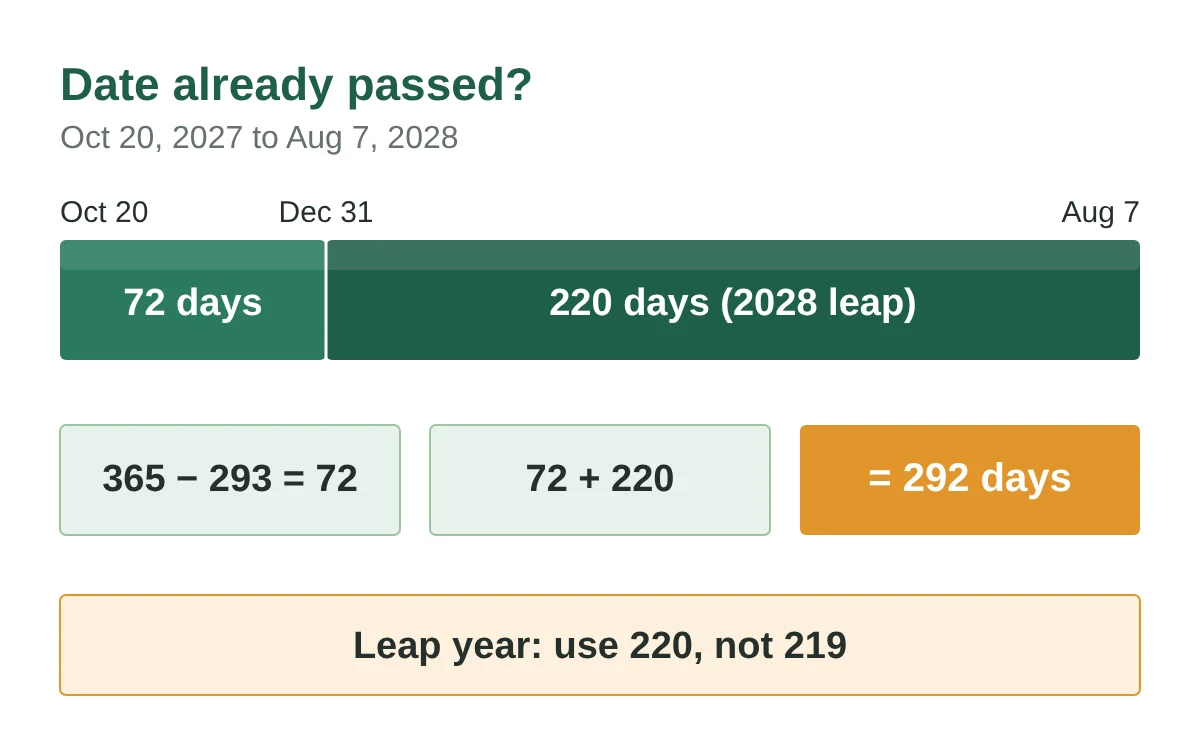
Now a start that has already passed the target: say October 20, 2027, with the next August 7th in 2028, a leap year. October 20 is day 273 + 20 = 293 of 2027 (the days before October add up to 273), so 365 minus 293 leaves 72 days in the year. Add 220 for 2028’s August 7th and the total is 292 days. Using 219 there would be a classic one-day miss.
Try this: Pick any date you know, work out its day number from the month totals above, and subtract it from 219. Then check the result against the widget by entering that date in the date calculator.
Weeks and weekdays to August 7th
Divide the day count by 7. The whole number is the weeks, and the remainder is the extra days. In the example above, 145 days is 20 weeks and 5 days. The remainder also tells you the weekday of your start date: August 7th, 2027 is a Saturday, so a start 5 days earlier in the week is a Monday.
Weekdays follow from the same split. Every full week holds exactly 5 weekdays, so 20 weeks gives 100. Then count only the weekdays in the leftover days. In the example, Monday through Friday gives 5 more, so 105 weekdays, counting the start day and not counting August 7th. Whether the start and end days are included is the most common source of disagreement between two calculators, so settle it before comparing numbers.
Weekday totals ignore public holidays. If you are counting working days toward a deadline, subtract the holidays that land on weekdays in the span yourself.
Which weekday August 7th lands on
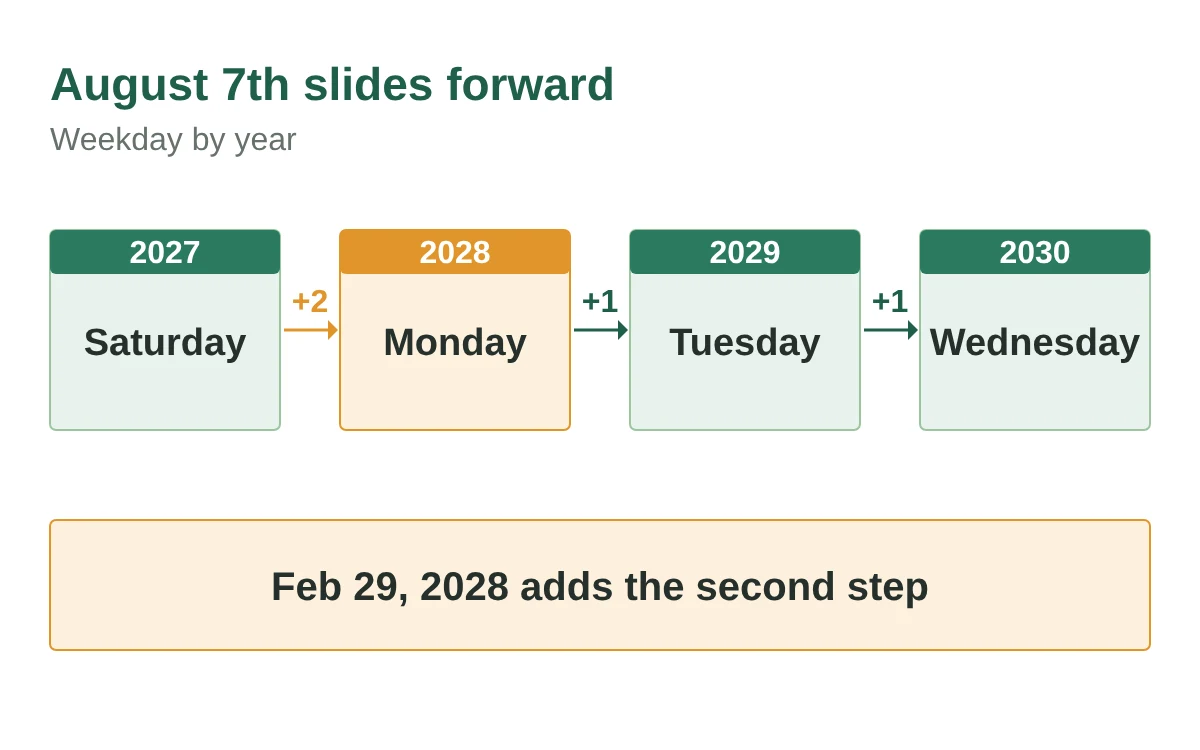
The date drifts forward one weekday each year, because 365 days is 52 weeks plus one day. After a February 29 has passed, the drift is two. That gives this run:
- 2027: Saturday
- 2028: Monday (leap year, so a two-day jump)
- 2029: Tuesday
- 2030: Wednesday
This matters for planning. A Saturday date gives you a clear weekend, while a Monday date means the weekend before it is the real deadline for travel or packing. The pattern repeats on a 28-year cycle in the Gregorian calendar, apart from century years that skip a leap day.
Start-of-day and time zone traps
A countdown to a date ends at 00:00 on August 7th, the very start of the day. On the evening of August 6th the widget shows a few hours, not a day. That is why a plain “days until” figure can feel one short if you think of August 7th as the day you wake up in.
Time zones add a second wrinkle. The date arrives first in places far east and last in places far west, so the same countdown ends at different real moments for different people. If you are timing something across countries, count to the local midnight of the place where it happens. For that kind of timing, how long until midnight shows the clock-based version.
Hours are the third trap. A span that runs from before a spring clock change to August 7th, or from after an autumn change, crosses a daylight saving shift in many countries. Days times 24 can then be an hour off. Counting calendar days avoids the problem.
What August 7th is known for
The date carries several fixed observances. In the United States it is Purple Heart Day, honoring service members wounded or killed in action, and National Lighthouse Day, which marks the 1789 act of Congress that put lighthouse upkeep under federal care. Colombia observes the Battle of Boyacá on August 7th, and Ivory Coast marks its independence on the same day.
Some “August 7th” days are not actually fixed. International Beer Day falls on the first Friday of August, so it lands on August 7th in some years and not others. National Mustard Day and National Disc Golf Day follow the first Saturday, which is August 7th in 2027. Check whether an observance is tied to a date or to a weekday before you plan around it.
In the Northern Hemisphere the date sits in high summer. In the Southern Hemisphere it is mid-winter. The Perseid meteor shower usually peaks a few days later, around August 12 and 13, which gives you a nice follow-on target after the 7th.
Planning around the countdown
Use the count to split a goal into blocks. If the number of weeks is large, set a checkpoint at the halfway week and another at the 30-day mark. For short windows, look at the 90 days from now or 10 days from now pages to see where a 90-day or 10-day block would land.
Neighboring dates help too. Many travel and event plans cluster in the same week, so the counts to August 4th and August 10th make quick comparison points. If you are counting to the whole month instead, the page for August covers that.
Try this: Write down August 7th’s weekday for your target year, then mark the Friday before it. That Friday is your practical deadline for anything that needs a working day to finish.
Frequently asked questions
Is August 7th the 219th day of the year?
Yes, in a common year. In a leap year it is the 220th day, because February 29 pushes every later date back by one. That number is the basis of the quickest hand calculation.
What day of the week is August 7th?
It moves forward one weekday each year, or two after a leap day has passed. It falls on a Saturday in 2027, a Monday in 2028, a Tuesday in 2029 and a Wednesday in 2030.
Does the countdown reach zero at midnight?
It reaches zero at 00:00 on August 7th in the time zone your device uses. A person in another time zone will see the same date arrive at a different moment.
If August 7th has already passed this year, which one does the countdown use?
It targets the next one, which is in the following year. By hand, add the days left in the current year to 219 (or 220 if the next August 7th falls in a leap year).