
How Many Days Until August 1st?
Calendar
Countdown chart
The fastest exact answer is the live countdown above this article, which reads your own clock and time zone and always targets the next August 1. To check it yourself, subtract today’s day-of-year number from 213, or from 214 if the target August 1 falls in a leap year. That one subtraction replaces counting month by month.
The rest of this page covers the arithmetic behind it, the edge cases that cause off-by-one errors, and how to turn the count into weeks and working days.
What the countdown actually measures
A countdown to “August 1” ends at the first instant of that date, which is midnight at the start of it, not the end. On July 31 the count is already under 24 hours, and it reads zero the moment August 1 begins where you are.
That is why two calculators can disagree by one day. Some count today as a full day, some do not, and some measure to the end of August 1. The live widget uses your device’s time zone, so if you travel or change a device setting, the figure shifts with it. Someone in Sydney reaches August 1 many hours before someone in Los Angeles.
The day-of-year shortcut
August 1 is the 213th day of a normal year and the 214th in a leap year. Jan 31, Feb 28, Mar 31, Apr 30, May 31, Jun 30 and Jul 31 add up to 212, so August 1 is the next number. Learn 213 and you can count to August 1 from any date before it.
The recipe has two steps. Find today’s day-of-year number (add the full months before it, then today’s date), then subtract it from 213. In a leap year use 214, but only if the start date falls after February 29. Before that, the extra day is already inside 214 on both sides, which is the case worked through below.
A worked example, including the leap-year catch
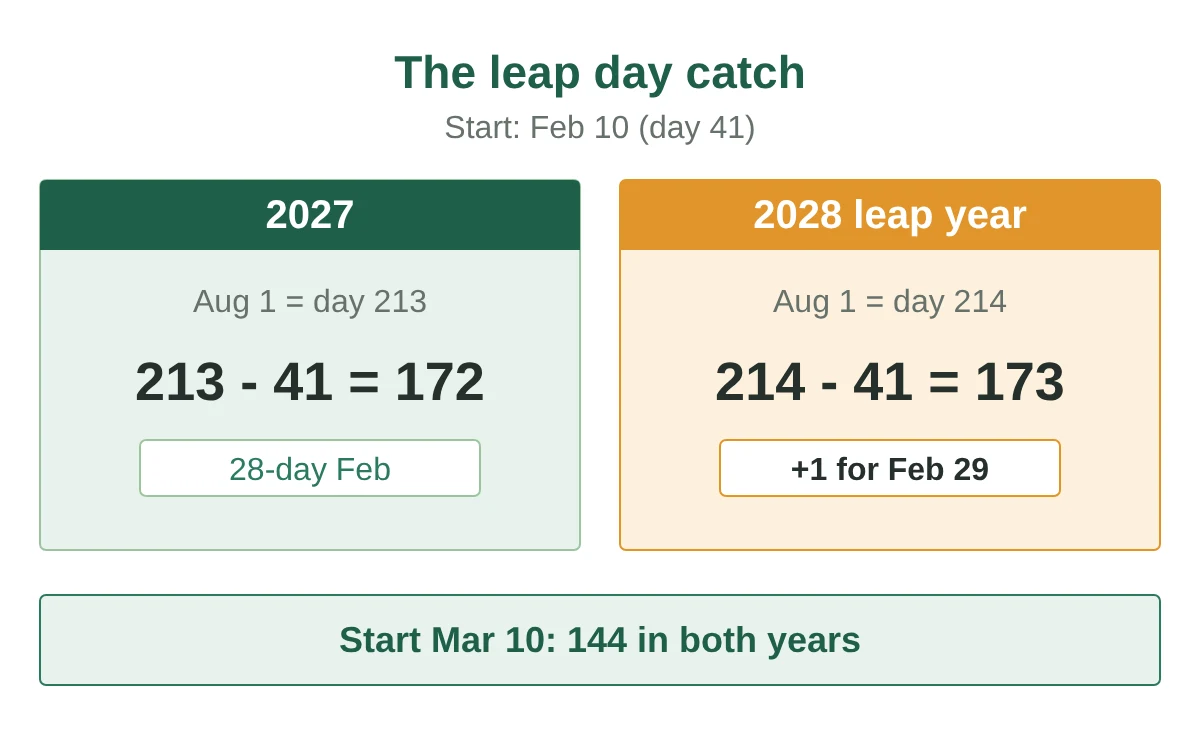
Take a hypothetical start of March 10, 2027. January and February give 59 days (31 + 28), so March 10 is day 69. Then 213 minus 69 gives 144 days.
Now move the start to February 10. In 2027 that is day 41, so the count is 213 minus 41, or 172. In 2028, a leap year, February 10 is still day 41, but August 1 is day 214, so the count is 173. A leap day only adds to the count when your start date falls before it.
Try this: Pick a date three months before August 1 and work out its day-of-year number on paper. Subtract it from 213, then check the result against the live widget set to that date.
The month-block shortcut
July and August both have 31 days, which makes a tidy set of landmarks. From July 1 to August 1 is exactly 31 days. From June 1 it is 61 days (30 + 31), and from May 1 it is 92 days (31 + 30 + 31). Those match the counts on the June 1 countdown and the May 1 countdown once the year is aligned.
Use these as anchors. For a start of May 19, count back to the anchor: May 1 is 92 days out, and May 19 is 18 days later, so 74 days remain. It is quicker than adding four month lengths in your head.
Counting weeks and weekdays
Divide the day count by 7. The remainder tells you the weekday gap: if you have 20 weeks and 4 days left, August 1 falls four weekdays after today’s weekday. A 144-day gap from a Wednesday, for example, ends on a Sunday. For a ready-made version of this split, see how many weeks until August 1st.
For working days, each full week contributes 5. Count the leftover days by their weekday names. From Wednesday, March 10, 2027, the 144 days are 20 full weeks (100 weekdays) plus Thursday through Sunday, which adds 2, so 102 weekdays fall in the stretch. Public holidays in your country come off that total, and the date calculator on the date calculator page is handy for the day-count side.
What August 1 is known for
August 1 is Switzerland’s National Day, marked with bonfires and fireworks. It is also the day Benin celebrates independence from France (1960). In several Caribbean countries, including Jamaica, Barbados and Trinidad and Tobago, it is Emancipation Day, commemorating the 1834 start of the end of slavery in the British Empire.
Older calendars treat it as a seasonal marker. Lammas, the Christian loaf festival, and the Gaelic harvest festival Lughnasadh both sit on or around this date, roughly midway between the June solstice and the September equinox. In the Northern Hemisphere it is high summer. In the Southern Hemisphere it is deep winter.
Racing fans know it as the official birthday for Southern Hemisphere thoroughbreds, which are all aged up on August 1 for eligibility. Canada’s Civic Holiday, observed in many provinces on the first Monday of August, only lands on August 1 itself when the 1st is a Monday. In 2027 it falls the next day, on the 2nd.
Why the weekday keeps shifting
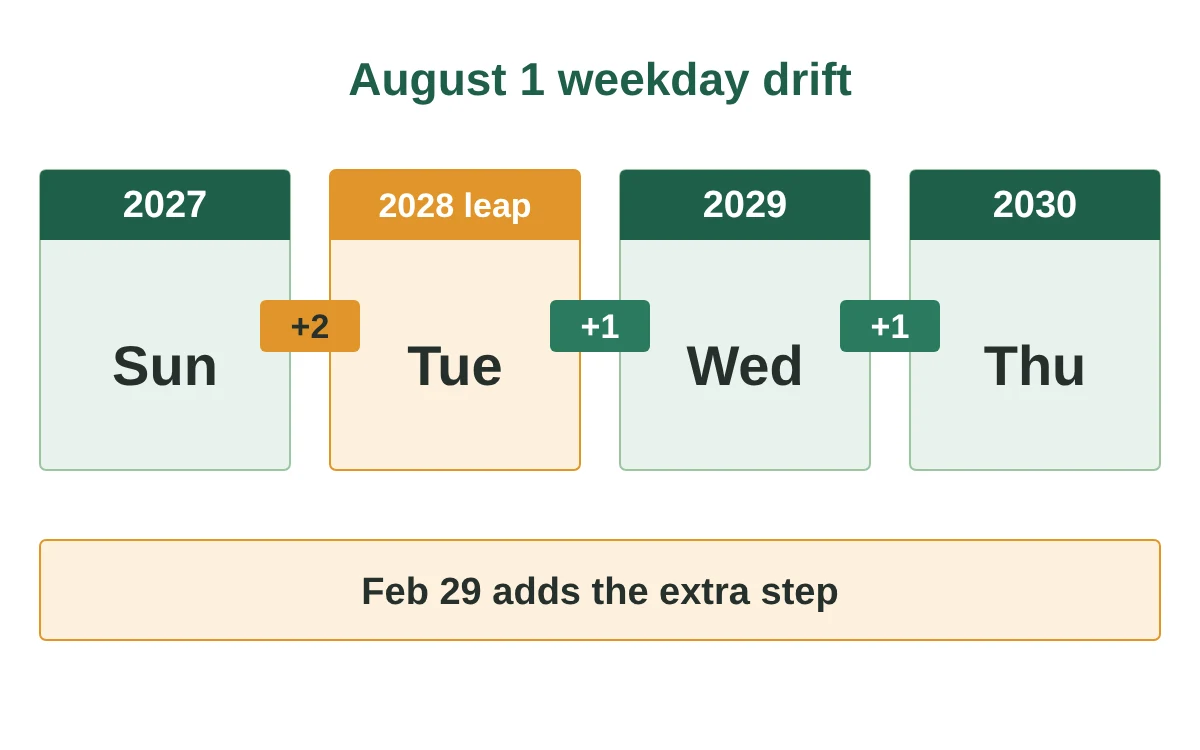
August 1 advances one weekday each year, and two after a leap year, because 365 days is 52 weeks plus one day. That gives Sunday in 2027, Tuesday in 2028, Wednesday in 2029 and Thursday in 2030. If your plan depends on a weekday (a lease start, a launch, a party), check the year, because the same date can sit on a Friday one year and a Saturday the next.
The jump over a leap year is the part people miss. Between 2027 and 2028 the weekday moves two steps rather than one, because February 29 is crammed in between.
Planning around the countdown
August 1 makes a useful milestone for work because it opens the second half of the summer quarter and is a common start date for leases, trial periods and fiscal planning. Working back from it with fixed blocks is more reliable than a flat day count. A 90-day plan ending on August 1 starts in early May, and an 8-week block starts in early June.
For a neighbouring target, the August 4 countdown and the September 1 countdown use the same method, and the general August page covers the month as a whole. Treat the final 31 days as a separate phase: July is the last full month, so deadlines that must be met before August 1 are best finished by mid-July.
Try this: Write down the three dates that are 90, 60 and 30 days before August 1, and attach one deliverable to each. Use the live widget to confirm each gap.
Frequently asked questions
How many days until August 1st?
The live countdown at the top of this page gives the exact figure for your own clock and time zone. By hand, subtract today's day-of-year number from 213 (or 214 if the target August 1 falls in a leap year).
What day of the week is August 1st?
It changes every year. August 1 is a Sunday in 2027, a Tuesday in 2028, a Wednesday in 2029 and a Thursday in 2030, because it moves forward one weekday a year and two after a leap day.
Does the countdown include August 1 itself?
No. It counts down to the moment August 1 begins, which is midnight at the start of that date in your time zone. Some calculators add one day to count today, so figures can differ by one.
What is the day number of August 1?
August 1 is day 213 of a normal year and day 214 of a leap year. That leaves 152 days in the year after it, in a normal year.