
How Many Days Until January 5th?
Calendar
Countdown chart
The quickest exact answer is the live countdown above this article. It reads your own clock and time zone, so it shows the days, hours and minutes left until January 5 begins where you are. The rest of this page explains how to check that number yourself and why other calculators sometimes show a number one higher or lower.
The next January 5 falls on a Tuesday in 2027, and the date lands on a different weekday almost every year. That small fact shapes how you count weeks, plan a trip or schedule a deadline around it.
Why countdowns to January 5 disagree by one day
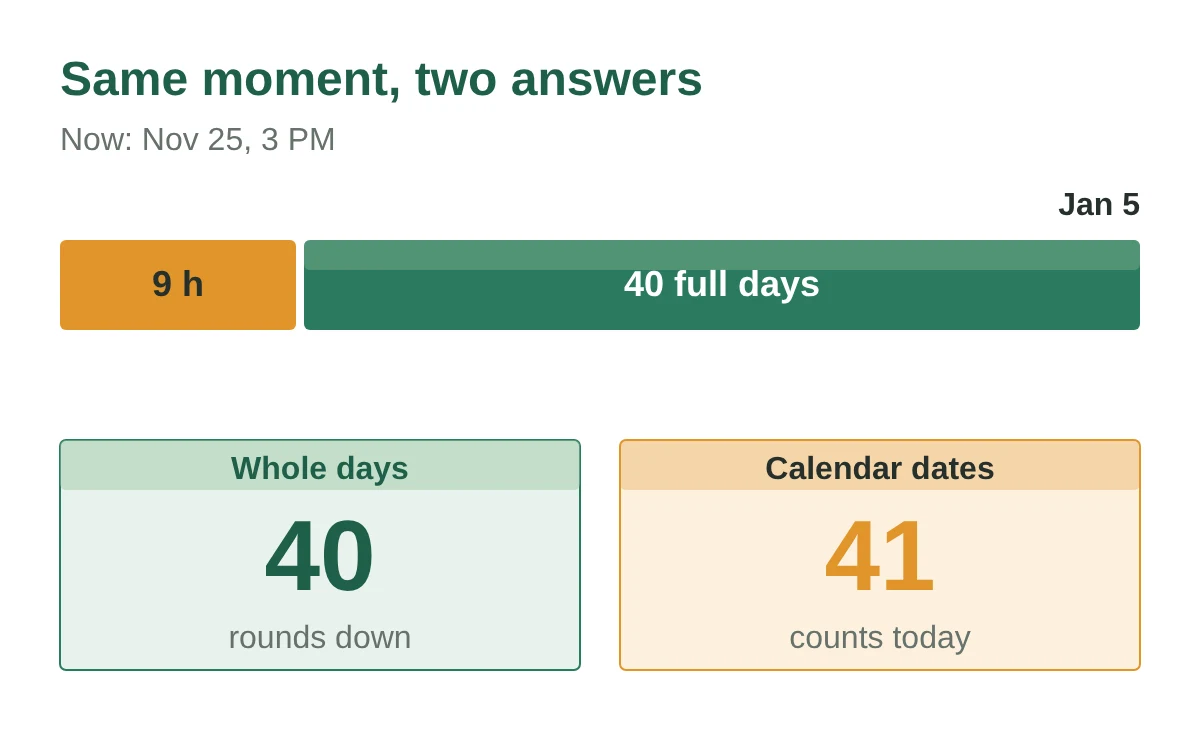
Two sites can both be correct and still show different numbers. The first cause is rounding. If the target is 40 days and 9 hours away, a calculator that rounds down says 40, and one that counts calendar dates says 41, because the date on the calendar changes 41 times before you arrive.
The second cause is inclusive counting. Counting both today and January 5 adds one day, which is how many people count a holiday on paper. The third is time zone: a countdown set to a fixed city such as Los Angeles will differ from your local one for part of every day.
The live widget uses the cleanest definition: the time from now to midnight at the start of January 5 in your own zone. If you want a precise cut-off for something like a form that closes at the end of that day, see how long until midnight and add 24 hours.
Count it by hand in under a minute
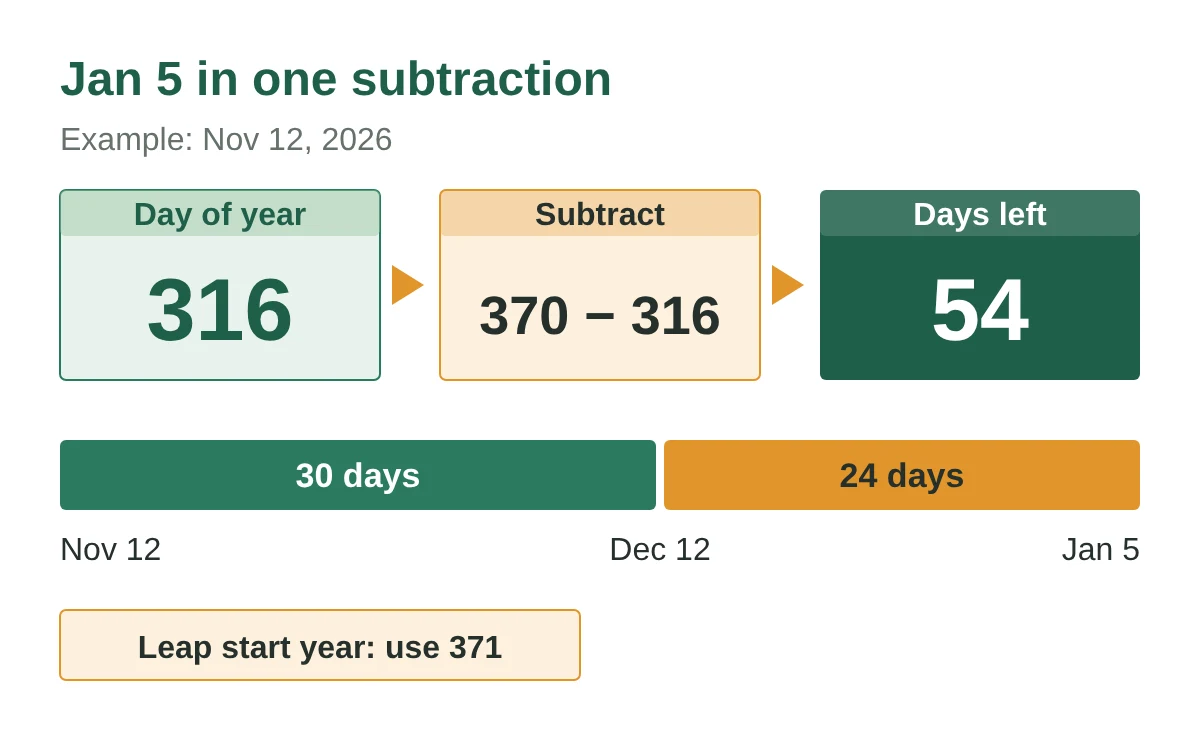
Use the day-of-the-year shortcut. In an ordinary year, the days left until the next January 5 equal 370 minus today’s day number. In a year before a leap year is complete (the leap day still ahead of you in the next year does not matter), the 365-day year length is what counts, so 370 holds.
Worked example with a hypothetical start of November 12, 2026. That is day 316 of the year (Jan 31, Feb 59, Mar 90, Apr 120, May 151, Jun 181, Jul 212, Aug 243, Sep 273, Oct 304, plus 12). Then 370 minus 316 gives 54 days. A second check: November 12 to December 12 is 30 days, December 12 to January 5 is 24 more, and 30 plus 24 is 54.
If the starting year is a leap year, use 371 instead of 370. To skip the table of cumulative days, remember the month-end totals: 31, 59, 90, 120, 151, 181, 212, 243, 273, 304, 334, 365.
Try this: Pick any date in November or December, work out its day number, and subtract it from 370. Then confirm the answer with the date calculator. If the two differ, you almost certainly mixed up a month-end total.
Weeks and weekdays to January 5
Divide the day count by 7. The quotient is whole weeks, and the remainder tells you the weekday of arrival. In the example above, 54 days is 7 weeks and 5 days. November 12, 2026 is a Thursday, and Thursday plus 5 is Tuesday, which matches January 5, 2027. The remainder is a free error check.
Weekdays are trickier. Each whole week holds 5 working days, so 7 weeks gives 35. Then walk through the leftover days one at a time: Friday, Saturday, Sunday, Monday, Tuesday adds 3 more, for 38 weekdays in the example (counting January 5, not counting the start day). Many online counters skip the start day and the end day differently, which is another source of off-by-one gaps.
Holidays then reduce the working-day total. In 2026 and 2027, both December 25 and January 1 fall on a Friday, so many employers observe them on those Fridays. Subtract them from any working-day figure for a deadline. For a broader range, how many days until January 1, 2027 is a useful neighbouring count.
Where January 5 sits in the calendar
January 5 is always day 5 of the year, which leaves 360 days after it in a 365-day year. It moves one weekday forward each year, or two after a leap year. So the sequence runs Tuesday in 2027, Wednesday in 2028, Friday in 2029, Saturday in 2030 and Sunday in 2031.
It also has a quirk in the ISO week system. January 1, 2027 is a Friday, so the first three days of the year still belong to the last week of 2026 (week 53). January 4, 2027 starts ISO week 1, and January 5 sits inside it. If a payroll or project schedule uses week numbers, the “first week” begins one day before this date.
What January 5 is known for
The best-known link is Twelfth Night, the eve of Epiphany. Where Christmas Day is the first of the twelve days, the twelfth day is January 5. Where counting starts on December 26, Twelfth Night falls on January 6 instead, which is why the date is argued about every year. If your plans hinge on the other day, check how many days until January 6.
In Orthodox traditions, January 5 is the Eve of Theophany (Paramony), a day of strict fasting until the first star appears. Churches on the Julian calendar keep Christmas on December 25 of their calendar, which falls on January 7 in the Gregorian one, so their timing differs.
In the United States, January 5 is also National Bird Day. It closes the annual Christmas Bird Count window, which runs from December 14 to January 5. Sweden marks the evening as Trettondagsafton. It is not a public holiday in most countries, which matters when you are counting working days.
Time zones and clock changes
January 5 arrives in the Pacific islands of Kiribati and New Zealand many hours before it reaches the Americas. A friend abroad can be on January 5 while you are still on January 4, so for a shared event, agree on one time zone and a clock time.
Daylight saving time can quietly skew an hours count. If your start date falls before the clocks change in autumn (in the United States, the first Sunday of November), the window contains a 25-hour day, so the total in hours is one more than days times 24. The widget handles this automatically, but a hand calculation in hours does not. After the change, no clock shift occurs between late December and January 5 in the Northern Hemisphere.
Planning around the countdown
Because January 5, 2027 is a Tuesday, you can place milestones on earlier Tuesdays: December 29, 22, 15, 8 and 1. Weekly checkpoints on a single weekday are easier to remember than a shrinking number.
- Use the first Monday, January 4, as the soft start for new routines, since many workplaces reopen that week.
- Take decorations down on Twelfth Night if your tradition marks it, or on January 6 if it follows Epiphany.
- Mark January 15, the usual US deadline for the final estimated tax payment, ten days after the date, and see the days until list for other fixed dates.
For a larger plan, a block of eight weeks works out neatly, since 8 weeks is 56 days. Counting back 56 days from January 5 lands on a Tuesday in early November.
Try this: Choose the Tuesday exactly 28 days before January 5 and set a calendar reminder for it. A four-week lead is long enough to book, short enough to still feel real.
How to check the widget yourself
Open the widget, note the day count, then add that many days to today’s date on the date calculator and see whether you land on January 5. If you are off by one, check whether your tool counts the end date. The hand method above, the remainder check on the weekday and the live widget should all agree, and you can use the widget as the reference at any moment.
Frequently asked questions
What day of the week is January 5, 2027?
January 5, 2027 is a Tuesday. The same date moves forward one weekday each year, and two weekdays after a leap year, so 2028 is a Wednesday and 2029 is a Friday.
Is January 5 the last day of Christmas?
In traditions where Christmas Day counts as the first day, yes: Twelfth Night falls on January 5, the eve of Epiphany. Other traditions start counting on December 26, which puts Twelfth Night on January 6.
Is January 5 a public holiday?
Not in the United States, the United Kingdom or most countries. It is an observance rather than a day off, so offices and schools in most places are open or just resuming after the break.
Does the countdown include January 5 itself?
The standard method counts the days between today and the start of January 5, so the target day is not included. If you want to count both ends, add one to the result.