
How Many Days Until January 6th?
Calendar
Countdown chart
The exact answer to how many days until January 6 is in the live countdown above, which reads your device’s clock and time zone. The date recurs every year, so the counter always points at the next January 6, and on the day itself it shows zero.
The sections below cover what the widget does not: how to verify the number by hand in about ten seconds, how weekdays and weeks behave on the way there, and what the date means in different parts of the world.
Count it by hand with day-of-year numbers
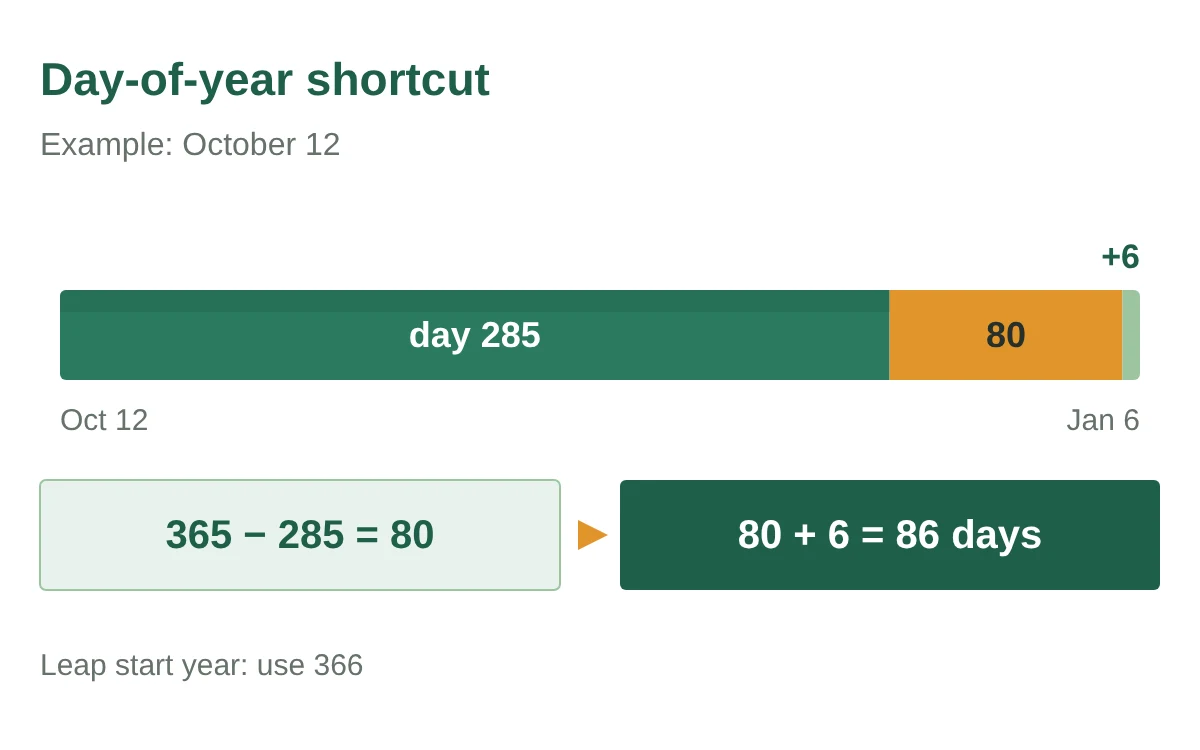
Counting month by month is slow and error-prone. A faster method is to use day-of-year numbers. January 6 is always day 6 of its year, and the days left in the current year are the year length minus today’s day number. So the formula is: 365 minus today’s day number, plus 6. In a leap year, use 366.
Here is a worked example with a made-up start date of October 12 (not today’s date). October 12 is day 285 of a normal year (273 days through September, plus 12). That leaves 365 − 285 = 80 days in the year, and 80 + 6 = 86 days to January 6. A month-by-month check agrees: 19 left in October, 30 in November, 31 in December and 6 in January also gives 86.
The leap-year trap only affects the start year. The February 29 you care about is in the year you are counting from, so it matters only if your start date falls before it in a leap year. Counting from late in a leap year, use 366. The January 6 you are heading for is never affected.
Try this: Pick any date this month and work out its day-of-year number by adding the full months before it, then add the day. Run the formula, then compare your answer with the live widget.
Weekdays and weeks to January 6
Dividing the day count by 7 gives whole weeks and a remainder. That remainder decides your weekday count. In the 86-day example, 86 is 12 weeks plus 2 days. Twelve weeks hold exactly 60 weekdays, and the two leftover days add 0, 1 or 2 more depending on where they land.
If the start date is a Monday, the leftover days are Tuesday and Wednesday, so both count. The result is 62 weekdays, with January 6 itself included as a Wednesday. Whether you include the start day or the end day changes the answer by one, so decide which convention you need before comparing numbers across sites.
Public holidays are the other hidden gap. A weekday count treats December 25 and January 1 as ordinary days, so a working-day estimate to January 6 will run high if you want days actually worked. For arbitrary pairs of dates, the date calculator handles inclusive and exclusive counting.
Why the zero moment depends on your time zone
A countdown to a date hits zero at 00:00 on January 6 in the time zone it uses. If your widget runs on your device clock, that is your own midnight. It will not match someone a few time zones away, who reaches January 6 hours earlier or later.
This matters for coordinated plans. If an event is anchored to a place (a midnight Mass in Rome, a stream starting in Sydney), convert its start time into your zone rather than counting to your own midnight. For the final stretch, the midnight countdown shows the hours remaining until the next day starts.
Travelers hit a quieter edge case: if you cross the date line, the day count shown on your device may change by one when the clock switches zones.
How the weekday of January 6 shifts
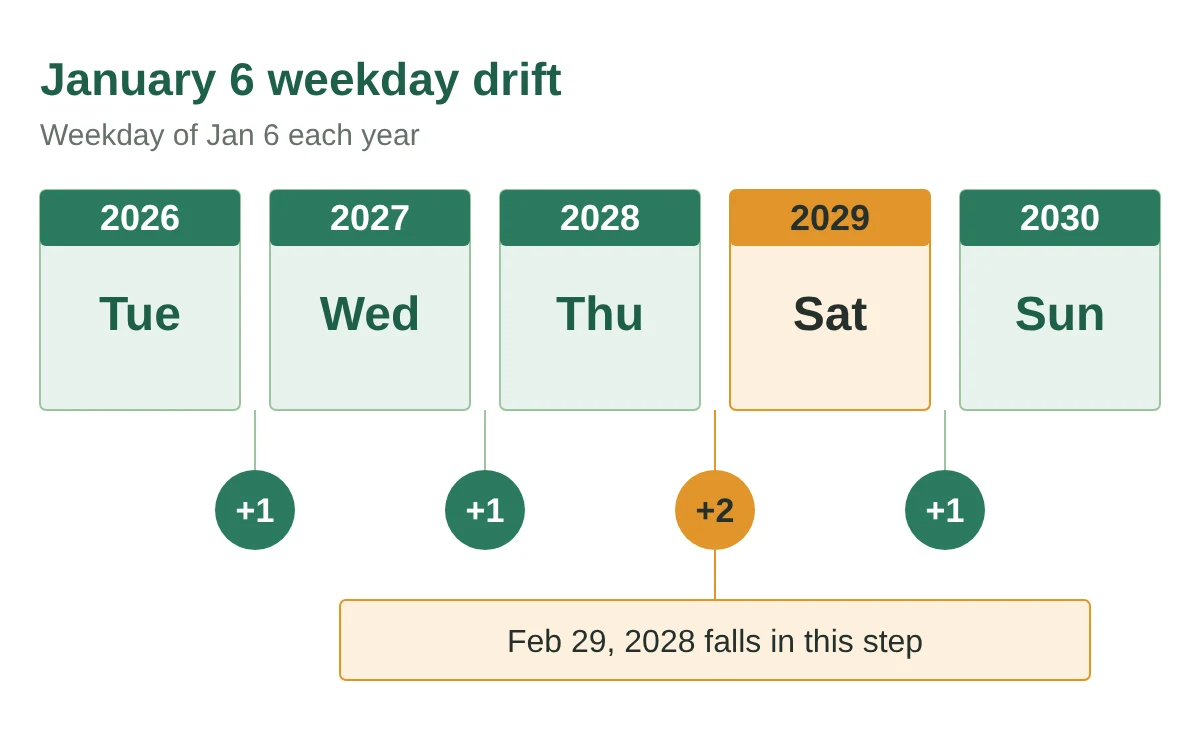
Because a normal year is 52 weeks plus one day, January 6 lands one weekday later each year. After a leap year, it jumps two. January 6 is a Wednesday in 2027, then a Thursday in 2028. It skips to Saturday in 2029, because 2028 contains a February 29. Then it is a Sunday in 2030.
The weekday also decides the ISO week number. In the ISO system, week 1 is the week containing January 4. So January 6 falls in ISO week 1 when it is a Wednesday through Sunday, and in week 2 when it is a Monday or Tuesday. That is why payroll and project calendars sometimes disagree on whether the first week of the year has started.
What January 6 is known for
In Western Christianity, January 6 is Epiphany, the feast that closes the twelve days of Christmas. It is also called Three Kings Day or Día de Reyes. It is a public holiday in several European countries, including Spain, Italy, Austria, Poland, Sweden, Finland and Greece. In Spain and across Latin America, children traditionally receive gifts on this day, and in Mexico a ring-shaped bread called rosca de reyes is shared.
In New Orleans, January 6 is traditionally the start of the Carnival season, and king cakes appear in bakeries from that day. In the Armenian Apostolic Church, January 6 is Christmas itself. Many Eastern Orthodox churches that use the Julian calendar celebrate Christmas on January 7, which makes January 6 their Christmas Eve. The Orthodox liturgical calendar also lists January 6 as a feast day, with the same date falling 13 days later in the civil calendar for churches that follow the Julian reckoning.
In US civic life, Congress meets in joint session on January 6 to count electoral votes after a presidential election, and the date is also tied to the 2021 attack on the Capitol. There is no federal tax or school deadline fixed to the day, although many schools reopen around this date after winter break, with local calendars varying.
Twelfth Night, and why the count of twelve is confusing
The twelve days of Christmas run from December 25 through January 5, which puts Epiphany on the day after. Twelfth Night is therefore the evening of January 5 for many people. Others count it as the evening of January 6, because older customs treated the day as beginning at sunset.
If your plans depend on it (taking down decorations, hosting a party), check which convention your family or community follows. The same ambiguity applies to the “twelve days” song, which does not settle whether the count starts on Christmas Day or the day after.
Planning around the countdown
A January 6 deadline is easy to underestimate because it sits just after the holidays. Work backward from it in blocks. First, pick the last full working day before December 24. Then mark the days between Christmas and New Year, which are often unavailable for others. Finally, treat January 2 to 5 as your real buffer. For anything involving other people, such as signatures, deliveries or approvals, the buffer is often shorter than it looks.
Two neighboring pages help with adjacent targets: the January 5 countdown and the January 8 countdown. If you want the start of the year as a milestone, the January 1, 2027 countdown shows the days to New Year’s Day.
Try this: Subtract your total days to January 6 from the count, then split what is left into weekdays only. Assign one task to each of the final five weekdays and see how much room you really have.
Frequently asked questions
How many days until January 6?
The live countdown above the article gives the exact figure for your own clock and time zone. To check it by hand, subtract today's day-of-year number from 365 (366 in a leap year) and add 6.
What day of the week is January 6?
The weekday moves forward one day each year, or two after a leap year. January 6 is a Wednesday in 2027, a Thursday in 2028 and a Saturday in 2029.
Is January 6 a public holiday?
It is a public holiday in several countries, including Spain, Italy, Austria, Poland, Sweden, Finland and Greece, where it marks Epiphany. It is not a US federal holiday.
Is January 6 the same as Twelfth Night?
Not always. Twelfth Night is the evening before the twelfth day of Christmas, and traditions differ on whether that falls on the evening of January 5 or January 6. Epiphany itself is January 6.