
How Many Days Until September 3rd?
Calendar
Countdown chart
The live countdown above gives the exact answer for your own clock and time zone, down to the second. To check it by hand, take the day-of-year number for September 3 (246 in a normal year, 247 in a leap year) and subtract the day-of-year number of your starting date.
That one subtraction is more reliable than counting month by month, and the rest of this page covers the edge cases that make countdown numbers disagree: inclusive counting, weekdays, time zones and leap years.
Why two countdowns can differ by one day
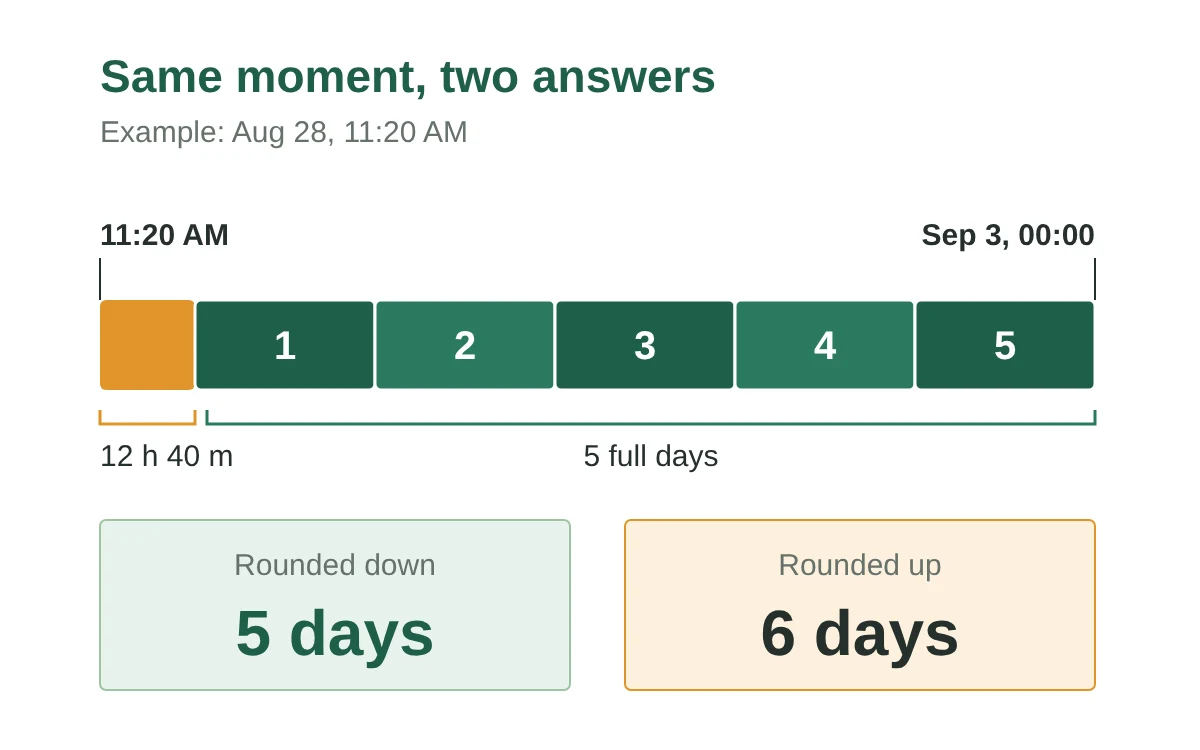
Most disagreement between countdown tools comes from one choice: whether the start day is counted. The standard convention is to count from the next midnight, so the start day is excluded and September 3 is the finish line. At 00:00 local time on September 3, the countdown reaches zero.
The second source of difference is rounding. A tool that shows days, hours and minutes will say “5 days” with hours attached, while a tool that rounds up will say “6 days” for the same moment. If a number from another site is one off from the widget above, one of these two conventions is almost always the reason.
Calculating it by hand
Every date has a day-of-year number. September 3 is the 246th day of the year (247th in leap years), with 119 days remaining until the end of the year. That gives you a clean formula for any start date in the same calendar year: 246 minus your start date’s day number (247 in leap years).
For a start date in an earlier year, add the days left in that year (365 or 366 minus the start day number) to 246 or 247, and add 365 for each full year between them. The leap day only matters if February 29 sits between the start and the target.
Try this: Memorise three anchors: January 1 is day 1, March 1 is day 60 (61 in leap years), and September 1 is day 244 (245 in leap years). From any date you can count to the nearest anchor and finish the sum in your head.
A worked example
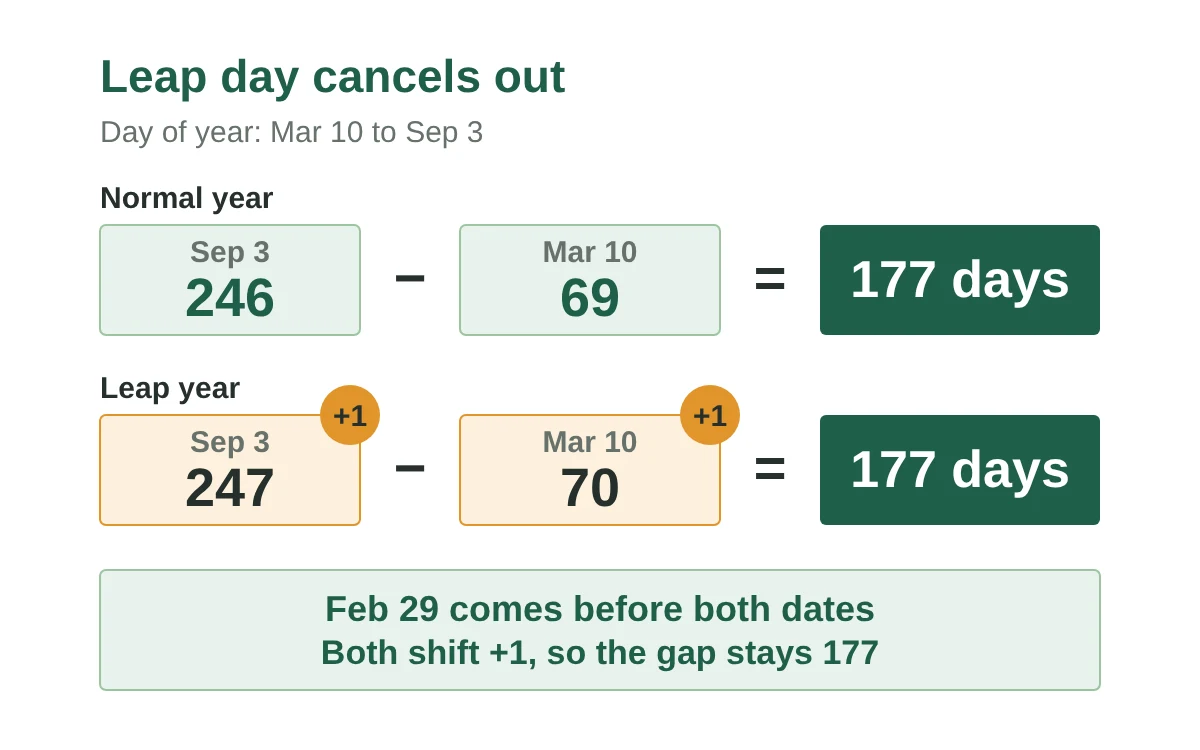
Take a hypothetical start of March 10 in a non-leap year. March 10 is day 69 (31 for January, 28 for February, plus 10). Then 246 minus 69 gives 177 days.
To confirm it, count the leftover pieces: 21 days left in March, then 30, 31, 30, 31 and 31 for April through August, then 3 for September. That sums to 177 again. Doing the sum two ways catches nearly every slip.
If the same start date fell in a leap year, the day numbers shift together (March 10 becomes day 70, September 3 becomes day 247), so the answer stays 177. Leap years only change the result when the start date comes before March 1 and the target comes after it.
Counting weeks and weekdays
Divide the day count by 7. The quotient is full weeks and the remainder is loose days. In the example, 177 days is 25 weeks and 2 days. If you want a quick reference for week-to-day conversions, the pattern shifts forward one weekday each year, or two after a leap year, and the 8 weeks to days page covers the multiplication side.
Weekdays are trickier. Each full week holds exactly 5 weekdays, so 25 weeks gives 125. The loose days then depend on the weekday you start on. If the start is a Wednesday, the 2 leftover days are Thursday and Friday, adding 2 and giving 127 weekdays, with the start day excluded and the target counted. Public holidays are a separate subtraction, and tools that skip it label the result as plain weekdays rather than working days.
Which weekday September 3 lands on
The weekday moves forward by one each year, or by two when a leap day was crossed. That means a Monday September 3 is a rarity worth knowing about: the table of upcoming years shows 2029 landing on a Monday, which matters for the Labor Day connection below.
If your countdown ends in a trip, wedding or deadline, check the weekday first. A Friday or Saturday target behaves very differently for flights and venues than a Tuesday one. For a quick feel of how far away a Friday is, the days until Friday page does the weekly rhythm for you.
What September 3 is known for
September 3 is not a public holiday in most countries, so it rarely carries a fixed deadline. A few things are tied to it.
- Labor Day in the US: this is the first Monday in September, so it only falls on September 3 when that date is a Monday. 2018 was one such year.
- San Marino: the republic marks its founding on September 3, which is also the feast day of its patron saint.
- China: September 3 is the official commemoration day of victory in the War of Resistance against Japan.
- History: the Treaty of Paris, ending the American Revolutionary War, was signed on September 3, 1783. Britain and France declared war on Germany on September 3, 1939.
Seasonally, in the Northern Hemisphere meteorological autumn has already begun on September 1, while the astronomical autumn equinox comes around September 22 or 23. In the Southern Hemisphere it is the other way round and meteorological spring is already underway. Many schools in the US and the UK start around this time, though exact start dates vary by district, so check your local calendar.
Time zones and daylight saving
The countdown above uses your device’s clock. A friend in another time zone will see a different hour count, and near the end the day count can differ by one because their midnight arrives at a different moment. For events that start at a set time elsewhere, such as a livestream or a flight, count to that local time instead of to midnight.
Daylight saving changes cause a quieter problem. If a countdown spans a clock change, the hour total will not equal days multiplied by 24, because one day in the span is 23 or 25 hours long. Counting in calendar days avoids the issue, which is why the day figure is the safest one to quote.
Planning around the countdown
Count backwards, not forwards. Set your real deadlines (bookings, orders, applications) and subtract lead times from September 3 rather than waiting for the number to get small. A 90 days from now check is handy for finding when a three-month lead starts.
Because September 3 often sits next to the Labor Day weekend and the start of school terms, travel and venue prices around it tend to rise early. Treat the date as a long weekend candidate and look at the dates on both sides: September 1 and September 4 are useful to compare when a single day is not fixed. For an arbitrary pair of dates, the date calculator does the subtraction, and the days until September page gives the month-level view.
Try this: Pick a task you want finished by September 3 and write down its end date as the day-of-year number. Then list three milestones as day numbers too. Subtracting is far quicker than flipping through calendar months.
Frequently asked questions
How many days until September 3?
The live countdown above gives the exact figure for your clock and time zone. By hand, subtract today's day-of-year number from 246 (or 247 if the target September 3 falls in a leap year).
Is September 3 always the same weekday?
No. It moves forward one weekday each year, and two weekdays when a leap day sits in between. The pattern repeats on a long cycle, so the same weekday returns after 5, 6 or 11 years.
Is September 3 ever Labor Day?
Yes, but only when it lands on a Monday. US Labor Day is the first Monday of September, so it can fall anywhere from September 1 to 7.
Does the count include September 3 itself?
The usual convention is no: the start day is excluded and the target day is the finish line. If you need both ends counted, such as a booking of consecutive nights or days, add one.