
How Many Days Until September 5th?
Calendar
Countdown chart
The live countdown above gives the exact answer for your clock and time zone, down to the second. If you want to check it yourself, the fastest method is day-of-year arithmetic: September 5 is day 248 of a common year and day 249 of a leap year, so the gap is that number minus today’s day number.
The rest of this page covers what the widget cannot: the shortcuts, the traps that make two countdowns disagree, and the weekday and week maths that help with planning.
Counting it by hand
Counting month by month is slow and error-prone. Converting both dates to day-of-year numbers turns the problem into one subtraction. Cumulative days at the end of each month in a common year run 31, 59, 90, 120, 151, 181, 212, 243, which means September 5 is 243 plus 5, or 248.
Add 1 to every figure from March onward in a leap year. That is why September 5 becomes day 249 in 2028 and 2032.
If your start date is already past September 5 this year, the target is next year’s. Take the days left in the current year (365 or 366 minus today’s day number), then add September 5’s day number for the target year. The only thing to check is which of the two years is a leap year.
A worked example across a leap year
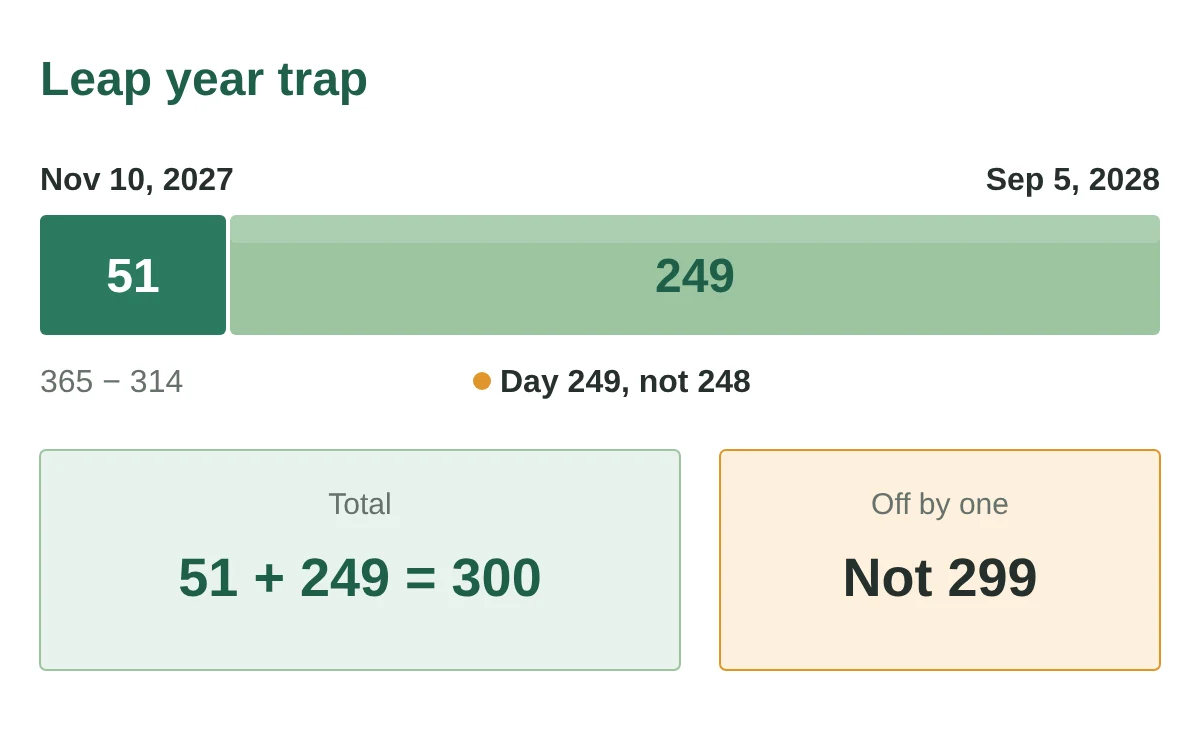
Take a hypothetical start of November 10, 2027, counting to September 5, 2028. November 10 is day 314 of 2027 (October ends on day 304). That leaves 365 minus 314, or 51 days, until the year ends.
September 5, 2028 is day 249, because 2028 is a leap year. So the total is 51 plus 249, which is 300 days. A common slip is using 248 here and landing one day short.
A quick sanity check: 300 days is 42 weeks and 6 days. November 10, 2027 is a Wednesday, and six days past Wednesday is Tuesday, which matches September 5, 2028.
Try this: Pick any date today and work out the gap to September 5 using day-of-year numbers. Then check it against the date calculator. If you are off, the culprit is almost always a leap year or an inclusive count.
Weeks and weekdays to September 5
Divide the day count by 7 to get full weeks and a remainder. The remainder is the useful part, because it tells you how many extra days sit on the end. In the worked example above, 300 days gives 42 weeks and 6 spare days.
For weekdays, multiply the full weeks by 5, then count only the weekdays in the leftover days. The spare 6 days there run Thursday, Friday, Saturday, Sunday, Monday, Tuesday, which contributes 4 weekdays. That makes 210 plus 4, or 214 weekdays, counting the end date but not the start date.
These are working days only in a loose sense. Public holidays are not subtracted, and in the US and Canada, Labor Day always falls inside the stretch just before or on September 5, so subtract it by hand if you are counting business days.
Where the day of the week lands each year
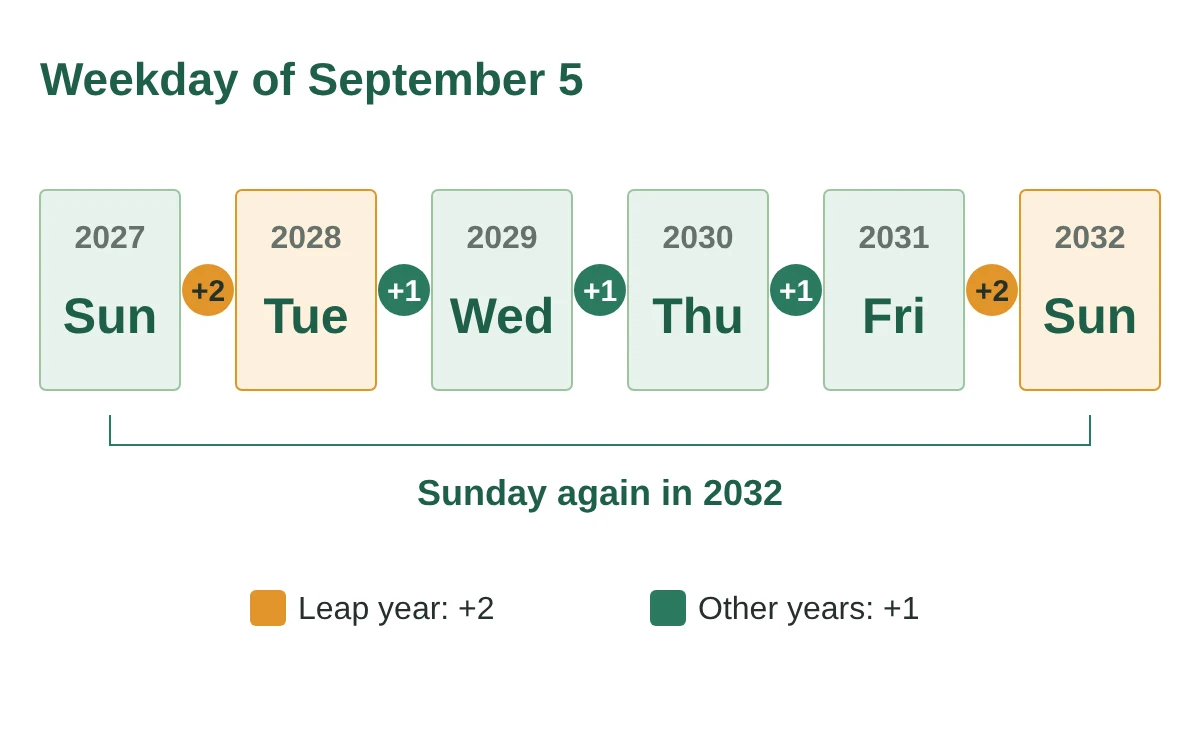
September 5 slides forward one weekday every year and jumps two after a leap day. Because the leap day (February 29) comes before September, the two-step jump happens in leap years themselves. So the weekday sequence runs:
- 2027: Sunday
- 2028: Tuesday
- 2029: Wednesday
- 2030: Thursday
- 2031: Friday
- 2032: Sunday
Only a handful of years in a row give you a weekend date, which matters if the countdown is for an event, a deadline or a trip. The same date returns to the same weekday in a 28-year cycle for most of the century, which is a handy way to check old calendars.
Why two counters can disagree by one
Most mismatches come from three causes. The first is whether the start day is counted. “Days until” normally means the number of midnights you cross, so today is not included, but an inclusive count adds one.
The second is the time zone. September 5 begins at different moments around the world, and a counter fixed to a server’s zone can be a day ahead of you for part of the day. The widget above uses your own device time to avoid that.
The third is daylight saving. If your start date falls before a clock change, a day can be 23 or 25 hours long. Counting hours and dividing by 24 can then produce a half-day error, so count calendar dates rather than hours when the span crosses a change. This matters most when you start counting in spring or early autumn.
What September 5 is known for
September 5 is the International Day of Charity. The UN General Assembly established it in 2012 at Hungary’s initiative, and the date marks the death of Mother Teresa in 1997. Charity organisations often time appeals and volunteer drives around it.
In India, September 5 is Teachers’ Day, which honours the birthday of Sarvepalli Radhakrishnan, the scholar and second President of India. It is also commonly listed as National Cheese Pizza Day, one of many informal food days that have no official status.
It is also the date Voyager 1 launched in 1977, which makes it a good anchor for space-minded countdowns. There is no fixed national holiday or tax deadline on September 5 in most countries, so check local rules if a deadline matters.
Season, Labor Day and the calendar around it
In the northern hemisphere, September 5 falls in early meteorological autumn, which starts on September 1. The astronomical autumn equinox comes later, around September 22 or 23. In the southern hemisphere the same date is late winter, with spring still weeks away.
The date sits right next to Labor Day in the US and Canada. Because that holiday is the first Monday of September, it can fall on any date from the 1st to the 7th, so the long weekend can start as early as August 29 or as late as September 4. If your countdown is for travel or a school start, check the Monday first. Neighbouring pages such as September 1 and September 8 help you bracket the week.
Milestones worth setting
Counting back from September 5 gives clean planning dates. Because February 29 never falls between late May and early September, the same dates work every year: 100 days before is always May 28, and 90 days before is always June 7 (see also 90 days from now).
Set the first checkpoint for 100 days out, a second at 30 days, and a final one a week before to confirm bookings. For anything with a deadline, work back from a weekday: if September 5 falls on a Sunday, the practical deadline is often the Friday before.
Try this: Write down the three dates that are 100, 30 and 7 days before September 5 in the year you care about, and note the weekday for each. Move any that land on a weekend to the nearest weekday.
Frequently asked questions
How many days until September 5th?
The live countdown above calculates it from your own clock and time zone, so it is always current. By hand, subtract the day-of-year number of today from 248 (or 249 if September 5 falls in a leap year), and add 365 or 366 for each year-end you cross.
What day of the week is September 5th?
It moves forward one weekday each year, or two after a leap day. It falls on Sunday in 2027, Tuesday in 2028, Wednesday in 2029, Thursday in 2030, Friday in 2031 and Sunday in 2032.
Is September 5th ever Labor Day?
Yes. US and Canadian Labor Day is the first Monday of September, which can be any date from the 1st to the 7th. It lands on September 5 whenever that date is a Monday, as it does in 2033.
What is the day number of September 5th in the year?
It is day 248 in a common year and day 249 in a leap year. That means 117 days remain after it in a common year, and 117 in a leap year too, since the leap day is already counted before it.