
How Many Weeks Since May 30?
Calendar
The live counter above gives the exact number of weeks since May 30, worked out on your own clock and time zone. It counts from the most recent May 30 that has already passed, and it shows whole weeks plus any leftover days, so nothing is hidden by rounding.
The rest of this page covers what the counter cannot show: how to check the result by hand, why the figure sometimes disagrees with other sites, and a few traps around weekdays, time zones and week numbering.
Which May 30 the count uses
A date with no year is ambiguous, and tools resolve it differently. This page counts from the latest May 30 that has already happened. Once May 30 comes around again, the count resets to zero and starts over, which can look like a bug if you were expecting a running total.
If you need a specific year, say May 30, 2024, you are really asking a different question: elapsed time since a fixed date. For that, the date calculator lets you enter both dates and returns days, weeks and months between them.
Whole weeks versus weeks and days
“Weeks since” can mean three different things: complete weeks only, weeks rounded to the nearest whole number, or a decimal such as 11.43. These can differ by a full week. At 80 days, a floor gives 11, rounding gives 11, and at 81 days to 83 days rounding still gives 12 only from 84 days. The decimal is 11.43 at 80 days, and the rounded figure flips at the halfway point, 3.5 days into the week.
Pick the version that matches your purpose. Recovery timelines, deadlines and “no sooner than 12 weeks” rules almost always mean completed weeks, so floor the number. Casual statements like “about 22 weeks ago” usually mean the nearest week.
Calculating it by hand
Count days first, then divide by 7. Take a hypothetical start date of August 14 and a hypothetical end date of November 2 in the same year.
- Days left in the start month: 31 minus 14 is 17.
- Add every full month in between: September (30) and October (31).
- Add the days into the final month: 2.
- Total: 17 + 30 + 31 + 2 = 80 days.
- Divide by 7: 80 = 11 × 7 + 3, so 11 weeks and 3 days.
The remainder is the part people drop. The quotient is the whole-week count, and the remainder tells you how close the next week is.
Try this: Pick any past date, count the days with the method above, then check yourself with the date calculator. If you are off by one, you probably counted both the start and end day.
The weekday shortcut
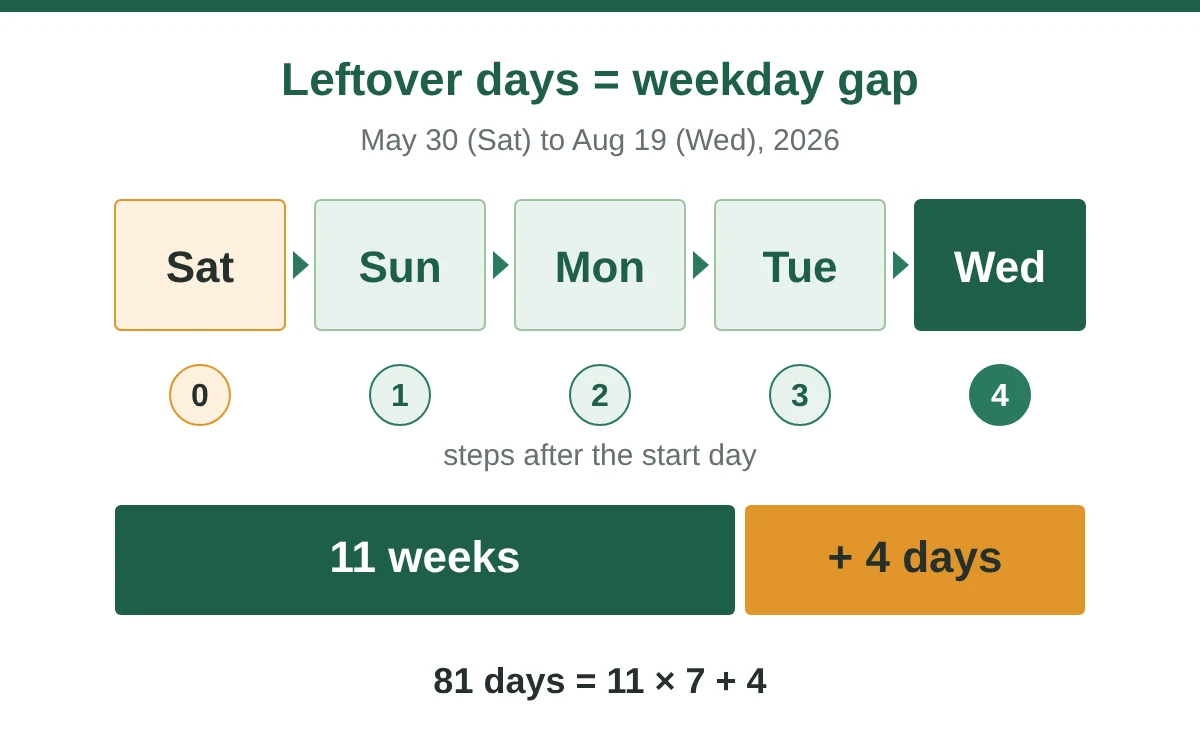
You can skip the day count entirely if you know the weekday of each date. The leftover days equal the forward distance from the start weekday to today’s weekday. In the example above, August 14 fell on a Thursday that year and November 2 on a Sunday. Thursday to Sunday is 3 days, which matches the remainder.
This gives a quick sanity check on any weeks-since figure. If the start was a Saturday and today is a Wednesday, the leftover must be 4 days. If your arithmetic says otherwise, recount. It also tells you exactly when the whole-week figure ticks up: on the same weekday as the start date, once a day has passed.
What weekday May 30 falls on
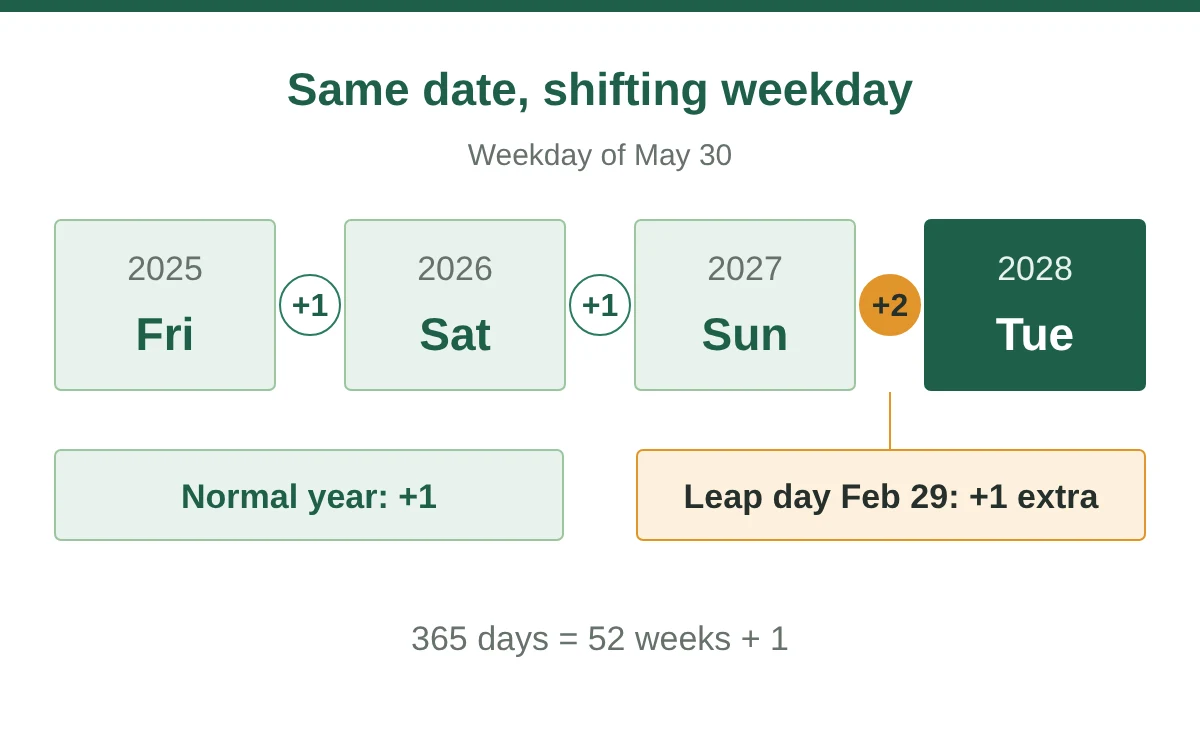
May 30, 2026 was a Saturday, so the whole-week count rolls over every Saturday until the date comes around again. The weekday then shifts: May 30 is a Friday in 2025, a Saturday in 2026, a Sunday in 2027 and a Tuesday in 2028. It jumps by two in 2028 because the leap day, February 29, falls before May 30.
This is why “52 weeks ago” does not land on the same date. Fifty-two weeks is 364 days, so a year after May 30, 2026, the count sits at 52 weeks and 1 day. Anyone tracking annual milestones in weeks will drift by a day each year, or two across a leap day.
Historically, May 30 was also the fixed date for Memorial Day in the United States until the holiday moved to the last Monday of May in 1971. Old records may therefore reference May 30 for that reason. If you are checking a neighbouring date, the May 31 countdown works the same way.
Time zones and daylight saving
The widget measures from midnight at the start of May 30 in your own time zone. That means someone in Auckland and someone in Los Angeles can see different whole-week counts for a few hours each week around the rollover, because their Saturdays begin at different moments.
Daylight saving adds a second trap. A day that changes the clock is 23 or 25 hours long, so converting hours to weeks by dividing by 168 can fall one hour short at a boundary and show a week too few. Counting calendar days and dividing by 7 avoids this, which is why that is the method to use whenever the span crosses a clock change. For short offsets and exact hour math, the time conversions pages cover the unit arithmetic.
Week numbers are not elapsed weeks
Subtracting week numbers from a calendar or planner gives a misleading answer. May 30, 2026 sits in ISO week 22, but that numbering depends on where the year’s first week falls, and it restarts every January. A span that crosses New Year can be off by one in either direction if you simply subtract.
Some systems also start the week on Sunday and some on Monday, which changes which week a Saturday or Sunday belongs to. Elapsed weeks do not care about any of this: they are just days divided by 7. Use week numbers only for scheduling, never for measuring how long ago something happened.
Turning the weeks into days or a deadline
Once you have the number, the reverse conversion is quick: multiply by 7. For reference, 8 weeks is 56 days, and the same pattern holds for any count. If you are looking ahead rather than back, the weeks until June 1 page shows the countdown version, and days since January 1, 2027 handles a fixed start date in the new year.
Try this: Take today’s weeks-since figure from the counter, multiply it by 7, and add the leftover days. The total should match the day count exactly. If it does not, the counter and your arithmetic are using different rounding.
Frequently asked questions
How many weeks have passed since May 30?
The live counter at the top of this page shows the exact figure on your own clock, as whole weeks plus leftover days. It counts from the most recent May 30 that has already happened.
Does the weeks count include the leftover days?
The whole-week figure does not. A span of 80 days is 11 weeks and 3 days, and most counters show only the 11. Check the leftover days if you need precision.
Why do two sites give different week counts for the same date?
They usually differ in rounding (floor, nearest or exact decimal), the year they assume, or the time zone they use. A counter running on your own clock avoids the last two.
What day of the week was May 30, 2026?
May 30, 2026 was a Saturday. The following year, May 30, 2027 falls on a Sunday.