
How Many Days Since January 1, 2027?
Calendar
The live counter above gives the exact number of days since January 1, 2027, using your own clock and time zone. The by-hand version is simple: take the day of the year for today’s date and subtract 1. January 1 is day 1, so zero days have passed on that date.
January 1, 2027 is a Friday, and 2027 is a common year with 365 days. Until midnight on that date arrives where you are, no time has elapsed since it, so the widget counts down to it instead. After that, it counts up.
The fastest way to calculate it by hand
Count the days to the first of your target month, then add the day of the month minus 1. Because you are measuring from the 1st, the first day of any month adds nothing.
Take a hypothetical date: March 15, 2027. January contributes 31 days and February 28, which gets you to March 1 at 59 days. Then add 14 (the 15th minus 1) for a total of 73 days since January 1. The same date has day-of-year number 74, which leads to the first trap below.
Month-start numbers worth memorizing
You only need the days elapsed at the start of each month in 2027. Add the day of the month minus 1 to the matching figure and you are done.
- February 1: 31
- March 1: 59
- April 1: 90
- May 1: 120
- June 1: 151
- July 1: 181
- August 1: 212
- September 1: 243
- October 1: 273
- November 1: 304
- December 1: 334
Three of these are easy anchors: April 1 is 90, July 1 is 181 and October 1 is 273. Two of them, 90 and 181, nearly split the year into clean quarters, which makes a quick sanity check possible. For a single month’s boundary, pages such as how many days until March 1st show how far away that anchor is from the reader’s own date.
Try this: Pick any date you care about in 2027, such as a birthday or a trip. Find its month-start number from the list, add the day minus 1, and compare with the result on the date calculator.
Elapsed days versus day of the year
Most wrong answers come from mixing two different numbers. Days elapsed counts the gaps between midnights, so January 10 is 9 days since January 1. Day of the year counts the date itself, so January 10 is day 10. They always differ by exactly 1.
Partial days add a second layer. If it is 6 PM on January 10, a precise elapsed figure is 9 days and 18 hours, and a counter that rounds down shows 9. A spreadsheet or calculator that includes both endpoints would show 10. Decide whether you want the gap or the inclusive tally before comparing results from different tools.
A weekday shortcut hidden in the count
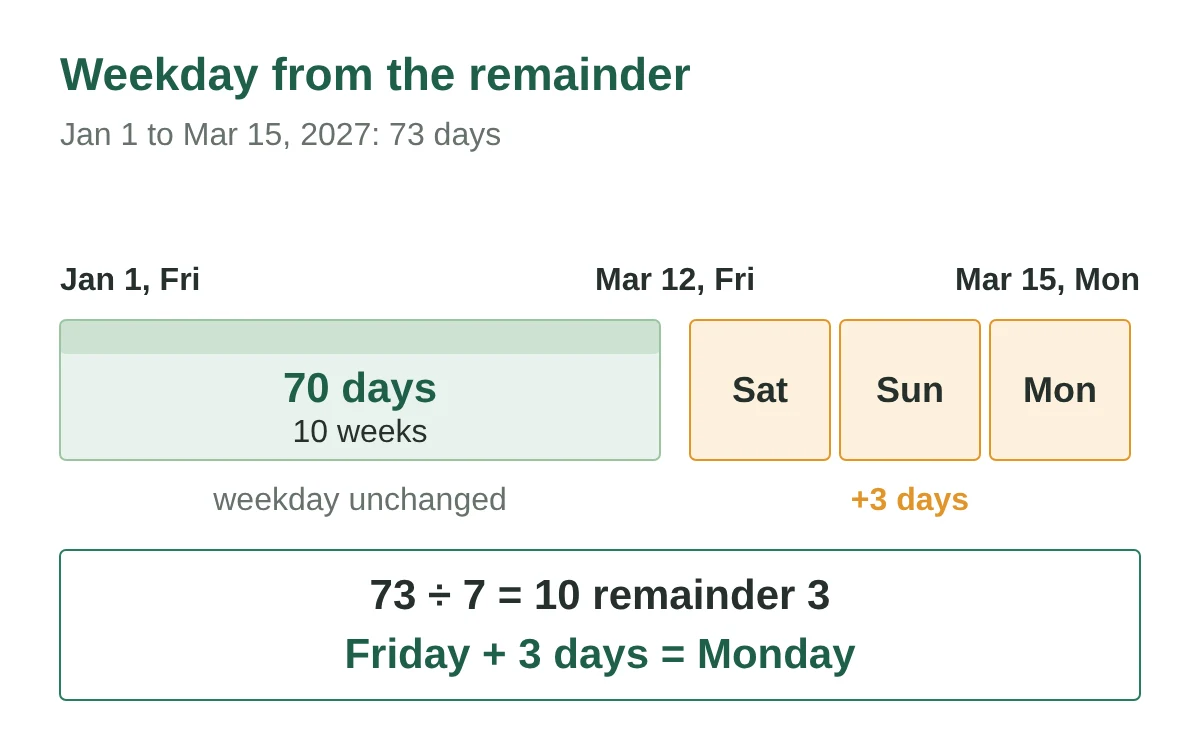
Because January 1, 2027 falls on a Friday, the weekday of any later date follows from the days since it. Divide the count by 7 and look at the remainder: 0 is Friday, 1 is Saturday, 2 is Sunday, and so on.
For the hypothetical March 15 above, 73 divided by 7 leaves a remainder of 3, which lands on Monday. March 15, 2027 is indeed a Monday. The same trick explains why January 3, 2027 is a Sunday, the weekday that calendar-math enthusiasts call the year’s “doomsday” anchor.
Time zones and daylight saving
The count changes at local midnight, not at a universal moment. Someone in Auckland passes into January 1 many hours before someone in Los Angeles, so two readers can see different day counts at the same instant. The live widget reads your device clock, so it follows your own midnight.
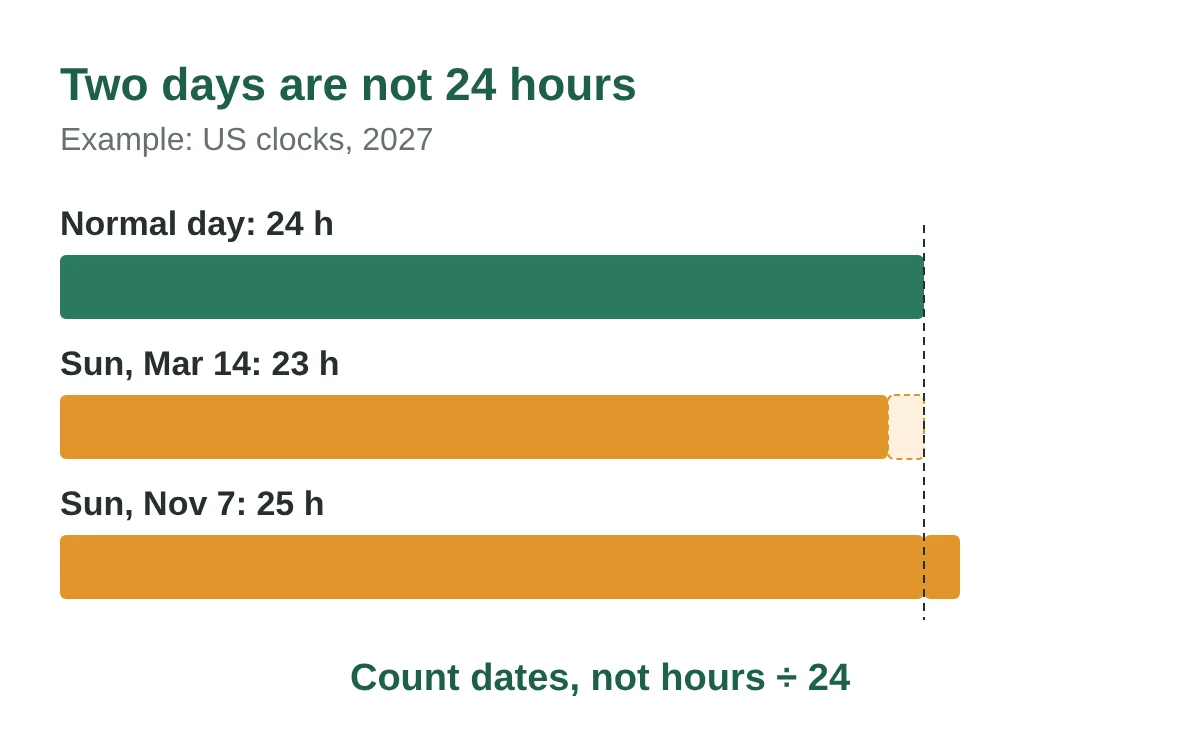
Daylight saving time is the second quiet source of error. In the US, clocks move forward on March 14, 2027 and back on November 7, 2027, which makes those days 23 and 25 hours long. If you convert hours to days by dividing by 24, you can land a day off around those dates. Counting calendar dates avoids the problem, and the 48 hours to days page covers the hour-to-day conversion itself.
Counting into 2028 and beyond
2027 has 365 days, so January 1, 2028 is exactly 365 days after the start of 2027. That date is a Saturday, because 365 days is 52 weeks plus one day.
The next year is a leap year. Any count that passes February 29, 2028 gains one extra day, so January 1, 2029 is 731 days after January 1, 2027. This is why dividing a long count by 365 slowly drifts away from true years. When a count reaches into hundreds of days, expressing it in weeks is cleaner: 8 weeks is 56 days, as the 8 weeks to days page shows.
Try this: Take the count shown in the widget and divide by 7. The whole number is the weeks passed, and the remainder is the extra days. Check the remainder against the weekday shortcut above.
When to use the forward-looking page instead
This page measures time that has already passed. If you are still waiting for the date, how many days until January 1, 2027 shows the countdown in the same format. The two pages are mirror images that meet at midnight on January 1.
For gaps between any two dates, including ones that do not start on January 1, the date calculator accepts a custom start and end. More fixed-date countdowns are collected on the days until hub.
Frequently asked questions
How do I calculate the days since January 1, 2027 by hand?
Find the day of the year for the date and subtract 1, since January 1 is day 1 and zero days have elapsed on it. A faster route is to take the days elapsed at the start of the month (for example 59 for March 1 or 181 for July 1) and add the day of the month minus 1.
Why do some calculators show one more day than the elapsed count?
Some tools count inclusively, treating both January 1 and the target date as full days. Elapsed days count only the gaps between midnights, so the inclusive result is always exactly 1 higher, and it matches the day-of-the-year number.
How can the days since January 1, 2027 reveal the weekday of a date?
January 1, 2027 is a Friday, so divide the elapsed days by 7 and read the remainder: 0 is Friday, 1 is Saturday, 2 is Sunday, and so on. For instance, 73 days elapsed leaves a remainder of 3, which gives Monday (March 15, 2027).
Do time zones and daylight saving time change the day count?
Time zones do, because the count rolls over at local midnight, so people in different zones can see different numbers at the same instant. Daylight saving makes March 14 and November 7, 2027 (US) 23 and 25 hours long, so converting hours to days by dividing by 24 can be off by one; counting calendar dates avoids that.