
How Long Is 48 Hours? Converting 48 Hours to Days
Conversion table
48 hours is exactly 2 days, or 2,880 minutes, or 172,800 seconds. The live widget above applies that to your own clock and time zone, so it shows the moment 48 hours after right now without any arithmetic from you.
The conversion is simple. The edge cases are where people go wrong: which calendar dates a 48-hour window touches, what happens across a daylight saving change, and whether “48 hours” in a policy means elapsed time or business days. This page covers those, plus the working and a table of nearby values.
The exact conversion
A day is defined as 24 hours, so hours to days is a division: divide the number of hours by 24: 48 ÷ 24 = 2. There is no rounding, because 48 is an exact multiple of 24. The result is a clean 2 days with 0 hours left over.
The same exactness holds downward. Multiply by 60 for minutes (2,880) and by 3,600 for seconds (172,800). Some converters use a decimal factor of 0.0416667 days per hour, which is only a rounded version of 1/24. Dividing by 24 avoids that rounding.
Nearby values at a glance
The table shows how the neighbours of 48 behave. The values just either side of 48 are not round numbers, which is why dividing by 24 beats memorising.
| Hours | Days | Days and hours |
|---|---|---|
| 36 | 1.5 | 1 day 12 hours |
| 47 | 1.958 | 1 day 23 hours |
| 48 | 2 | 2 days |
| 49 | 2.042 | 2 days 1 hour |
| 60 | 2.5 | 2 days 12 hours |
| 72 | 3 | 3 days |
For the neighbours, see 36 hours from now and 72 hours from now. To go the other way, 5 days to hours shows the multiplication.
A worked example by hand
Take a hypothetical start of 6:30 PM on 30 June. Adding 48 hours means adding two whole days and leaving the time of day alone. Two days after 30 June is 2 July, so the result is 6:30 PM on 2 July. The month rolls over, but the clock time does not move.
For hours that are not a multiple of 24, divide and keep the remainder. 100 hours is 100 ÷ 24 = 4 remainder 4, so 4 days and 4 hours. Add the 4 days to the date first, then the 4 hours to the time.
Try this: Pick any time on your clock and say it aloud with “the day after tomorrow” attached. That is 48 hours from now, to the minute, in a single step. Check it against the widget.
48 hours spans three calendar dates
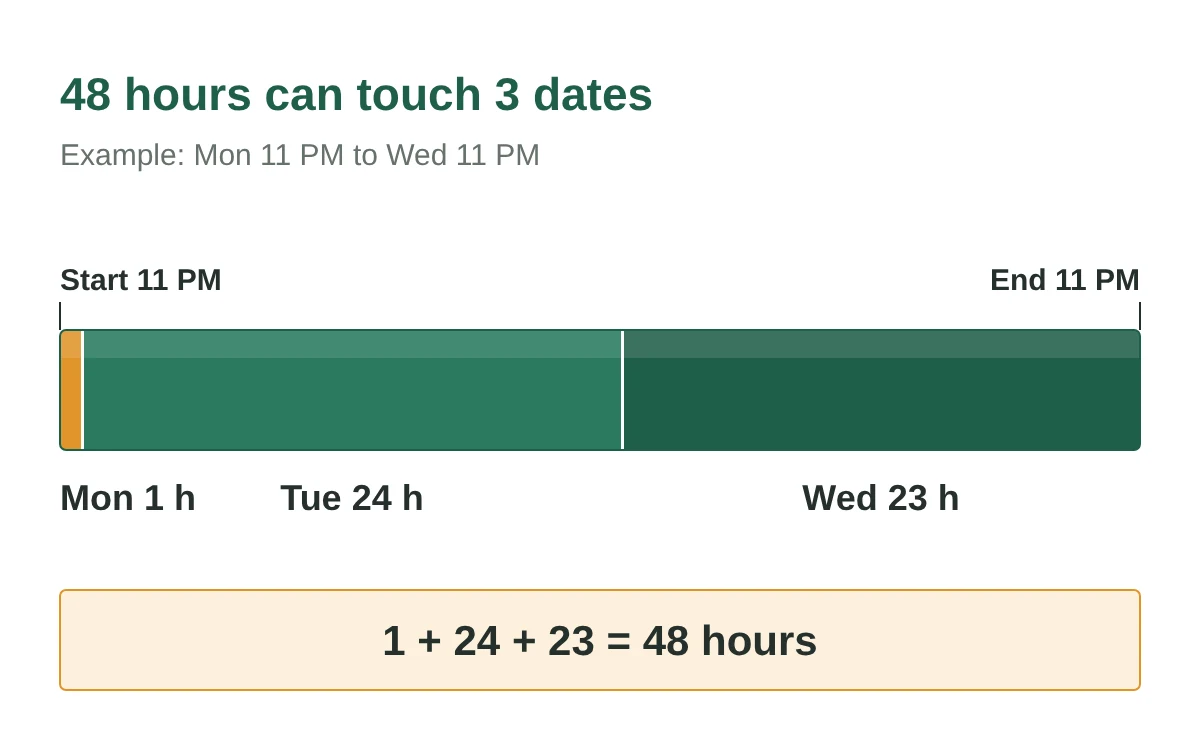
A 48-hour window is two days long, but it usually touches three dates. Start at 11 PM on a Monday and the window ends at 11 PM on Wednesday, so Monday, Tuesday and Wednesday are all involved. Only a start at exactly midnight keeps the window to two dates, and even then the end lands on the third date’s midnight.
This matters for deadlines that say “within 48 hours” and for anyone counting dates on a calendar. Counting calendar squares from Monday to Wednesday gives three. Counting elapsed time gives two days. For date differences the date calculator handles the counting rules for you.
When the wall clock disagrees
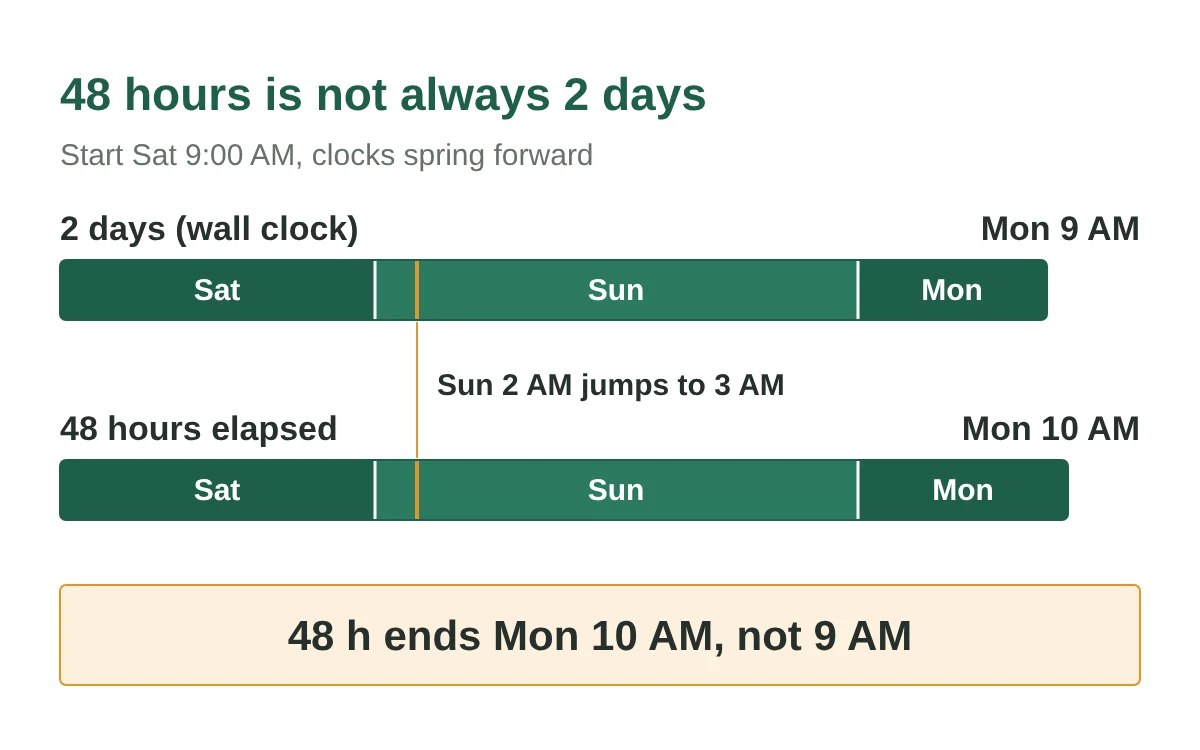
Forty-eight elapsed hours does not always equal two days on the wall clock. When clocks move forward by an hour, a day is only 23 hours long. Start at 9:00 AM on the Saturday before a spring-forward change, and 48 elapsed hours ends at 10:00 AM on Monday, not 9:00 AM. When clocks go back, the same start ends at 8:00 AM on Monday.
So there are two reasonable meanings. “48 hours” counted as elapsed time follows the stopwatch. “2 days” counted on the calendar follows the wall clock. Most software that adds hours uses elapsed time, and software that adds days uses the wall clock, which is why the two can differ by an hour twice a year.
Try this: Find the next clock-change weekend for your region. Add 48 hours to Saturday at 9:00 AM using the widget, then add “2 days” by hand. If the answers differ by an hour, you have found the gap.
Business days and contracts
In legal and customer service wording, 48 hours can mean different things. A contract may count it as two continuous 24-hour periods, or as two business days, depending on how the drafting reads. A request received on a Friday afternoon with a 48-hour reply promise is due Sunday on a calendar count, but possibly Tuesday if weekends are excluded.
The practical habit is to check three things: whether the clock runs on weekends and holidays, when it starts (sending, receipt or the next business morning), and which time zone applies. If the document does not say, assume nothing and ask.
Months and years are approximations
Hours convert to days exactly because the day is a fixed 24 hours. Months and years are not fixed. An average month is about 30.44 days (730.5 hours), and an average year is 365.25 days (8,766 hours).
Using those averages, 48 hours is about 0.066 of a month and about 0.0055 of a year. Those are rounded figures. A true month count depends on which month you start in, because February holds 28 or 29 days and others hold 30 or 31. For anything where precision matters, count in days or hours and convert once at the end. The time conversions hub lists the other unit pairs, and the 60 months to years page shows the same issue in the other direction.
For a past reference point, 2 days ago shows the date and time 48 hours back, which follows the same rules in reverse.
Frequently asked questions
How many minutes and seconds are in 48 hours?
48 hours is 2,880 minutes or 172,800 seconds. Both are exact, found by multiplying 48 by 60 for minutes and by 3,600 for seconds.
Is 48 hours always the same as 2 days on the clock?
Not across a daylight saving change. Starting at 9:00 AM on the Saturday before clocks spring forward, 48 elapsed hours ends at 10:00 AM Monday, and when clocks fall back it ends at 8:00 AM Monday. Adding 2 calendar days instead lands on 9:00 AM both times.
How many calendar dates does a 48-hour window cover?
Usually three. A window starting at 11 PM Monday ends at 11 PM Wednesday, touching Monday, Tuesday and Wednesday. Only a start at exactly midnight keeps it to two full dates, and the end still lands on midnight of the third.
Does a 48-hour deadline include weekends?
It depends on the wording. Counted as continuous elapsed time, a request received Friday afternoon is due Sunday afternoon, but if the terms mean business days it could be due Tuesday. Check whether the clock runs on weekends and holidays, when it starts, and which time zone applies.