
What Is 36 Hours From Now?
Calendar
Same span, other units
36 hours from now is exactly one day and twelve hours after the current moment. The live widget above works out the precise date and clock time on your own device, using your own time zone, so that is the figure to trust. The rest of this page covers how to get the same answer by hand and where the usual mistakes happen.
The result depends on when you ask and where you are. Two people reading the same moment in different time zones will see different clock times and sometimes different dates, even though the underlying instant is identical.
The half-day shortcut
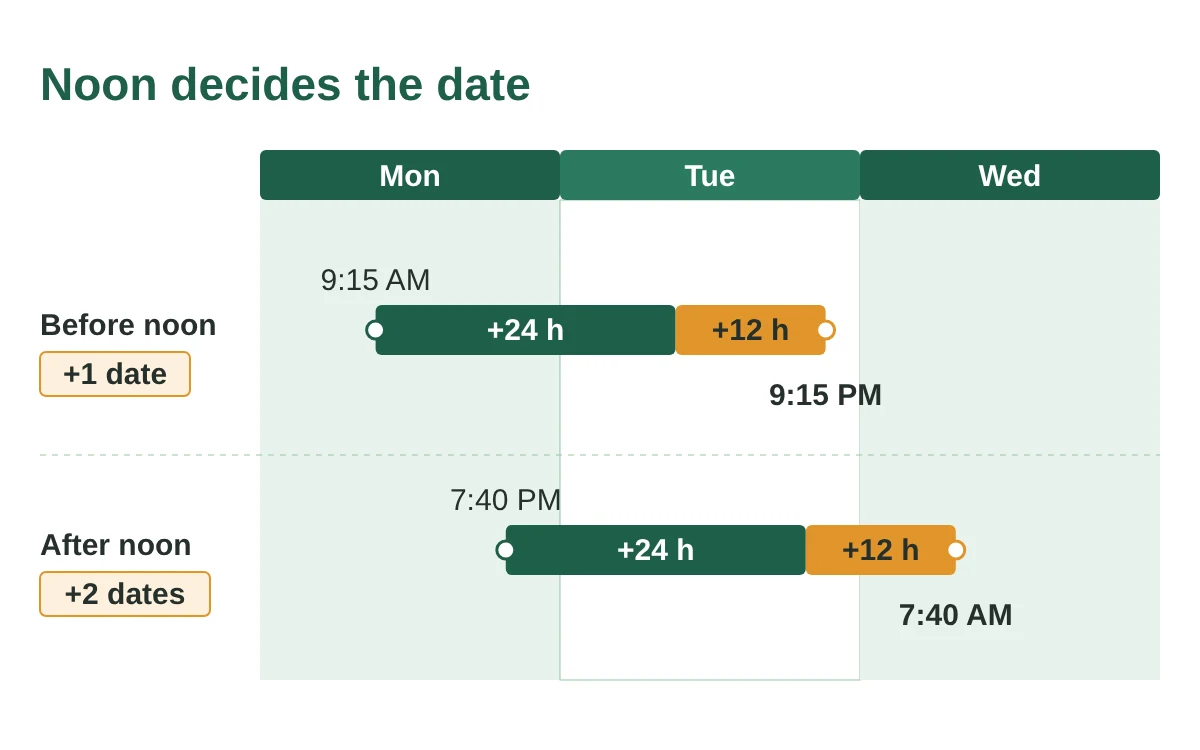
Treat 36 hours as “tomorrow, plus 12 hours”. Adding 12 hours flips AM to PM or PM to AM, so the clock face is easy to predict: the minutes never change, and only the AM/PM label flips. That is faster and less error-prone than adding 36 to the hour and subtracting 24.
The date rule is the part people miss. If you start in the morning, the flip lands in the afternoon of the same calendar day, so the answer is one date ahead. If you start in the afternoon or evening, the flip crosses midnight, so the answer is two dates ahead. Noon is the dividing line.
On a 24-hour clock the same idea reads as: add 12 to the hour. If the total passes 24, subtract 24 and add one more day to the date.
A worked example
Take a hypothetical start of Monday, 3 August at 7:40 PM. Add one full day to reach Tuesday, 4 August at 7:40 PM. Add the remaining 12 hours and the clock flips to 7:40 AM, crossing midnight into Wednesday, 5 August. The answer is Wednesday at 7:40 AM.
Now a morning start, also hypothetical: Monday at 9:15 AM. One day later is Tuesday at 9:15 AM. Twelve more hours gives 9:15 PM, still Tuesday. Same method, but only one date forward.
Try this: Pick any time on your clock right now, say it aloud as “tomorrow, plus 12 hours”, then check yourself against the live widget. Do it three times at different hours and the AM/PM rule will become automatic.
Daylight saving can shift the answer
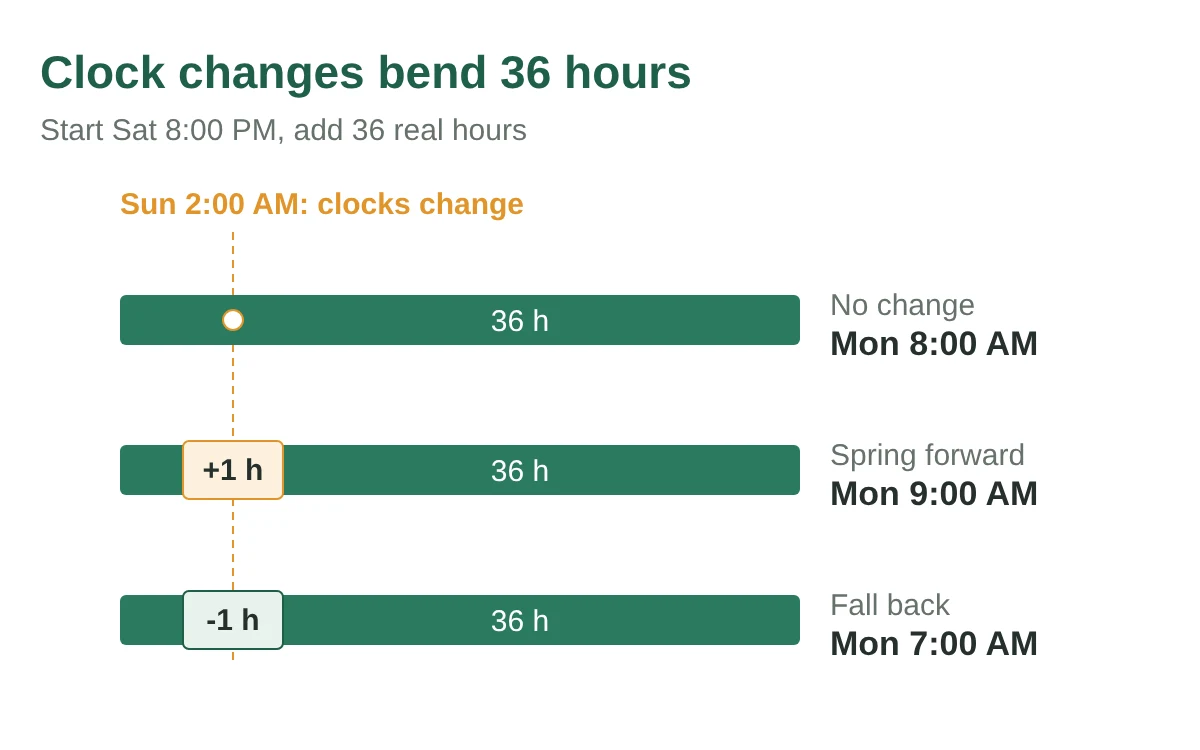
Clock arithmetic and elapsed time are not the same thing when a daylight saving change falls inside the 36 hours. If clocks spring forward during that stretch, the wall clock shows 37 hours of change for 36 hours of real time. If they fall back, it shows 35.
Hypothetical case: you start at 8:00 PM on the Saturday before a spring-forward Sunday. Hand arithmetic gives Monday at 8:00 AM, but 36 real hours later the clock reads Monday at 9:00 AM. In autumn the same start gives Monday at 7:00 AM. The widget accounts for this automatically because it uses your device’s time zone rules.
Hours are also not the same as “a day and a half” in calendar terms. A calendar day on a change weekend can be 23 or 25 hours long, so software that adds 1.5 days and software that adds 36 hours can disagree by an hour.
Medication windows
A 36-hour gap shows up in medicine as a minimum wait, a washout period or a “do not repeat within” rule. For these, count from the exact time of the last dose, not from the date. A dose at 11:30 PM and a dose at 11:30 AM two days later are 36 hours apart, which is easy to misjudge if you only think in days.
Use 24-hour times when you write the schedule down. “23:30” has no AM/PM ambiguity, which removes the most common source of a 12-hour error. For anything with a safety limit, follow the label or ask a pharmacist, and treat any calculator as a check, not the authority.
Shipping and notice periods
Carriers and contracts rarely mean 36 plain clock hours. A “36 hour” delivery estimate often counts business hours or business days, so a Friday afternoon dispatch can land the following Tuesday. Check whether weekends and public holidays are excluded before relying on the figure.
Notice periods raise a different question: when does the clock start? Common choices are:
- When the notice is sent
- When it is received or delivered
- At the next business day opening, if sent outside working hours
Wording like “36 hours’ notice” in a lease, booking or contract can change the outcome by a full day. Where it matters, get the start trigger in writing and calculate from that moment, not from when you think it began.
Try this: Take a real deadline you have, such as a form or a return window, and write down its start trigger and whether weekends count. Then enter that start time into the live widget above.
Comparing it with nearby spans
36 hours sits exactly halfway between one and two days, which makes it a handy mental midpoint. If you need a clean two-day figure, 48 hours is the next whole-day mark, and 72 hours from now gives you three days. For shorter planning, 12 hours from now is the exact half-day component of the shortcut above.
Looking backwards uses the same logic in reverse. Two days ago lands on the same clock time, and 36 hours back is the same time minus a day, then minus 12 hours.
Other tools for related questions
If you need the gap between two specific dates rather than a fixed 36-hour step, the date calculator handles days between dates and adding days. For converting 36 hours into minutes, seconds or days (2,160 minutes, 129,600 seconds, 1.5 days), the time conversions page covers the full set of units.
For a deadline stated as a day count instead of hours, 3 days from now gives the neighbouring answer when the 36-hour mark falls just short.
Frequently asked questions
How do I work out 36 hours from now in my head?
Think of it as the same time tomorrow, plus 12 hours. The minutes stay the same and only AM/PM flips. If you start before noon the answer lands one calendar date ahead, and if you start at noon or later it lands two dates ahead.
Does daylight saving time change what time it will be 36 hours from now?
Yes, if a clock change falls inside the 36 hours. When clocks spring forward the wall clock moves 37 hours for 36 real hours, and when they fall back it moves 35. For example, 8:00 PM on the Saturday before a spring-forward Sunday gives Monday 9:00 AM, not 8:00 AM.
Is a '36 hour' delivery estimate or notice period the same as 36 clock hours?
Not always. Delivery estimates often count business hours, so a Friday afternoon dispatch can arrive the following Tuesday. Notice periods depend on the start trigger (sent, received, or next business day opening), which can shift the deadline by a full day.
How should I count a 36-hour gap between medication doses?
Count from the exact time of the last dose, not from the calendar date. A dose at 23:30 and the next at 11:30 two days later are exactly 36 hours apart. Writing times in 24-hour format avoids 12-hour AM/PM mistakes, and the label or a pharmacist should settle any safety limit.