
How Long Till 3:10? Counting Down to 3:10 PM
Around the world
The time left until 3:10 PM is 15:10 minus your current time on a 24-hour clock. The live countdown above does that sum on your own device, in your own time zone, down to the second, so use it for the exact figure. The rest of this page explains how to check the result by hand and where the answer can go wrong.
Most of the errors come from a few places: an unspecified AM or PM, a different time zone, or a clock change. Each is covered below, along with a mental shortcut that makes the sum quick.
What “3:10” means without AM or PM
A bare “3:10” always points to the next 3:10 to arrive, and that is never more than 12 hours away. Between 3:10 AM and 3:10 PM it means the afternoon one. Between 3:10 PM and the following 3:10 AM it means the early morning one. Plans that say “3:10” with no marker are usually clear from context, but a late-night shift worker and a school pickup parent mean opposite halves of the clock.
This page counts down to 3:10 PM, written 15:10 or 1510 in 24-hour and military style. If you need the early morning version, the same method applies with 03:10 as the target.
The 910 minute shortcut
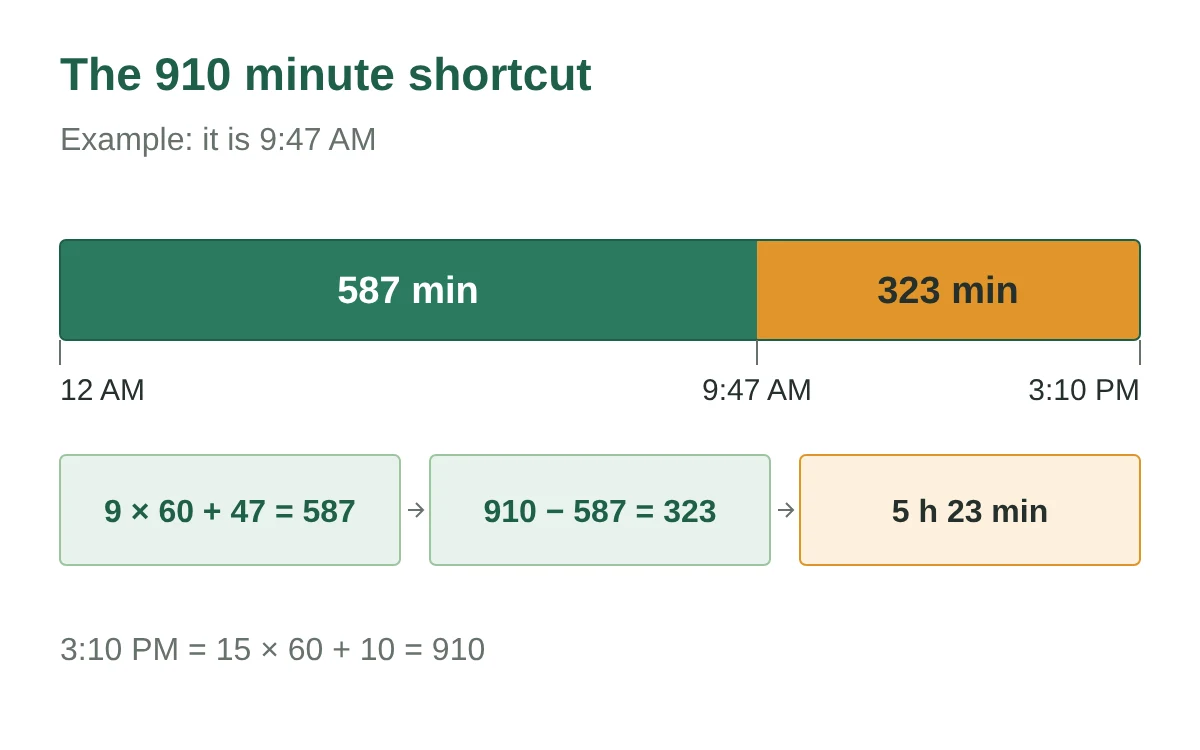
3:10 PM sits exactly 910 minutes after midnight (15 × 60 + 10). If you convert your current time to minutes since midnight and subtract it from 910, you get the minutes remaining in one step. This avoids borrowing hours, which is where most mental slips happen.
An even faster route works for everyday use: count to the next round hour, then count the whole hours to 3:00 PM, then add 10. From 11:40 AM, that is 20 minutes to noon, 3 hours to 3:00 PM, plus 10, giving 3 hours 30 minutes. The “+10” is the only part that is special to 3:10.
A worked example by hand
Take a hypothetical start of 9:47 AM. Using the round-hour method: 9:47 to 10:00 is 13 minutes. 10:00 to 15:00 is 5 hours. Add the final 10 minutes. The total is 5 hours 23 minutes.
Check it with the minutes method. 9:47 AM is 587 minutes after midnight (9 × 60 + 47). 910 minus 587 is 323 minutes, which is 5 hours 23 minutes. Both routes agree. In seconds, that is 323 × 60 = 19,380.
Try this: Pick the time on your clock right now and work out the gap to 3:10 PM with both methods, the round-hour route and the 910 minute route. If they disagree, the slip is nearly always a borrowed hour.
When 3:10 has already passed
Once 3:10 PM is behind you, the countdown rolls to tomorrow. The quickest way to count it is to measure how long ago 3:10 was and subtract that from 24 hours. At 4:30 PM, 3:10 was 1 hour 20 minutes ago, so tomorrow’s 3:10 PM is 24 hours minus 1 hour 20 minutes, which is 22 hours 40 minutes away.
This complement trick beats the longer “time to midnight plus 15 hours 10 minutes” route because it needs only one small subtraction. For a nearby benchmark on the same afternoon, the pages for 3 PM and 3:15 PM work the same way, and the gap between 3:10 and either is simply 10 or 5 minutes.
Time zones and whose 3:10 it is
The countdown uses your device clock, so it answers “how long until 3:10 PM where I am”. If a meeting is at 3:10 PM in another city, convert that time to your zone first, then subtract. Entering the other city’s local time into a local-time sum is the most common source of a wrong answer, and it is often wrong by a whole number of hours, so it looks plausible.
Some zones sit on half or quarter hours from UTC, such as India (UTC+5:30) and Nepal (UTC+5:45). A 3:10 PM start in those places lands at an unfamiliar minute when you convert it, so convert the full time, never just the hour. If you work in US Central time, the Central time page shows the current clock reading there.
Daylight saving can change the answer
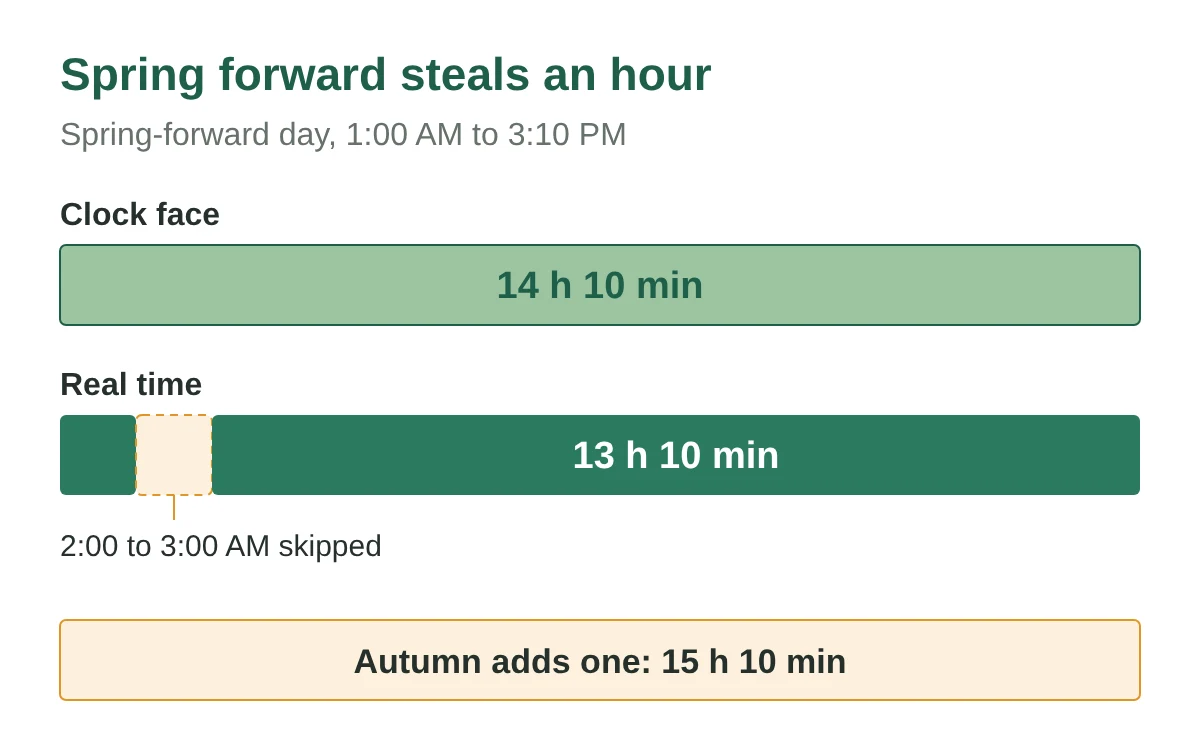
A countdown to 3:10 PM is exact only if you measure real elapsed time, not the difference between two clock faces. On a day when clocks change, the two disagree. If you start counting at 1:00 AM on the spring-forward date in the US, the clock difference to 3:10 PM is 14 hours 10 minutes, but only 13 hours 10 minutes of real time pass, because an hour is skipped overnight. In autumn the reverse happens: 15 hours 10 minutes of real time pass.
If you start counting after the switch (the change happens in the small hours), the arithmetic is normal again. Regions change on different dates, so a call between a US office and a European one can be an hour off for a couple of weeks each year. The live widget handles this automatically. Hand sums do not.
Why people check 3:10
A few common deadlines land near this time. Many school days end around 3:00 to 3:30 PM, so 3:10 is a typical pickup or bell time. In an office, 3:10 PM is often the point where a “last meeting of the day” slot starts. For appointments, a 3:10 slot is common in clinics that book in 10 or 20 minute blocks.
For markets, it helps to remember that the US stock market closes at 4:00 PM Eastern, so 3:10 PM Eastern leaves 50 minutes of regular trading. The same clock reading in Central time falls after the close, because Central is an hour behind. If your goal is a different afternoon target, the 4 PM and 3:30 PM countdowns are one click away.
Mistakes that cost minutes
Three errors cause most wrong answers. The first is reading 3:10 as 3.10 hours. 3 hours 10 minutes is 3.17 hours in decimals, and 3.10 hours is only 3 hours 6 minutes. If you need to switch between formats, the time conversions page covers the maths for every unit.
The second is mixing up 12 AM and 12 PM. Noon is 12:00 PM, which is 3 hours 10 minutes from 3:10 PM. Midnight is 12:00 AM, which is 15 hours 10 minutes away. The third is subtracting minutes the wrong way, for example 3:10 minus 2:45 treated as “65 minutes” rather than 25. When the minutes you are subtracting are larger than the target’s, borrow 60 and take 1 from the hours.
Try this: Pick any three start times, such as 8:50 AM, 12:35 PM and 2:58 PM, and mentally work out the gap to 3:10 PM using the complement trick (how far to the next hour, then how many whole hours, then +10). Then check them against the live countdown when the clock reaches those times.
For a related type of sum, how long until midnight uses the same method with a target of 24:00.
Frequently asked questions
How many minutes are there in 3:10 PM?
3:10 PM is 15:10 on a 24-hour clock, which is 910 minutes after midnight. Subtract your current minutes-since-midnight from 910 to get the minutes remaining.
How long until 3:10 if I don't know whether it means AM or PM?
The next 3:10 is never more than 12 hours away, because 3:10 AM and 3:10 PM alternate. The live countdown above targets 3:10 PM today.
Is 3:10 the same as 3.10 hours?
No. 3:10 means 3 hours and 10 minutes, while 3.10 hours is 3 hours and 6 minutes. Decimal hours multiply the fraction by 60, so 0.10 of an hour is 6 minutes.
Does the countdown change on daylight saving days?
Yes, if the clock change falls between now and 3:10 PM. A countdown that starts before the switch is an hour shorter in spring and an hour longer in autumn. A countdown that starts after the switch is unaffected.