
How Long Until 2:45 PM?
Around the world
The live countdown above shows exactly how long until 2:45 PM (14:45) on your own device clock, down to the second, and it switches to tomorrow’s 2:45 PM once today’s has passed. To check it by hand, subtract the current time from 14:45. Since 14:45 is 885 minutes after midnight, you can also convert the current time to minutes and subtract.
The widget is the quick answer. The rest of this page covers the parts a plain subtraction misses: what happens after 2:45 has passed, why clock-change days break the maths, and how time zones shift the target.
The by-hand method that avoids borrowing
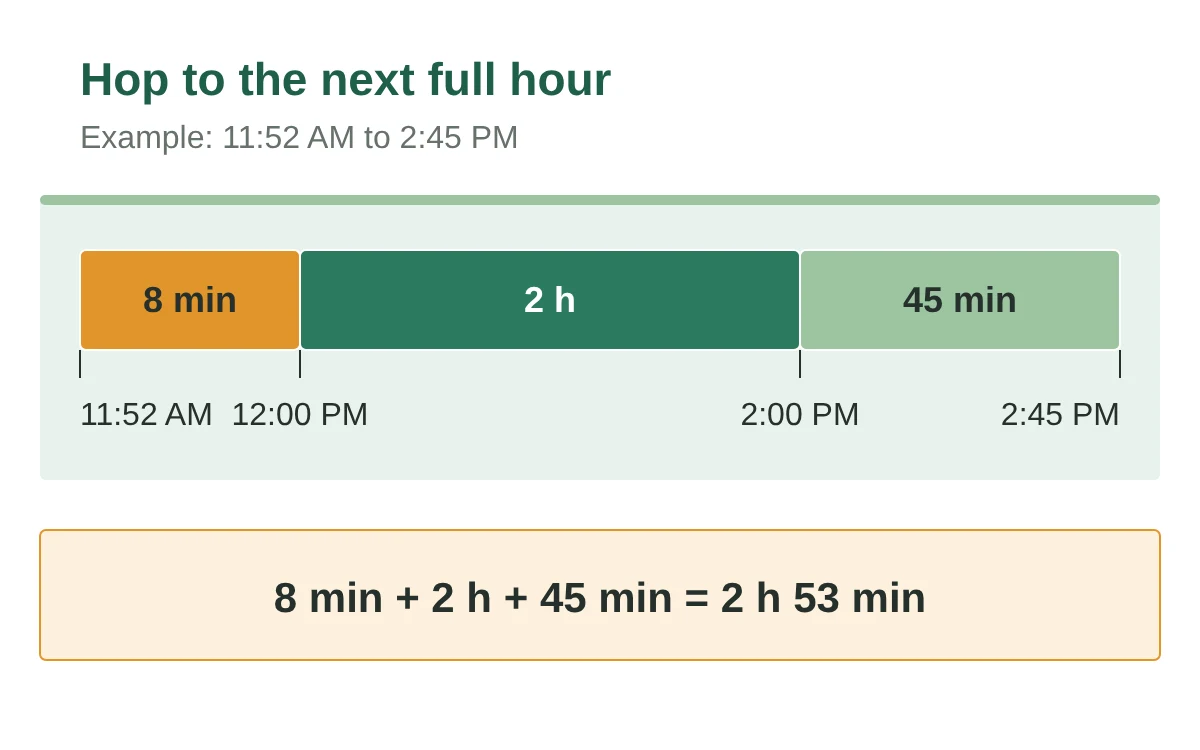
Most people stumble on the subtraction because the minutes need borrowing. Skip that by stopping at the next full hour. Count from now to the next hour, then add whatever remains between that hour and 2:45 PM.
Take a hypothetical 11:52 AM. It is 8 minutes to noon, and noon to 2:45 PM is 2 hours 45 minutes. Total: 2 hours 53 minutes. The same trick works at any time, because the final leg is always whole hours plus 45 minutes.
If you prefer numbers, use minutes since midnight. Convert now to minutes (11:52 is 712), subtract from 885, and you get 173 minutes, or 2 hours 53 minutes. This method shines when you need the answer in minutes anyway.
Try this: Pick three random times on your clock right now (say 9:10, 1:38 and 12:59) and find the gap to 2:45 PM using the next-full-hour trick. Check each against the widget.
When 2:45 has already passed
After 2:45 PM, the question quietly changes to “how long until tomorrow’s 2:45 PM”. Split the trip at midnight: time left until midnight, plus 14 hours 45 minutes. From a hypothetical 9:20 PM, that is 2 hours 40 minutes to midnight plus 14 hours 45 minutes, or 17 hours 25 minutes.
A shortcut for the late-evening case: the full cycle from 2:45 PM to 2:45 PM is 24 hours. So time until tomorrow’s 2:45 is 24 hours minus the time since today’s. If it has been 6 hours 35 minutes since 2:45, you are 17 hours 25 minutes away.
For the midnight leg, the how long until midnight page has the same breakdown.
Why “2:45” alone is ambiguous
Searching “how long until 2:45” without AM or PM gives two possible targets, 02:45 and 14:45, which are exactly 12 hours apart. Most countdowns pick the next occurrence of whichever one you mean, so at 1 PM the next 2:45 is 1 hour 45 minutes away, while at 3 PM the next 2:45 is only 11 hours 45 minutes away, and it is an AM time.
That is the most common source of a countdown that looks wrong: someone expects the afternoon target and reads a result pointing at the small hours. If you want the afternoon one specifically, make sure the label says PM or 14:45. The 24-hour form has no such trap.
Daylight saving can change the answer
Clock arithmetic assumes every day has 24 hours. On a clock-change day, one does not. If your wait spans the changeover, the real elapsed time is an hour more or less than the subtraction suggests. A countdown that runs on real elapsed time, like the widget above, accounts for this. Your head will not.
There is also a quirk specific to this time. In the US, clocks jump forward from 2:00 AM straight to 3:00 AM in spring, so 2:45 AM does not exist that night. In autumn, 2:45 AM happens twice. This only affects the AM version, and 2:45 PM is always safe, but it is a real edge case if you set an overnight alarm for “2:45”.
Time zones, including the odd ones
The target is always local. 2:45 PM in New York is 1:45 PM in Chicago and 11:45 AM in Los Angeles. The widget uses your device’s zone, so if you are counting down to a meeting in another city, convert the meeting time into your own zone first. For a Central Time reference, see what time it is in Central Time now.
Some zones add a twist. India runs on a half-hour offset, so 2:45 PM in London is a time ending in :15 or :45 in Mumbai depending on the season. Nepal uses a 45-minute offset, which makes the minute hand match London’s only in odd combinations. For these zones, convert in minutes rather than by eye.
Try this: Write the meeting time as minutes since midnight in the other zone (14:45 is 885), add or subtract the offset in minutes, and convert back. Half-hour and 45-minute zones stop being a problem.
Why people check 2:45 PM
Two common cases: the end of a shift or school day, and the last stretch before a market close. For US stocks, 2:45 PM Eastern is 75 minutes before the 4:00 PM close, so any 2:45 PM Eastern countdown is really a closing-hour planner. If you are in another zone, convert the 4 PM close first.
For school pickups and appointments, the useful number is often the buffer, not the countdown. Subtract your travel time from 2:45 and you get the leave-by time. For a related reference point, how long until 3 PM is a natural companion when the bell is at 3.
Handy numbers for 2:45 PM
Keep these in mind and the rest is easy:
- 14:45 in 24-hour time, written 1445 in military style
- 885 minutes after midnight, or 53,100 seconds
- 14.75 in decimal hours, which is what timesheets and payroll software want
- 15 minutes before 3:00 PM, which is why it is called “quarter to three”
The decimal form catches people out. 2 hours 45 minutes on a timesheet is 2.75 hours, not 2.45. If you need the unit switch in general, the time conversions page covers it.
Related countdowns when 2:45 is not the target
If your real target is a neighbouring time, how long until 2:30 PM sits 15 minutes earlier and is handy for a “be ready by” time. To count forward from now instead, 45 minutes from now answers the “what time will it be then” version. The full list of time-of-day countdowns is on the time until page.
FAQ
Placeholder for FAQ rendering.
Frequently asked questions
How do I work out how long until 2:45 PM without borrowing in subtraction?
Count from the current time to the next full hour, then add the whole hours from that hour to 2:00 PM, plus 45 minutes. From 11:52 AM that is 8 minutes to noon plus 2 hours 45 minutes, which makes 2 hours 53 minutes. Alternatively, convert the current time to minutes since midnight and subtract it from 885, the minute count for 14:45.
How long until 2:45 PM if it has already passed today?
The target becomes tomorrow's 2:45 PM, so subtract the time elapsed since today's 2:45 PM from 24 hours. Another way is to add the time left until midnight to 14 hours 45 minutes. Both methods give the same result, for example 17 hours 25 minutes from 9:20 PM.
Why does a countdown to "2:45" sometimes point to the middle of the night?
Without AM or PM, 2:45 can mean 02:45 or 14:45, which are 12 hours apart, and many countdowns choose whichever comes next. After 2:45 PM the next occurrence is 2:45 AM, so the result looks far too short. Writing 14:45 or specifying PM removes the ambiguity.
Does daylight saving time change how long it is until 2:45 PM?
It can. If the wait crosses a clock change, the real elapsed time is an hour more or less than simple subtraction gives. A countdown based on actual elapsed time handles this automatically. The 2:45 PM time itself always exists, though in the US 2:45 AM is skipped on the spring clock-change night.