
How Long Until 2:30 PM?
Around the world
The time left until 2:30 PM is the gap between your current clock time and 14:30. The live countdown above works it out on your own device in your own time zone, down to the second, so use it for the exact figure. This page covers how to check it by hand and where the quick answers go wrong.
Most of the errors come from three places: the AM and PM ambiguity, the moment 2:30 has already passed, and clock changes. Each is easy to handle once you know it is there.
Which 2:30 the countdown means
A bare “2:30” could be 02:30 or 14:30, and the two are twelve hours apart. This page counts toward 2:30 PM, the afternoon one. If you need the early-morning time, the gap is the same sum with 02:30 as the target.
The countdown always aims at the next 2:30 PM on your clock. Before 14:30 that is today. After 14:30 it is tomorrow, which is why the widget can show a figure close to 24 hours in the late afternoon.
Calculate it by hand in ten seconds
Convert to 24-hour time, then count up to the next full hour and add the rest. Say a hypothetical clock reads 10:47 AM.
- From 10:47 to 11:00 is 13 minutes.
- From 11:00 to 14:00 is 3 hours.
- From 14:00 to 14:30 is 30 minutes.
- Total: 3 hours and 43 minutes.
The alternative is to work in minutes after midnight. 10:47 is 647 minutes (10 times 60, plus 47), and 2:30 PM is 870, so the gap is 223 minutes. Divide by 60 for 3 hours with 43 left over. The first method is faster in your head, the second is safer when the numbers are awkward.
Try this: Glance at any clock and work out the time to 14:30 using the “next full hour” method before checking the widget. Do it three times at different hours and the step becomes automatic.
When 2:30 PM has already passed
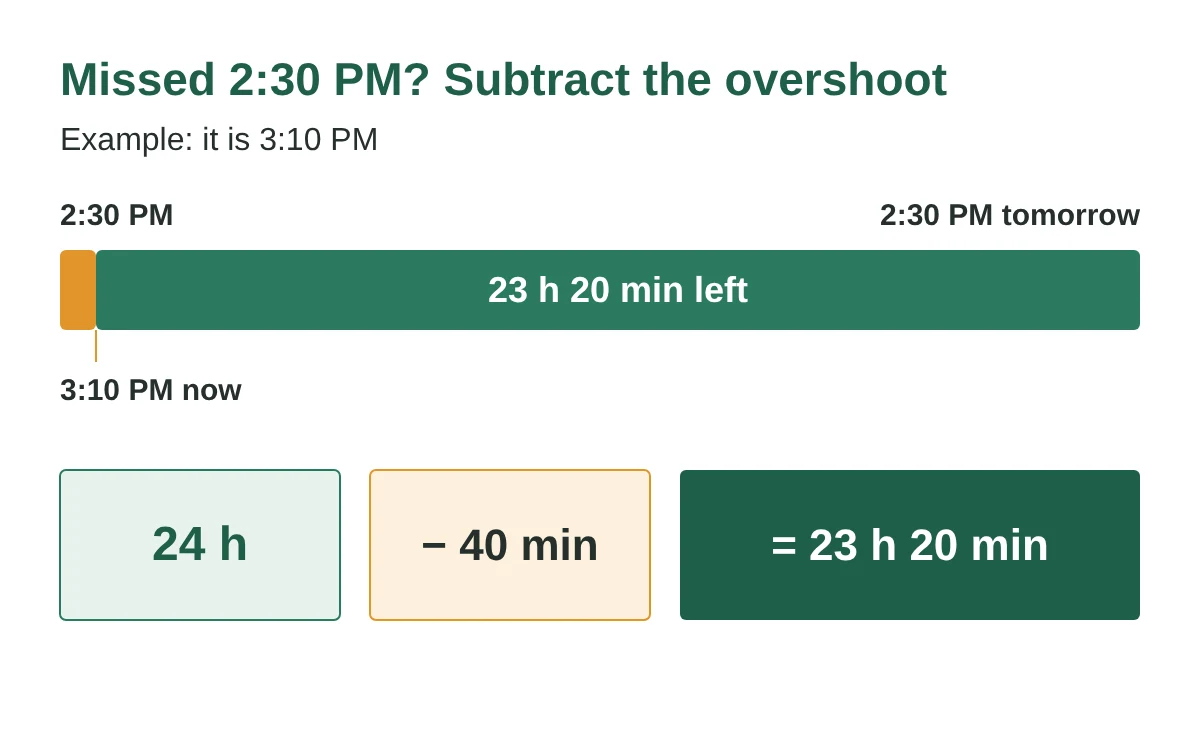
After 14:30 the target moves to tomorrow, and the sum needs a day added. The cleanest way is to add 1,440 (the minutes in a day) to 870 and then subtract your current minutes after midnight. With a hypothetical 3:10 PM, that is 910 minutes, so 870 + 1,440 − 910 = 1,400 minutes, or 23 hours and 20 minutes.
A quicker mental route: it is 24 hours minus the time since 2:30. At 3:10 PM, 40 minutes have gone by since 2:30, so 24 hours less 40 minutes is 23 hours 20 minutes. This “subtract the overshoot” trick works for any target and any time of day.
Why 870 is the number worth remembering
2:30 PM sits 870 minutes into the day, which is 60.4 percent of the way through. That makes it a handy reference for planning. Any time you know in minutes after midnight can be subtracted from 870 in one step, and a negative result tells you immediately that the moment has passed.
The same logic gives neighbouring targets. 2:00 PM is 840 and 3:00 PM is 900, so 2:30 PM is the midpoint of that hour. If you are timing a series of afternoon deadlines, the pages for 2 PM and 3:30 PM use the same method with different anchors.
Time zones and 2:30
The widget uses your device clock, so it answers for wherever you are. The risk appears when you are counting toward someone else’s 2:30. A meeting at 2:30 PM Eastern is 1:30 PM Central and 11:30 AM Pacific, and you should convert the target first, then count.
Half-hour zones add a trap. 2:30 PM in India (UTC+5:30) is 09:00 UTC, while 2:30 PM in most of Europe’s winter time (UTC+1) is 13:30 UTC. If the other person’s offset ends in :30 or :45, a mental shift by whole hours will be wrong. To see the current Central time before converting, the Central time now page is a quick check.
Daylight saving can shift the answer
A countdown measures real elapsed time, not the difference on the clock face. If the clocks change between now and 2:30 PM, the true gap differs from the face-value gap by an hour. Counting from the evening before a spring-forward change, the real wait to 2:30 PM is one hour shorter than 24 hours would suggest. Counting before a fall-back change makes it one hour longer.
The 2:30 AM version is stranger still. In regions that change clocks at 2:00 AM, 2:30 AM does not exist on the spring-forward night and happens twice on the fall-back night. This is why scheduled jobs set for 2:30 AM sometimes skip a day or run twice. The afternoon 2:30 is safe from this.
Try this: Look up the next clock-change date for your region and check whether it falls between now and your next 2:30 PM. If it does, expect the live figure to be an hour off your mental sum.
Why people check 2:30
Typical reasons are fairly specific. Many schools release students between 2:30 and 3:30 PM, so parents count down to pickup. In offices, 2:30 PM often marks a post-lunch meeting slot or a standing call, and a countdown shows how much focused work fits before it.
For markets, US stocks close at 4:00 PM Eastern, so 2:30 PM Eastern leaves 90 minutes of trading. Scheduled announcements also land in the afternoon, so traders often count toward a specific minute, not an hour. Appointments with a 15-minute arrival buffer are really counting down to 2:15, which is the number to set your alert for.
Mistakes that throw off the minute maths
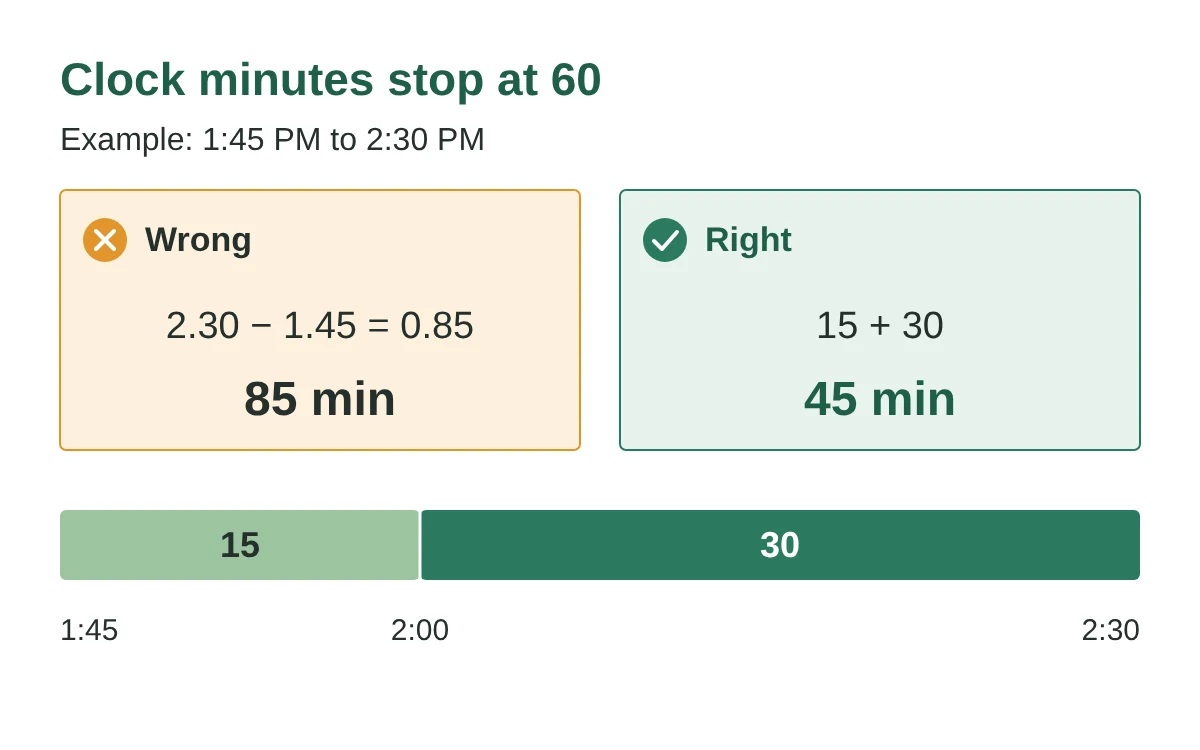
Most wrong answers come from a small set of slips:
- Treating 1:45 to 2:30 as 85 minutes because 2:30 minus 1:45 looks like 1.85. Clock minutes run to 60, not 100.
- Reading 1.5 hours as 1 hour 50 minutes. It is 1 hour 30 minutes.
- Forgetting the day rollover once 2:30 PM has passed.
- Using AM when the target is PM, which is a 12-hour error.
For decimal-to-minutes conversions, the time conversions page covers them, and the 100 minutes to hours page shows the same remainder logic. For nearby targets such as 2:45 PM, the method is identical with a different end point.
Frequently asked questions
How long until 2:30 if it is currently 2:30 PM?
The answer is zero, and a well-built countdown then rolls over to the next 2:30 PM, which is almost exactly 24 hours away. Some tools show 0 for a moment and others jump straight to tomorrow.
How many minutes is 2:30 PM after midnight?
It is 870 minutes (14 hours times 60, plus 30). Subtracting the current time, also written in minutes after midnight, gives the minutes remaining.
Is 2:30 the same as 14:30?
Only for the afternoon. 2:30 PM is 14:30, while 2:30 AM is 02:30. If you type a bare 2:30 into a tool, check which one it assumed.
Does the countdown change when I travel?
Yes. The widget reads your device clock and time zone, so 2:30 PM always means 2:30 PM where the device currently is. Changing zones or using a VPN with a different location setting can change the result.