
How Long Until 4:30 PM?
Around the world
The time left until 4:30 PM is the gap between your current clock time and 16:30 on the same day. The live countdown above calculates it from your own device clock and time zone, so it is accurate to the second wherever you are. If 4:30 PM has already passed, it counts toward 4:30 PM tomorrow.
The rest of this page covers what the widget cannot show you: a way to work out the answer in your head, what happens when the target has already gone by, and the cases where the clock face misleads you.
The 990 trick for doing it in your head
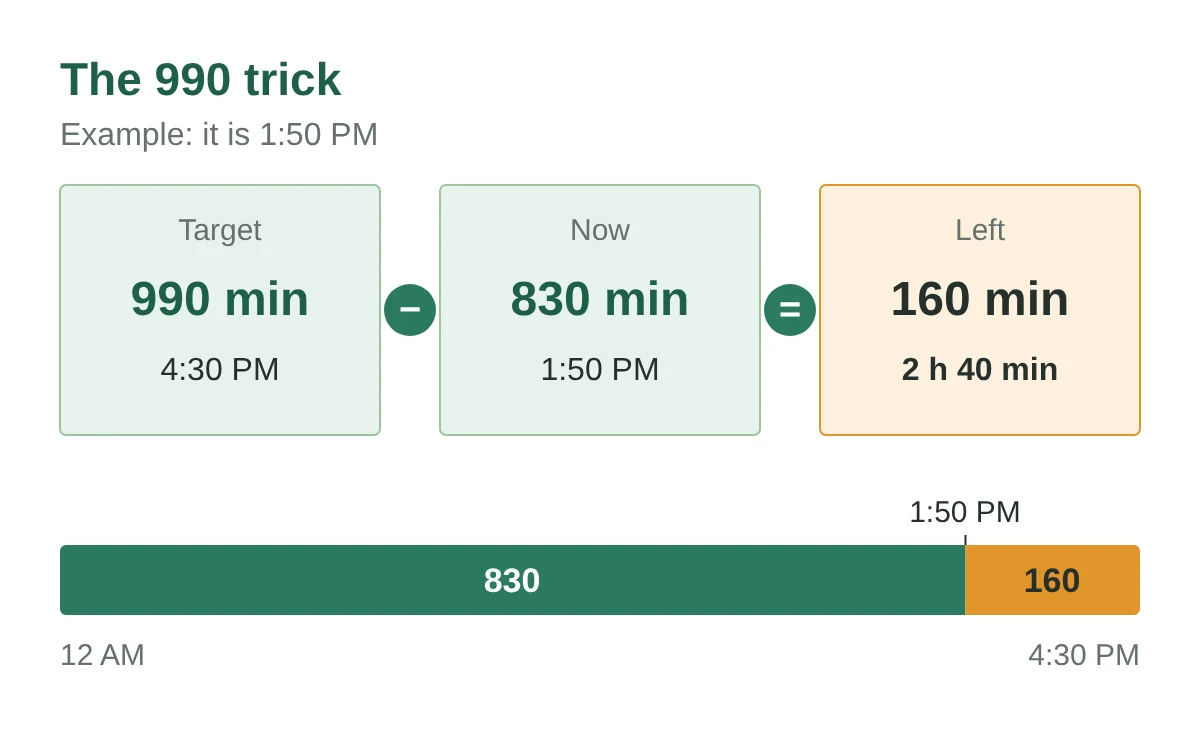
4:30 PM is 990 minutes after midnight (16 hours times 60, plus 30). Turn your current time into minutes since midnight, subtract it from 990, and you have the answer in minutes. Divide by 60 to get hours and minutes.
A hypothetical example: it is 1:50 PM, which is 13:50, or 830 minutes since midnight. 990 minus 830 is 160 minutes, which is 2 hours 40 minutes. Another: 9:12 AM is 552 minutes, and 990 minus 552 is 438 minutes, or 7 hours 18 minutes.
If you prefer clock arithmetic, borrow an hour. To subtract 13:50 from 16:30, rewrite 16:30 as 15:90 and subtract column by column: 2:40. The borrow is the step where most hand calculations go wrong.
Try this: Pick any time on your wall clock right now, convert it to 24-hour time, and work out the gap to 16:30 using the borrow method. Then check yourself against the live widget.
What happens after 4:30 has passed
Once the time is later than 16:30, the subtraction goes negative. Add 1,440 (the minutes in a day) to fix it. At a hypothetical 5:10 PM, which is 1,030 minutes, 990 minus 1,030 is minus 40, and adding 1,440 gives 1,400 minutes: 23 hours 20 minutes until tomorrow’s 4:30 PM.
A useful sanity check: the answer to “how long until 4:30 PM” is never more than 24 hours, and it is exactly 24 hours only at the instant 4:30 PM arrives. Some calculators show zero at that moment and some show a full day, so a countdown that flips from 0:00:01 to 23:59:59 is behaving normally.
Time zones and half-hour offsets
A countdown to “4:30 PM” means 4:30 PM on the clock where you are. If a meeting is at 4:30 PM in another city, convert that moment to your zone first, then count down. Counting to your own 4:30 PM instead is the classic mistake with remote calls.
Half-hour zones make the conversion less obvious. 4:30 PM US Eastern Standard Time (21:30 UTC) is 3:00 AM the next day in India (UTC+5:30), because the half hours cancel. In Eastern Daylight Time the same 4:30 PM lands at 2:00 AM in India. Nepal’s quarter-hour offset (UTC+5:45) would give 3:15 AM and 2:15 AM in the same two cases.
Daylight saving can change the answer
The clock-face difference and the real elapsed time are not always the same. On the night clocks spring forward, the span from 4:30 PM one afternoon to 4:30 PM the next is 23 hours. When clocks fall back, it is 25 hours.
This only matters when your count crosses the changeover, typically in the early hours of a weekend morning. A countdown started on a Saturday afternoon to a Sunday 4:30 PM target will be an hour off from the naive “24 hours” in the relevant weeks. The live widget uses real elapsed time, so it handles this correctly. Mental math using clock times will not.
Why people watch the clock for 4:30
Common reasons are the end of a shift, a school pickup window, a late-afternoon appointment slot, or a deadline just before the usual 5 PM finish. For a shift, the quickest way to find a 4:30 PM finish is to add the shift length to the start: a 8:30 AM start plus a nine-hour day (including an unpaid lunch) ends at 5:30 PM, while an eight-hour block with no lunch ends at 4:30 PM. The 8 hours from now page does that addition from any starting moment.
For trading, 4:30 PM Eastern is 30 minutes after the regular US stock market close at 4:00 PM. Closing prices are already set, but after-hours trading continues. Hours also shift on early-close days, so check the exchange calendar before counting on 4:30.
Neighbouring times and nearby countdowns
If 4:30 is a half-hour before something else, the nearby pages save you arithmetic. The 4 PM countdown is exactly 30 minutes shorter, the 5 PM countdown is 30 minutes longer, and the 3:30 PM countdown is exactly one hour shorter. Any half-hour target follows this same pattern: the answer is the nearest full-hour answer plus or minus 30.
For other times of day, the time-of-day countdowns list has the full set.
Decimal hours trip up timesheets
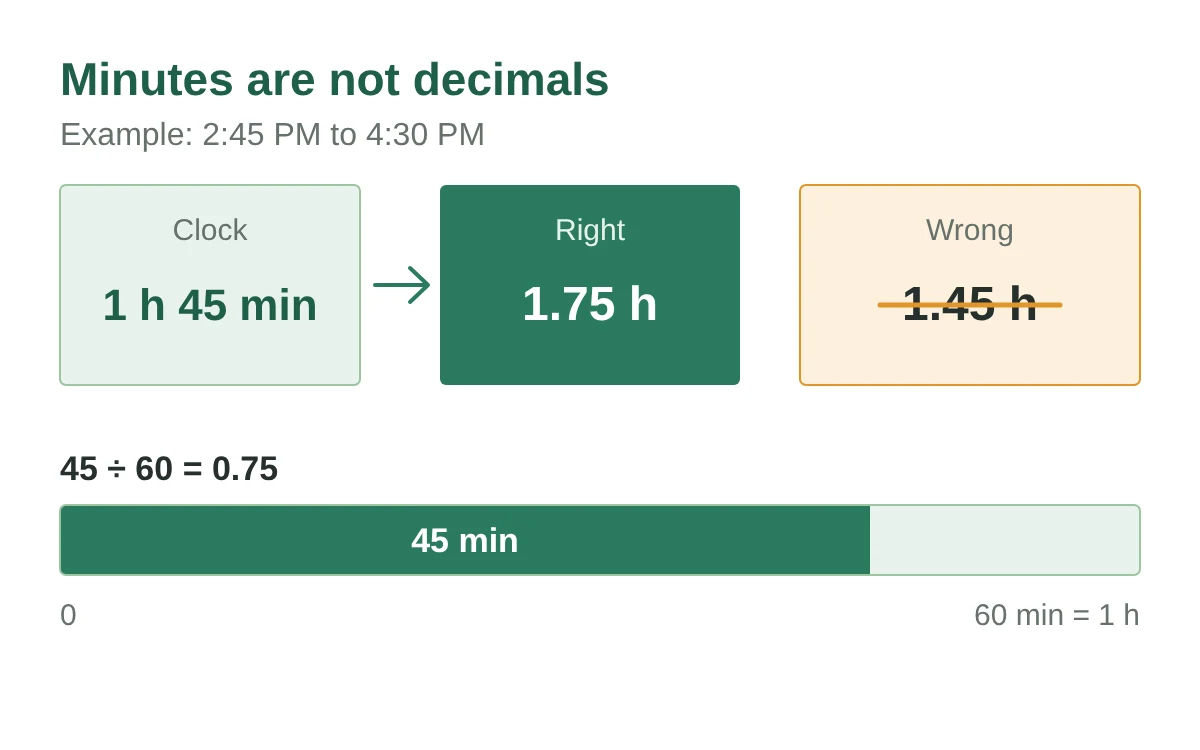
The most common arithmetic error is treating minutes as decimals. From 2:45 PM to 4:30 PM is 1 hour 45 minutes, which is 1.75 hours, not 1.45. Minutes run to 60, so multiply the minute part by 100/60, or just divide by 60: 45 minutes is 0.75 hours.
The same applies to 4:30 itself. As a decimal time, 4:30 PM is 16.5, not 16.30. If you enter hours into a spreadsheet or payroll form, convert first.
Try this: Work out the hours and minutes from 11:20 AM to 4:30 PM, then write the answer as decimal hours. (It is 5 hours 10 minutes, or about 5.17 hours.)
When you want less than a day
For short waits, the question often becomes “what clock time is X from now?” rather than “how long until 4:30?”. If 4:30 PM is close, the 30 minutes from now page and the midnight countdown cover the other end of the same afternoon and evening.
Frequently asked questions
How many minutes is 4:30 PM after midnight?
4:30 PM is 990 minutes after midnight, or 59,400 seconds. Subtract your own minutes-since-midnight from 990 and you have the minutes remaining.
What is 4:30 PM in 24-hour time?
It is 16:30, written as 1630 in military style. Add 12 to any PM hour from 1 to 11 to convert it.
How long is it until 4:30 PM tomorrow if 4:30 PM today has passed?
Usually 24 hours minus the time since 4:30 PM today. On a daylight saving change day the gap can be 23 or 25 hours instead, because the clock skips or repeats an hour.
Is the countdown to 4:30 PM based on my time zone?
Yes. The live widget reads your device clock and zone, so it counts to 4:30 PM where you are. For a meeting in another city, convert that city's 4:30 PM to your local time first.