
How Long Until 5:30 P.M.?
Around the world
The time left until 5:30 p.m. is the gap between your local clock and 17:30 today. The live countdown above works it out from your own device clock and time zone, so it is exact to the second. If you want to check it in your head, the quickest method is to count up to the next half hour or full hour, then add the rest.
The sections below cover the mental shortcuts, the mistakes that make people miscount by an hour, and what changes across time zones and daylight saving.
The fastest way to work it out by hand
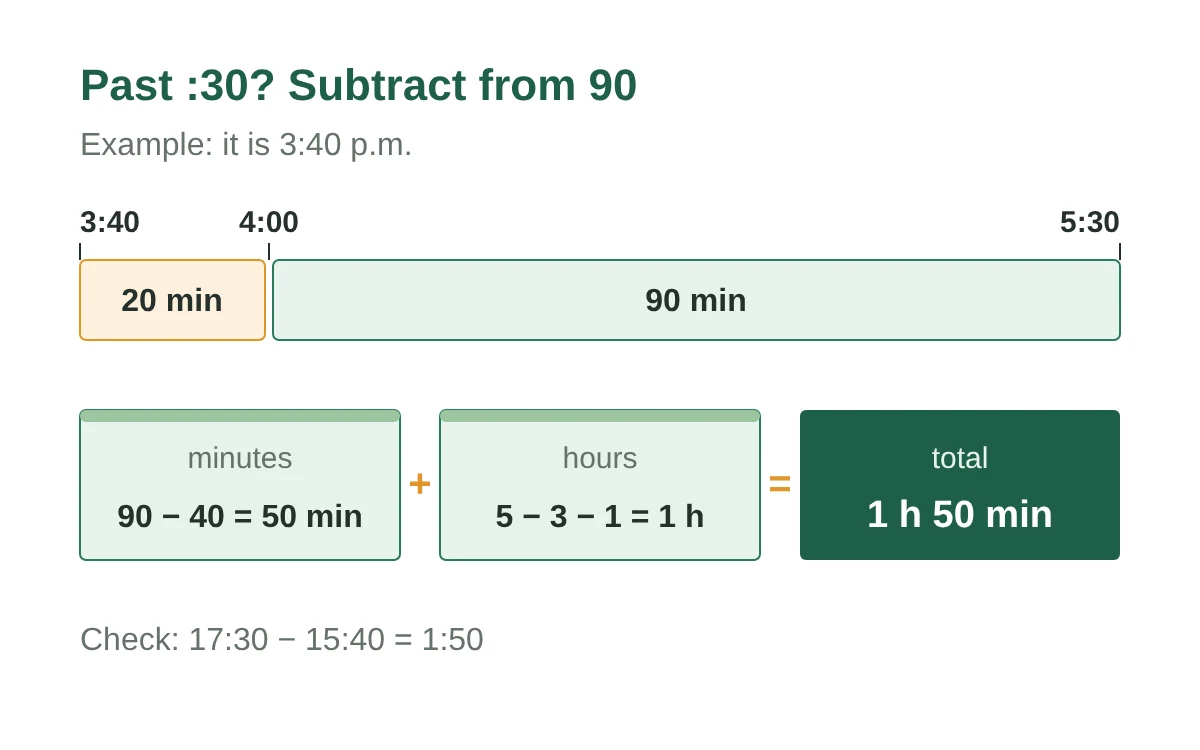
Counting in two hops beats subtracting. Hop one: go from now to the next round hour. Hop two: go from that hour to 5:30. Suppose it is 2:47 p.m. (a made-up example). The first hop is 13 minutes to 3:00. From 3:00 to 5:30 is 2 hours 30 minutes. Total: 2 hours 43 minutes.
Because the target ends in :30, there is a pattern worth remembering. If the current minute is 30 or less, the remaining minutes are 30 minus the current minutes. If the current minute is above 30, the remaining minutes are 90 minus the current minutes, and you take one extra hour off the hours. From 3:40, that gives 90 minus 40, or 50 minutes, with 1 hour fewer than the plain hour gap: 1 hour 50 minutes.
Try this: Pick any time on your clock right now and do the two-hop count to 5:30 p.m. in under ten seconds. Then compare it with the widget. A few rounds of this and the pattern becomes automatic.
Borrowing in 24-hour time
Convert to 24-hour time and 5:30 p.m. becomes 17:30. Subtract as you would on paper, borrowing an hour when the minutes do not cover it. From 14:45, you cannot take 45 from 30, so rewrite 17:30 as 16:90. Now 16:90 minus 14:45 is 2:45. Same answer as the two-hop method, but it works for any gap, including ones that span many hours.
The minute version is cleaner for anything under a few hours. 5:30 p.m. sits at 1,050 minutes after midnight, or 63,000 seconds. Convert your current time the same way (3:00 p.m. is 900) and subtract: 150 minutes remain. If you need other unit conversions, the time conversions page covers them.
After 5:30 has passed
Once the clock passes 17:30, the next 5:30 p.m. is tomorrow, so the gap is always under 24 hours but longer than 17 hours when you are just past it. From 6:00 p.m., the wait is 23 hours 30 minutes. A simple check: the time to tomorrow’s 5:30 p.m. is 24 hours minus the time since today’s.
The other trap is the morning. At 9:00 a.m., 5:30 p.m. is 8 hours 30 minutes away. At 5:30 a.m. it is exactly 12 hours away, because the two times are opposite each other on the clock. People who type “5:30” without a.m. or p.m. often mean the wrong one, which is why a separate countdown to 5:30 a.m. exists.
Why the countdown reads one minute low
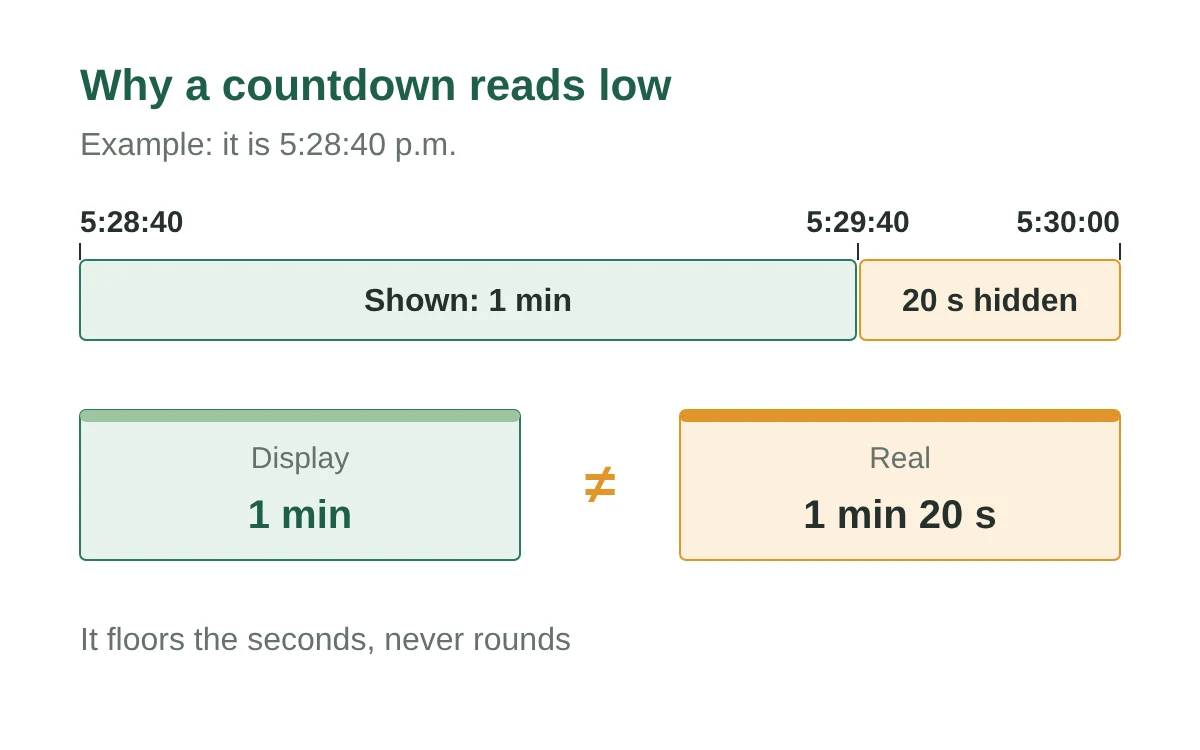
A countdown that shows minutes usually drops the leftover seconds rather than rounding. At 5:28:40 p.m., a minutes-only display reads 1 minute, though 80 seconds remain. At 5:29:59 it reads 0 minutes, with one second still to go. If you are timing something precise, such as a call that must start on the dot, watch the seconds, not the minutes.
The same effect explains why two different clocks can disagree by “a minute” without either being broken. One may floor and the other round. The target itself is 17:30:00, the very start of that minute, so there is no grace period.
Try this: Next time you are waiting on a deadline, note the minute figure at the moment the seconds hit 59. That is the display flipping, not the deadline arriving.
Time zones and daylight saving
5:30 p.m. is a local time. The widget uses your zone, so someone in New York and someone in Los Angeles see different countdowns to the same-looking target. That is correct for “when does my day end”, but wrong for a meeting called “5:30 p.m. Eastern” if you are not on Eastern time. Convert the meeting time into your own zone first, or check the Central time page if that is the zone you are converting from.
Half-hour zones add a surprise. India runs at UTC+5:30, so 5:30 p.m. there is exactly 12:00 UTC. For most other zones, the shift between UTC and local time is a whole hour, so it is the minutes that stay the same.
Daylight saving can distort a countdown that crosses the changeover. If you start before 2 a.m. on a US clock-change day, wall-clock subtraction will be an hour off, because that night is 23 or 25 hours long. Clocks change at different dates in the US and Europe, which creates a few weeks each year when a US-to-Europe gap shifts by an hour. For a countdown that starts after the change on the same day, none of this matters.
Why people count down to 5:30
The common reason is work. A 9:00 a.m. start with a 30-minute unpaid lunch finishes at 5:30 p.m. after an 8-hour paid day, which is also a handy check with the 8 hours from now page if your start time differs. Others count toward school pickup, a 5:30 p.m. class or appointment, or a commute that has to begin earlier.
For appointments, the useful number is not the time to 5:30 but the time to your leave-by moment. Subtract travel time and a buffer from 17:30, then count down to that. It is a few minutes of maths that prevents the usual 5:25 scramble.
Markets are a special case. In the US, regular stock trading ends at 4:00 p.m. Eastern, so 5:30 p.m. falls in after-hours trading, where access and hours depend on your broker. If you are tracking a close, check your exchange’s own schedule rather than assuming 5:30.
Try this: Choose tonight’s 5:30 p.m. appointment or finish time. Subtract your travel time plus 10 minutes, and use that earlier time as your real target.
Nearby times people also check
If 5:30 is not quite the right target, the neighbours are one tap away: 4:30 p.m., 5 p.m. and 6 p.m.. To finish the day, the midnight countdown covers the rest of the evening, and the countdowns to a time of day index lists every other clock time.
Frequently asked questions
How many minutes is 5:30 p.m. after midnight?
5:30 p.m. is 1,050 minutes after midnight (17 hours times 60, plus 30). Subtract your current time in minutes after midnight from 1,050 and you have the minutes remaining.
How long until 5:30 p.m. if it is already 6:00 p.m.?
The next 5:30 p.m. is tomorrow, 23 hours and 30 minutes after 6:00 p.m. The live countdown above switches to tomorrow automatically once 5:30 p.m. has passed.
Is 5:30 p.m. the same as 17:30?
Yes. Add 12 to any p.m. hour to get 24-hour time, so 5:30 p.m. is 17:30, often written 1730 in military style. 5:30 a.m. is a different moment: 05:30.
Why does the countdown show a different time than my phone?
The widget uses your device's clock and time zone, so it is only as accurate as that clock. If your device has a wrong time zone setting, or a manually set clock, the countdown will be off by the same amount.