
How Long Until 5 PM?
Around the world
The time left until 5 PM is 17:00 minus the current time on your clock. The live countdown above does this on your own device clock and time zone, to the second, so use it for the exact answer. If 5 PM has already passed today, the target automatically becomes tomorrow’s 5 PM.
The rest of this page covers what the widget cannot show you: a quick way to work it out without a calculator, the cases where simple subtraction goes wrong, and the time zone and daylight saving details that make “5 PM” less fixed than it looks.
The 16:60 trick for mental math
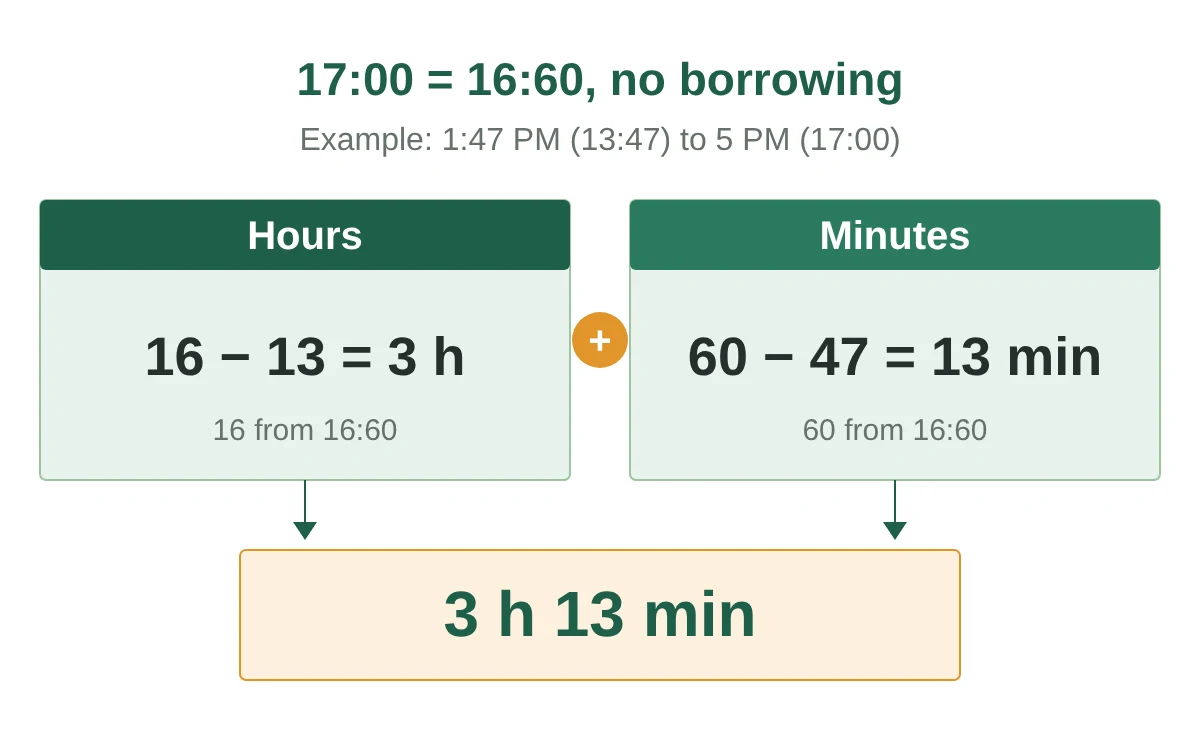
Subtracting clock times is awkward because of the borrowing. The cleaner method is to rewrite 5 PM as 16:60, then subtract hours and minutes separately with no borrowing at all. Hours left = 16 minus your hour (24-hour clock). Minutes left = 60 minus your minutes.
Take a hypothetical check at 1:47 PM, which is 13:47. Hours: 16 − 13 = 3. Minutes: 60 − 47 = 13. The answer is 3 hours 13 minutes. You can verify it: 13 minutes gets you to 2:00 PM, and three more hours is 5:00 PM.
One exception: when your minutes are exactly zero, skip the trick and use 17 minus the hour. At 14:00 that gives 3 hours, not 2 hours 60 minutes.
Try this: Glance at any clock and do the 16:60 subtraction before checking the countdown. Do it three times a day for a week and the answer will start to arrive without effort.
Counting in minutes since midnight
Another route is to convert everything to minutes. 5 PM is 1,020 minutes after midnight, and that figure never changes. Your current time is 60 × hour + minutes. For 13:47 that is 780 + 47 = 827, and 1,020 − 827 = 193 minutes, which is 3 hours 13 minutes again.
This method is slower for one-off checks but it wins when you need a single number: a timer app, a spreadsheet, a “minutes until my shift ends” note. It also avoids the AM/PM mix-ups that cause most wrong answers, because 24-hour time has no ambiguity.
After 5 PM, the target moves to tomorrow
Once the clock passes 17:00, the question changes from “how long until 5 PM today” to “how long until tomorrow’s”. The standard fix is to add 24 hours to the result, but the 16:60 trick handles it directly: use 40 instead of 16. At 20:15, hours = 40 − 20 = 20 and minutes = 60 − 15 = 45, so 20 hours 45 minutes.
The sharp edge is exactly 17:00:00. Some tools show zero, others jump straight to 24 hours. The widget treats 5 PM as reached and rolls to the next day, which matches how most people use it: at that second the wait is over.
Whose 5 PM is it?
The live countdown uses the clock on your device, so it answers “how long until 5 PM where I am”. That is not always what you need. A call at “5 PM Eastern” is 2 PM Pacific, and the countdown above will not know that.
- To count down to a meeting in another zone, convert it to your local time first, then target that hour on a time-of-day countdown.
- A laptop with a manually set time zone will give a different answer from your phone. Check both are set automatically.
- A VPN changes your apparent location, not your device clock, so it does not shift the countdown.
Daylight saving can break hand math
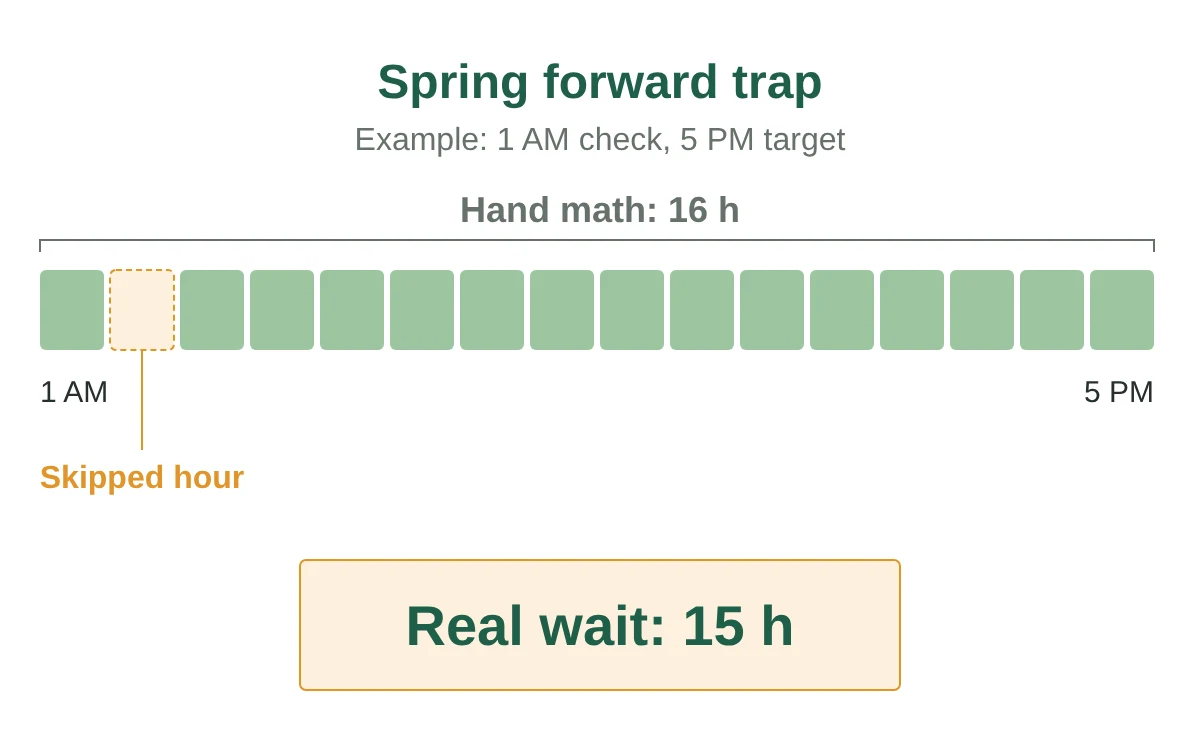
Subtracting clock times assumes every day has 24 hours. On a changeover day it does not. In the US, clocks jump forward at 2 AM in spring, so at 1 AM your hand calculation says 16 hours but the real wait is 15. In autumn the clocks fall back and the same 1 AM check is really 17 hours.
The error only affects checks made before the changeover moment. After about 3 AM on that day, plain subtraction is correct again. The live widget uses your device’s time zone rules, so it handles these days correctly, which makes it the safer answer whenever you are checking overnight or planning a long wait.
Try this: Next time clocks change, check the countdown at 1 AM and compare it with your hand result. The one-hour gap shows exactly why hand math drifts.
Why 5 PM is such a popular deadline
5 PM is the traditional end of the 9-to-5 day, which is why it shows up in contracts, courier cut-offs and “end of business” requests. Many people also use it as a school or childcare pickup anchor, and plenty of appointment systems close their final slot just before it.
Markets add their own twist. The New York Stock Exchange regular session closes at 4 PM Eastern, an hour earlier, so 5 PM is already after the bell for most traders. The foreign exchange market is different: its trading day is commonly rolled over at 5 PM New York time. Because that follows New York clocks, it moves by an hour in UTC when US daylight saving starts or ends.
Nearby countdowns worth keeping handy
If 5 PM feels too early or too late for your plans, the neighbouring hours work the same way. A wind-down check fits 4 PM, a dinner or commute plan fits 6 PM, and people who finish a half hour late can use 5:30 PM.
For relative waits, such as a shift that is a fixed length, it is easier to add than to subtract. If you clock in and work a set stretch, 8 hours from now shows the finish time directly, and 30 minutes from now suits the last stretch before a deadline. For the opposite end of the day, there is also a midnight countdown.
Frequently asked questions
How many minutes is 5 PM after midnight?
5 PM is 1,020 minutes after midnight (17 hours times 60). Subtract your own minutes-since-midnight figure from 1,020 to get the minutes left today.
How long until 5 PM tomorrow if it is already evening?
Add 24 hours to the normal subtraction. In 24-hour time, a quick version is 40 minus your hour, and 60 minus your minutes.
Does the countdown change if I travel to another time zone?
Yes, if your device updates its clock automatically. The target is always 5 PM on the clock your device is showing, so a flight west or east moves the answer with it.
Why is my hand calculation an hour off on some mornings?
A daylight saving change between now and 5 PM adds or removes an hour. This only affects checks made in the early hours of a changeover day.