
How Many Days Until March 1st?
Calendar
Countdown chart
The live countdown above gives the exact time left until March 1, down to the second, using your own clock and time zone. It measures to the first moment of March 1 (12:00 am local time), so it ends at the start of the day, not the end of it.
The rest of this page explains how to check that number by hand, where the usual mistakes come from, and how to turn the count into weeks, weekdays and a workable plan.
Why two correct sources can differ by one day
Search a few countdown sites and the answers often disagree by exactly one. The reason is a counting convention, not a bug. One method counts today as a full day and stops at the start of March 1. Another counts the gap between today’s date and March 1 and does not count today.
The live widget avoids the argument by measuring elapsed time. If it is mid-afternoon, only the part of today that remains is counted. Round that up and you get the “including today” figure. Round it down and you get the “full days between” figure. Both describe the same moment.
The day-60 shortcut
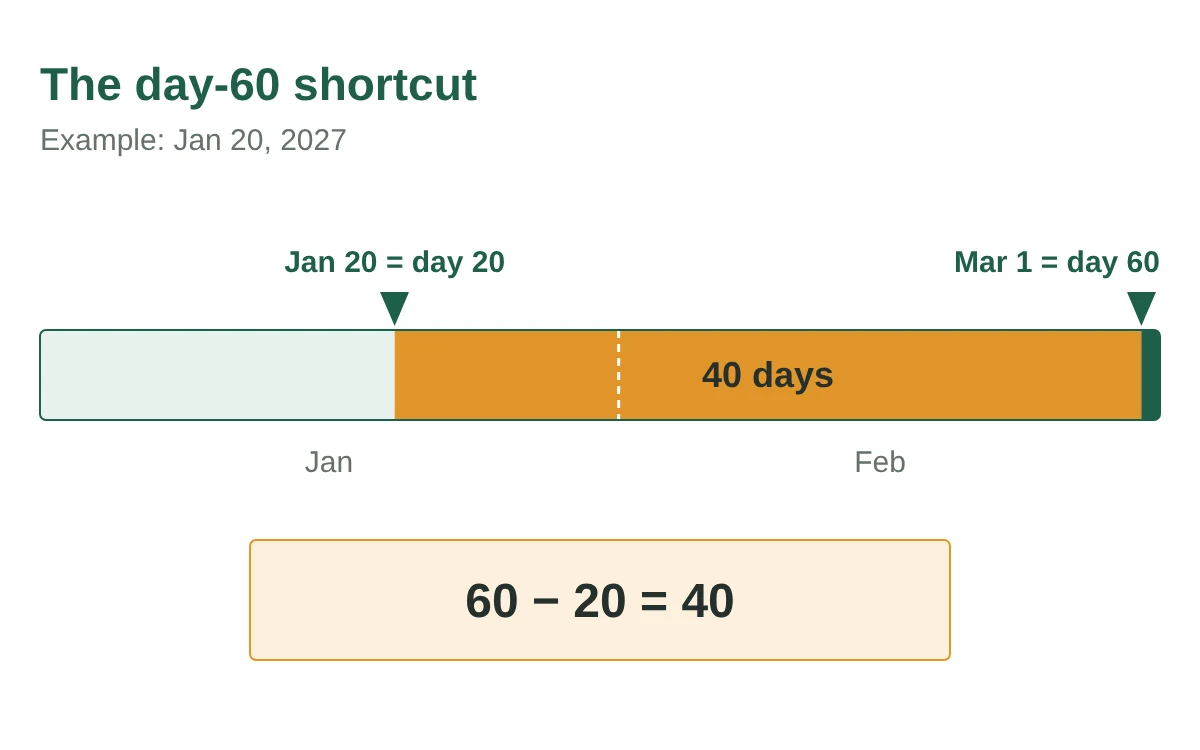
Every date has a day-of-year number, and March 1 is day 60 in a common year (31 + 28 + 1). In a leap year it is day 61. So for any start date from January 1 to February 28, the days remaining are simply 60 minus the start date’s day number.
For a start date later in the year, add the days left in that year first: 365 minus the start’s day number (366 in a leap year), then add 60 (or 61 if the coming February has a leap day). It replaces month-by-month counting with two subtractions, and it is hard to get wrong.
A worked example by hand
Take a hypothetical start of December 14 in a common year, followed by a common year. December has 31 days, so 17 days remain after the 14th. Then add all 31 days of January, 28 of February, and 1 to land on March 1.
17 + 31 + 28 + 1 = 77 days.
The shortcut agrees. December 14 is day 348, so 365 minus 348 is 17, and 17 + 60 is 77. If your two methods disagree, one has a slip, and it is usually in the month lengths.
Try this: Pick any January date, such as January 20. Calculate 60 minus its day number (20) and you get 40. Then set the date in the date calculator and see whether it matches.
The leap year trap
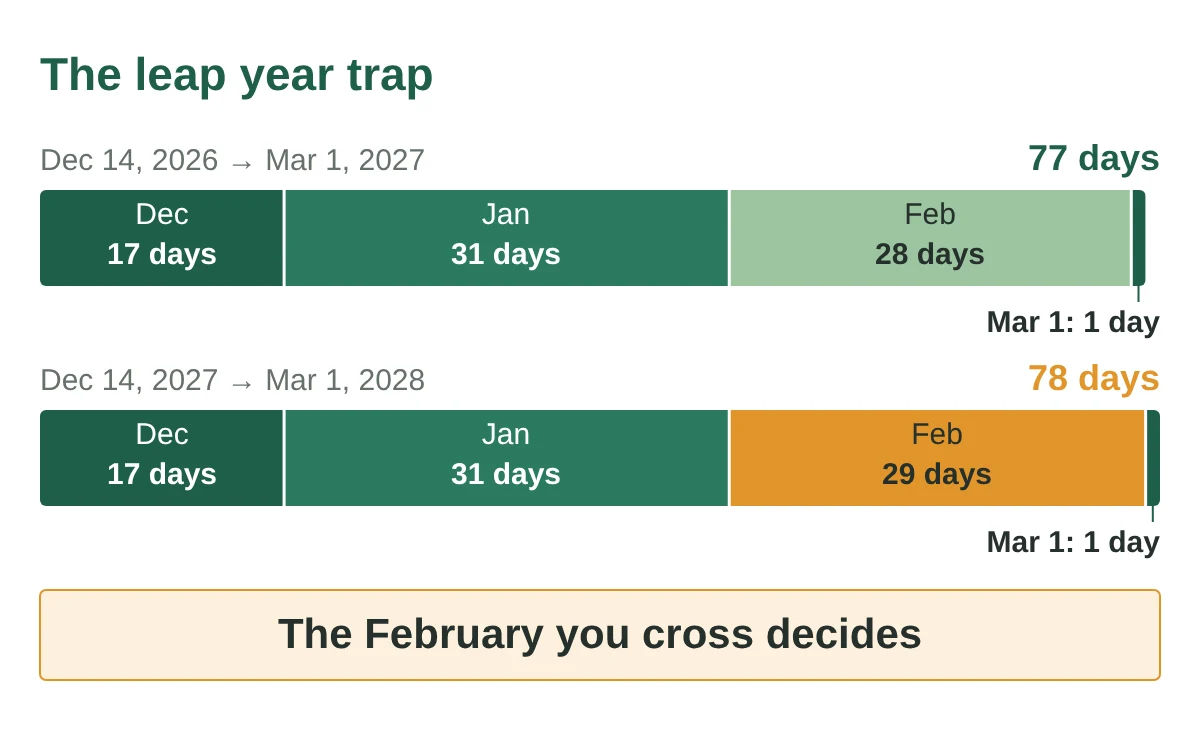
The leap day is added to the end of February, so it always sits just before March 1. The rule that decides your count is whether the February you pass through has 29 days, not whether the year you start in is a leap year. Starting on December 14 of a common year and heading into a leap year gives 78 days instead of 77.
Century years cause rare surprises. A year divisible by 100 is only a leap year if it is also divisible by 400, so 2100 will not have a February 29 even though it divides by 4. That affects counts that cross February in 2100 and no one else.
The leap day lands before March 1 for a historical reason. The early Roman calendar began its year in March, which made February the final month. Extra days were tacked on at the end of the year, and the habit stuck. It also explains why September, October, November and December are named for seventh through tenth.
Counting weeks and weekdays
Divide the day count by 7. The quotient is full weeks and the remainder is extra days. A neat consequence: if the count is a multiple of 7, March 1 falls on the same weekday as your start date. In the example above, 77 days is exactly 11 weeks, so a Monday start ends on a Monday.
For weekdays (Monday to Friday), take the full weeks times 5, then check the leftover days one by one against the calendar. Seventy-seven days from a Monday gives 55 weekdays, if you count the start day and leave out March 1. Decide that convention before you compare numbers with someone else.
Holidays are the other adjustment. A span running from late autumn to March 1 can include Christmas, New Year’s Day and, in the US, Martin Luther King Jr. Day and Presidents Day. Subtract the ones that land on weekdays and that your workplace observes.
What March 1 is known for
March 1 is the first day of meteorological spring in the Northern Hemisphere, and of meteorological autumn in the Southern Hemisphere. Meteorologists use whole months because they keep seasonal statistics tidy. The astronomical start comes with the equinox, around March 20 or 21 (see the countdown to March 21).
Several observances fall on this date:
- Zero Discrimination Day, observed by the United Nations.
- St David’s Day, the national day of Wales.
- Mărțișor in Romania and Moldova, and Baba Marta in Bulgaria, when people exchange red and white threads or charms to welcome spring.
- Samiljeol in South Korea, a public holiday marking the 1919 independence movement.
In the United States, March is also Women’s History Month. Yellowstone was established as the first national park on March 1, 1872. School, tax and application deadlines on this date vary by country and institution, so check the issuer’s own notice instead of relying on a general rule.
Clock changes and time zones
A calendar-day count is not affected by daylight saving time, but a count in hours can be. A countdown that starts before the autumn clock change will contain one 25-hour day, so the hours total is one more than days times 24. Start after that change and before March, and in the US and EU no clock change falls in the span. The spring change comes later: the US switches on the second Sunday of March, no earlier than March 8, and the EU on the last Sunday.
Time zones decide when your March 1 begins. Places far east of you reach it hours earlier, and anyone far west gets it later. If you are timing a message to someone in another zone, work out their midnight, not yours. The same logic applies to the countdown to midnight tonight, which is the same boundary on a smaller scale.
Planning around the countdown
The most useful move is to count backwards. March 1 minus 56 days (8 weeks) is January 4 in a common year and January 5 in a leap year, because February’s length shifts it. See how many days are in 8 weeks if you want other week-based checkpoints.
Break the span into blocks that end on a weekday you actually work. A final review on the last Friday before March 1 beats a deadline on a Sunday that nobody sees. If March 1 itself is the deadline, treat the last working day before it as your real one.
Try this: Write down your target start date, subtract 56 days, then subtract another 28. Those are your two checkpoints for an eight-week and a twelve-week plan, both ending on March 1.
When the date is a day you want to anticipate rather than meet, the neighbouring countdowns help. The countdown to February 28 is the last day of a common-year February, and March 2 is the day after.
Frequently asked questions
Does the countdown to March 1 include today?
The live widget counts from your current moment to midnight at the start of March 1 in your time zone, so today is not counted as a full extra day. Some sites add one day by counting today in full, which is why published numbers can differ by one.
Is March 1 day 60 of the year?
In a common year, yes: 31 days of January plus 28 of February plus 1 makes 60. In a leap year March 1 is day 61 because of February 29.
Does March 1 fall on the same weekday every year?
No. It moves forward one weekday each year, and two weekdays after a leap day has been added. The pattern repeats on a long cycle, so there is no fixed weekday to rely on.
Is March 1 the first day of spring?
It is the first day of meteorological spring in the Northern Hemisphere, which groups March, April and May together. Astronomical spring starts later, with the equinox around March 20 or 21.