
How Many Days Until May 1st?
Calendar
Countdown chart
The live counter above shows exactly how many days remain until the next May 1, calculated from your own clock and time zone. Once May 1 passes, it rolls over to the following year by itself, so you never need to reset it. To check the number by hand, take May 1’s day-of-year number (121, or 122 in a leap year) and subtract today’s.
The rest of this page covers the arithmetic behind that figure, how to turn it into weeks and weekdays, and why two countdowns sometimes disagree by a day.
The day-of-year shortcut
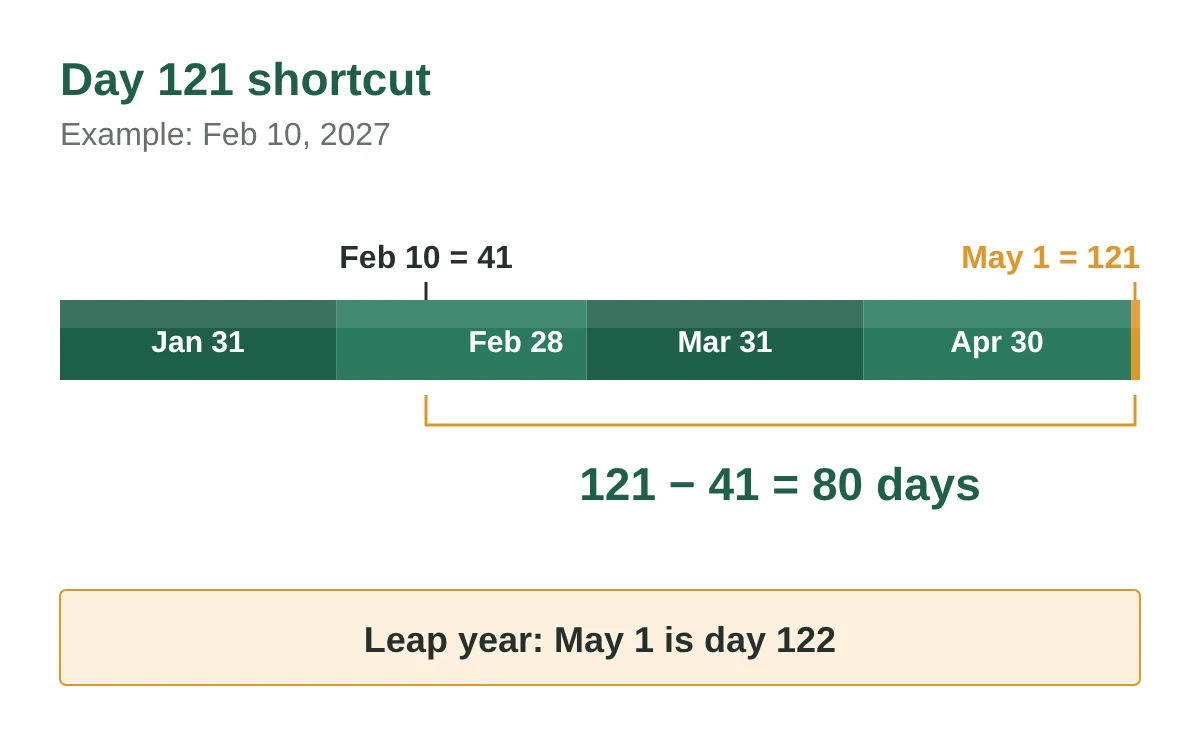
Counting month by month is slow and invites mistakes. A faster route is to treat the year as a numbered line. May 1 is day 121 in a normal year: January (31), February (28), March (31) and April (30) add up to 120, so May 1 is the next one. In a leap year it is day 122.
Find today’s day-of-year number, then subtract it from 121 (or 122 if the coming February has 29 days). If May 1 is already behind you this year, work out the days left to December 31 and add May 1’s number. A quicker version: add 365 to 121 first, then subtract today’s number.
Try this: Pick any date from last month and write down its day-of-year number using month lengths of 31, 28, 31, 30 and so on. Subtract it from 121. Check the result against the date calculator to see whether you made the usual slip of miscounting February.
A worked example with a made-up start date
Take a hypothetical start date of February 10, 2027. Its day-of-year number is 31 + 10 = 41. May 1, 2027 is day 121, because 2027 is not a leap year. The answer is 121 - 41 = 80 days.
Now verify it the long way: 18 days remain in February after the 10th, then 31 in March, 30 in April, and 1 more to land on May 1. That is 18 + 31 + 30 + 1 = 80. Both methods agree, which is a useful habit when the result will drive a deadline.
If you do not want to count at all, the month-based view is on the how many months until May page. It shows why days divided by 30 gives only a rough month figure.
Counting weeks and weekdays to May 1
Weeks are a division problem: 80 days is 11 weeks and 3 days. The leftover days are the interesting part, because they are always the final stretch before the target. In the example, May 1, 2027 is a Saturday, so the last three days are Thursday, Friday and Saturday.
That gives the weekday shortcut. Multiply the full weeks by 5, then count how many of the leftover days fall Monday to Friday. Here that is 55 + 2 = 57 weekdays, counting each day after the start date through May 1. You only need to know the weekday of May 1 itself and how many days are left over.
For a rough check, use five sevenths of the total days. Public holidays are not in that estimate, so subtract them separately. For a longer view, the weeks until June 1 page applies the same method one month further on.
Why two countdowns can differ by one
Countdown tools disagree for three reasons. First, some count today as a full day and others do not. A tool that says “including today” will show one more than a tool that measures from now to the target.
Second, May 1 starts at midnight, 00:00, in your time zone. A countdown to the start of May 1 reaches zero the moment April 30 ends, not at the end of May 1. If you care about the end of the day (a filing window, say), add one day. For the final hours, the how long until midnight page shows the clock side.
Third, time zone. The same instant is April 30 in New York and May 1 in Tokyo. A tool that runs on a server in another zone can be a day off for you. This page’s widget uses your device’s own clock, which avoids that.
What May 1 does each year
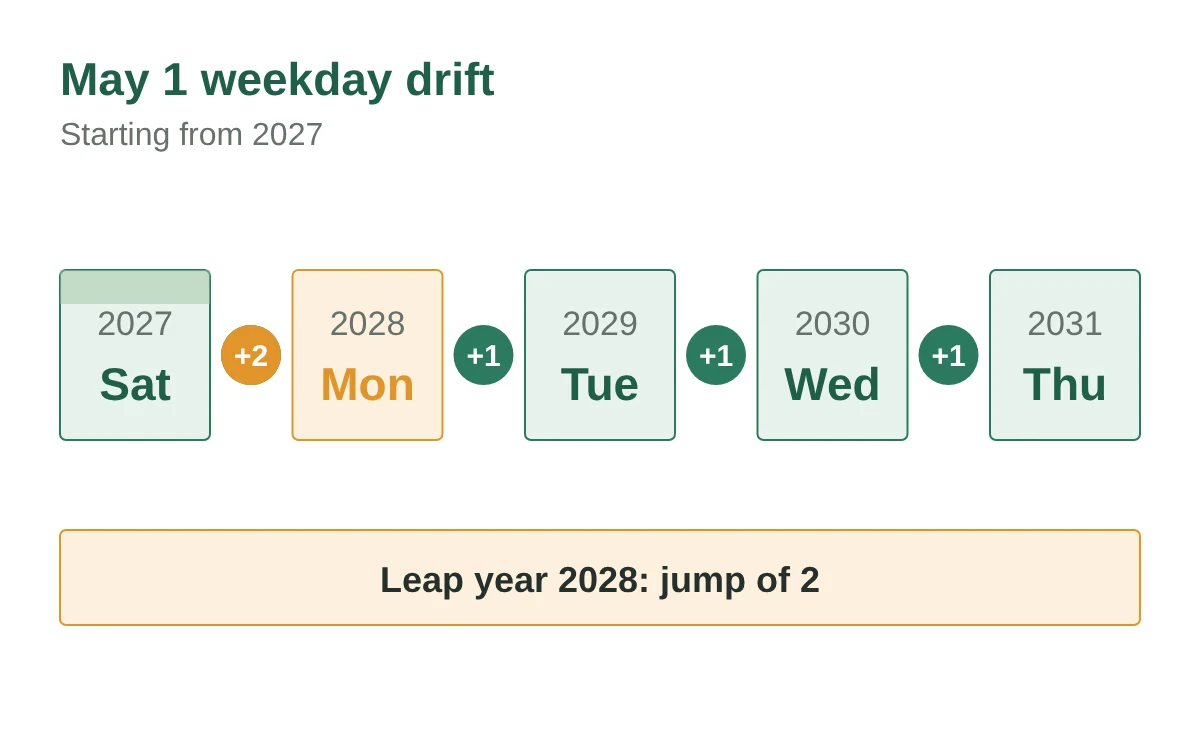
The weekday of May 1 advances by one each year, and by two when the new year is a leap year, because the extra day in February gets added in between. The pattern from 2027 looks like this:
| Year | May 1 falls on |
|---|---|
| 2027 | Saturday |
| 2028 | Monday (leap year) |
| 2029 | Tuesday |
| 2030 | Wednesday |
| 2031 | Thursday |
This matters for planning. A May 1 on a weekend means that, in countries where it is a holiday, there may be no weekday off, while a Monday gives a long weekend. The next 2027 date, May 10, 2027, sits in the second full week of May if you want a nearby anchor.
What May 1 is known for
May 1 is International Workers’ Day, observed as a public holiday in many countries. It traces back to 1886, when rallies in the United States demanded an eight-hour working day and led to the Haymarket affair in Chicago. Oddly, the United States itself marks Labor Day in September, and May 1 is not a federal holiday there. In the US it is Law Day instead, and Hawaii celebrates Lei Day.
It is also an older seasonal marker. Beltane, the Gaelic festival, traditionally falls on May 1 and marks the start of summer in the Irish tradition. In Sweden, Finland and Germany, Walpurgis Night on April 30 leads into May 1 festivities, so the evening before is often the real event.
One common mix-up: the distress call “Mayday” has nothing to do with the date. It comes from the French phrase for “come help me.” Another is the UK’s early May bank holiday, which is the first Monday of May, so it only coincides with May 1 when that date is a Monday.
Planning around the countdown
Because May 1 is a holiday in many countries, check whether your deadline lands on it before you count back. Business-day counts to a date that is itself a non-working day can lose a day. If a task needs 10 working days, 10 days from now shows the calendar date, though not the weekends and holidays you may need to skip.
Break long countdowns into checkpoints. A useful trick is to work backwards in blocks of 90 days, then 30, then 10, and the 90 days from now page helps with the first block. Seasonal tasks suit this well: garden prep, travel booking and event invitations all have lead times that are easier to schedule against a fixed May 1.
Try this: Take the live day count and divide it by 7. Write the whole-number result as your number of Sundays-to-plan-with, and put one checkpoint on the calendar at each quarter of the way there.
If May 1 is just the start of something, nearby dates may help. The May 2 and May 5 pages cover the days right after.
Frequently asked questions
How many days until May 1?
The live counter at the top of this page gives the exact figure on your own clock and time zone. By hand, subtract today's day-of-year number from 121 (or 122 if the coming February has a 29th), and add 365 or 366 if May 1 falls in next year.
Is May 1 a public holiday?
In many countries it is, usually as Labour Day or International Workers' Day. It is not a US federal holiday. The UK's early May bank holiday falls on the first Monday of May, which is often not May 1.
What day of the week is May 1 each year?
The weekday moves forward one day per year, or two when the year is a leap year. May 1 is a Saturday in 2027, a Monday in 2028, a Tuesday in 2029 and a Wednesday in 2030.
How many business days are there until May 1?
Multiply the full weeks by 5, then count the weekdays among the leftover days. Subtract any public holidays in your country, and remember that May 1 itself is a holiday in many places.