
How Many Days Until August 25th?
Calendar
Countdown chart
The number of days until August 25 is shown by the live countdown above, calculated from your own clock and time zone. It always targets the next August 25 that has not yet started, so it rolls over to the following year on its own once the date passes.
The rest of this page covers what the widget cannot: how to check the count by hand, how to turn it into weeks and working days, and what the date is known for.
Why the countdown can differ from another site’s number
Two countdowns to the same date can disagree by one day for entirely legitimate reasons. The first is the finish line. This countdown ends at 00:00 on August 25 in your time zone, so on the morning of the day itself it already reads zero. A tool that counts to the end of the day will show one more.
The second is the start. If you open a page at 11 p.m., some tools count from the current date and ignore the hour, so they behave as if it were already midnight. A live clock does not. If you want a whole-day figure that matches a wall calendar, read the day count and ignore the hours beside it.
Counting by hand with a worked example
Take a hypothetical start of March 10, 2027. First count what is left of the starting month, then add the full months, then add the day of the target month.
- Rest of March after the 10th: 21 days
- April: 30, May: 31, June: 30, July: 31
- August up to the 25th: 25
The total is 21 + 30 + 31 + 30 + 31 + 25 = 168 days. The pattern is the same from any start date: days left in the current month, plus every whole month in between, plus 25. The only trap is the lengths of February, April, June, September and November, so write them out instead of trusting memory.
Try this: Pick any date in the next few weeks, count to August 25 using the month-by-month method, then compare it with the date calculator. If they differ, the gap is almost always a month you counted as 31 days instead of 30.
The day-of-year shortcut
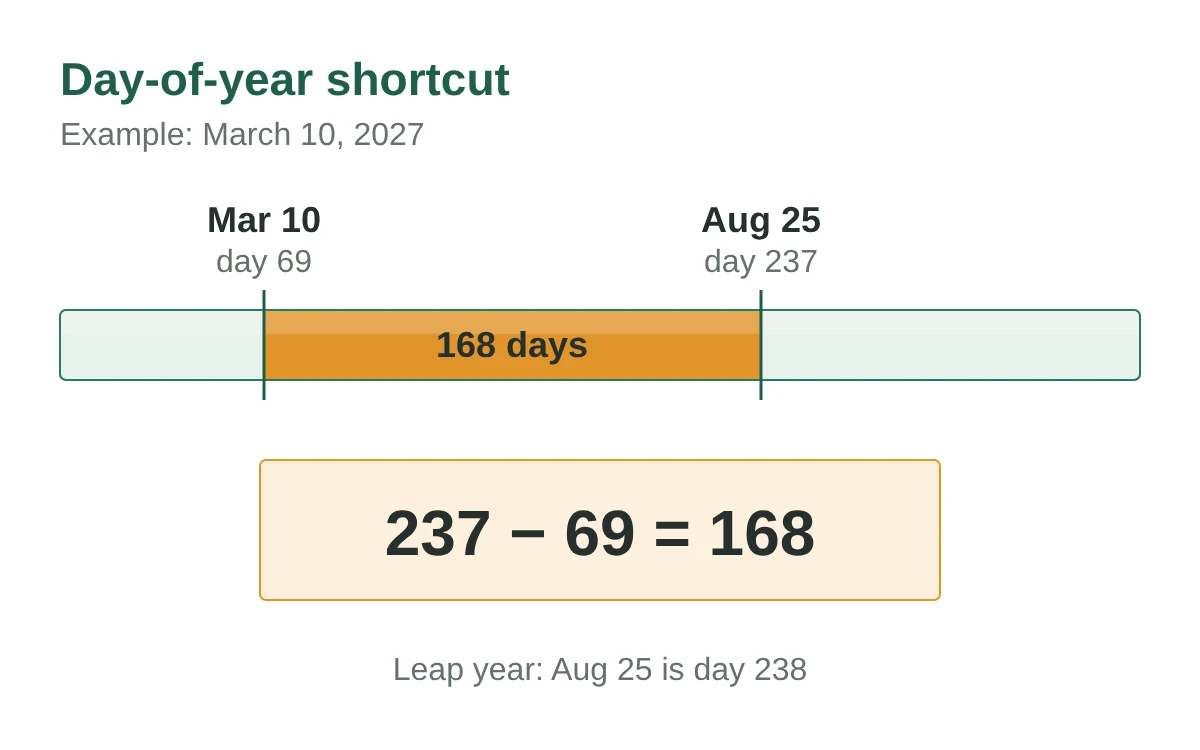
A faster method removes the month arithmetic. August 25 is day 237 of a common year (238 in a leap year). If you know your start date’s day-of-year number, subtract it from 237 and you are done.
For the same hypothetical March 10, 2027, the day number is 31 + 28 + 10 = 69. Then 237 - 69 = 168, matching the longer method. You only need to memorize a few anchors: the 1st of each month falls on day 1, 32, 60, 91, 121, 152, 182 and 213 for January to August in a common year. Add one to every anchor after February in a leap year.
The same number tells you how much of the year is left afterward: 365 - 237 = 128 days in a common year. That is a quick way to size the stretch between your date and year-end.
Counting weeks and weekdays
Divide the day count by 7. The whole number is the weeks, the remainder is the leftover days. In the example, 168 days is exactly 24 weeks, which means the start and finish fall on the same weekday. Whenever the remainder is zero, you can read the target weekday straight from your start date.
Working days need one extra step. Multiply the full weeks by 5, then walk through the leftover days one at a time and skip Saturdays and Sundays. Do not simply multiply the total by 5/7, because that gives a fraction when the leftover days straddle a weekend. Public holidays between now and then are not removed from any simple weekday count, so subtract those separately for your country. For a conversion table you can reuse, see how many days are in 8 weeks.
Which weekday August 25 lands on
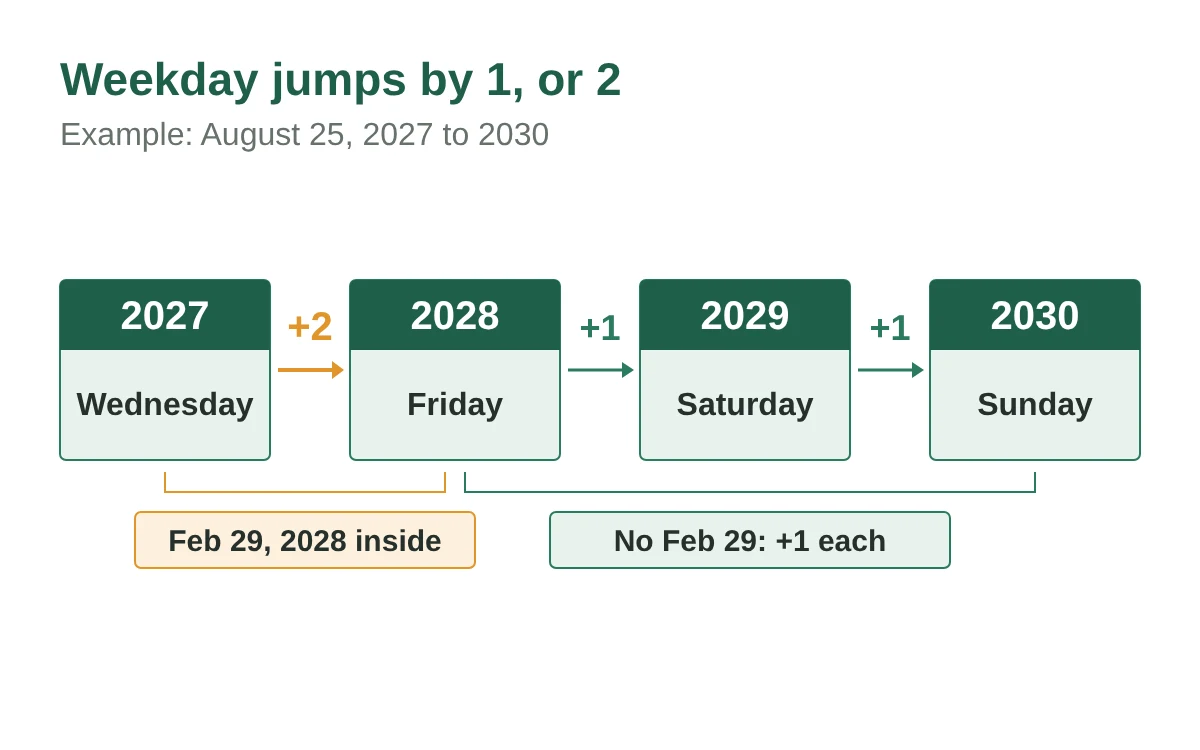
The weekday of a fixed date moves forward by one each year, and by two when a February 29 falls in between. That gives Wednesday in 2027, Friday in 2028 (the jump of two comes from the 2028 leap day), Saturday in 2029 and Sunday in 2030.
This matters for planning. A Saturday or Sunday date means any deadline tied to it, such as a booking, a delivery or a first day of term, usually lands on the nearest weekday instead. If your event is fixed on the 25th, check the weekday for the specific year before committing to a schedule.
What August 25 is known for
In Uruguay, August 25 is Independence Day, marking the 1825 declaration of independence from Brazil. It is a fixed-date public holiday, so it does not shift to a Monday. Some historians argue the date does not match the true moment of independence, since the formal settlement came later in the 1820s, but the 25th is the day the country keeps.
In the United States, August 25 is the anniversary of the National Park Service, created in 1916. The agency celebrates its birthday each year, and fee-free entrance has been offered on the date in some anniversary years, so check the park service’s own announcements before you plan a visit around it. It is an observance, not a federal holiday.
The Islamic holiday Mawlid fell on August 25 in 2026, but it follows the lunar calendar and drifts roughly 11 days earlier each year, so it will not sit on this date in later years. The many light-hearted “National Banana Split Day” style listings are informal observances and vary by source.
Seasonally, August 25 sits in the last week of meteorological summer in the Northern Hemisphere, a week before September 1 and about four weeks before the autumn equinox. For the next milestone after it, see how many days until September 1st.
Planning around the countdown
Break the wait into checkpoints that are measured in weeks, not days. A date that is many weeks out is easier to manage with a repeating rhythm: pick the same weekday each week for a check-in. Because August 25 is not fixed to a weekday, choose the checkpoints by counting backward from it, not forward from today.
Work backward in useful chunks. Four weeks out suits bookings and ordering. Two weeks out suits confirmations. One week out suits a final check. If you are comparing it with nearby dates, the neighboring countdowns for August 24th and August 27th are one click away.
Try this: Take the day count from the widget and divide it by 4. Mark each quarter point on your calendar as a check-in. You get four review dates, evenly spaced, with no extra counting.
Mistakes that throw the count off
The classic error is the fencepost problem: counting both the start and end dates. From the 1st to the 3rd is two days elapsed, not three. Decide up front whether you want elapsed days, which is what a countdown shows, or inclusive days, which is what an event schedule often needs, and add one only for the latter.
Another is using a fixed 30 days for each month, which drifts by up to five days over a half year. A third is forgetting time zones when the event happens somewhere else. Uruguay is on UTC-3 all year with no daylight saving, so it is one hour ahead of New York in summer but two hours ahead in winter. If your date involves a remote event, convert the clock time too.
For a wider view of the month, how many days until August shows the countdown to its first day, and the all date countdowns index covers every other date.
Frequently asked questions
What day of the week is August 25?
It changes every year. August 25 falls on a Wednesday in 2027, a Friday in 2028, a Saturday in 2029 and a Sunday in 2030. The weekday moves forward one step each year, and two steps when a leap day sits between the two dates.
Is August 25 a public holiday?
In Uruguay, yes: it is Independence Day and stays on the fixed date. In the United States it is National Park Service Founders Day, an observance rather than a public holiday, so offices and schools run as normal.
What number day of the year is August 25?
It is day 237 in a common year and day 238 in a leap year. That leaves 128 days in the year after it in a common year, or 128 in a leap year too, because the extra day sits earlier in the count.
Does the countdown reach zero at midnight or at the end of August 25?
The live widget counts to the start of the date, 00:00 on August 25 in your own time zone. If you care about the end of the day, add 24 hours to what the widget shows.