
How Many Days Until February 13th?
Calendar
Countdown chart
The live counter above gives the exact time left until February 13th, calculated from your own clock and time zone. The next one is Saturday, February 13, 2027. The rest of this page covers how to check the number yourself and the details that make counts to this date go wrong.
February 13 sits one day before Valentine’s Day, which gives it an unusual role. It is a deadline for some people and a celebration for others. The sections below cover both uses.
What the live count actually measures
A countdown to a date really counts to a moment: midnight at the start of February 13 in your time zone. That is why the number reads differently depending on the hour you check. At 9 pm you may see a count that ends in a few hours past a whole day, and the headline figure is the number of full days before that midnight.
The consequence is that “days until” and “days including the day itself” differ by one. Counting to the start of the date means February 13 is not a day remaining, only the day you are waiting for. If you need to plan around the whole day, such as an event that runs from morning to night, the count to the start is the figure to use. For a deadline at 11:59 pm, you have one more day than the countdown suggests. The page on how long until midnight covers that boundary in detail.
Counting it by hand with a worked example
Take a hypothetical start date of November 10, 2026. Count the days left in that month, then add whole months, then the day of the target month.
- Rest of November: 30 minus 10 is 20
- December: 31
- January: 31
- February up to the 13th: 13
The total is 95 days. A quick check: November 10 to December 10 is 30 days, then 31 more to January 10, 31 more to February 10, and 3 more to the 13th. That also gives 95.
The usual mistake is counting both ends. If you list the dates from November 10 through February 13 you get 96 entries, but only 95 days passed between them. To check any figure like this, use the date calculator, which handles the month lengths for you.
Day 44: a shortcut that skips the month maths
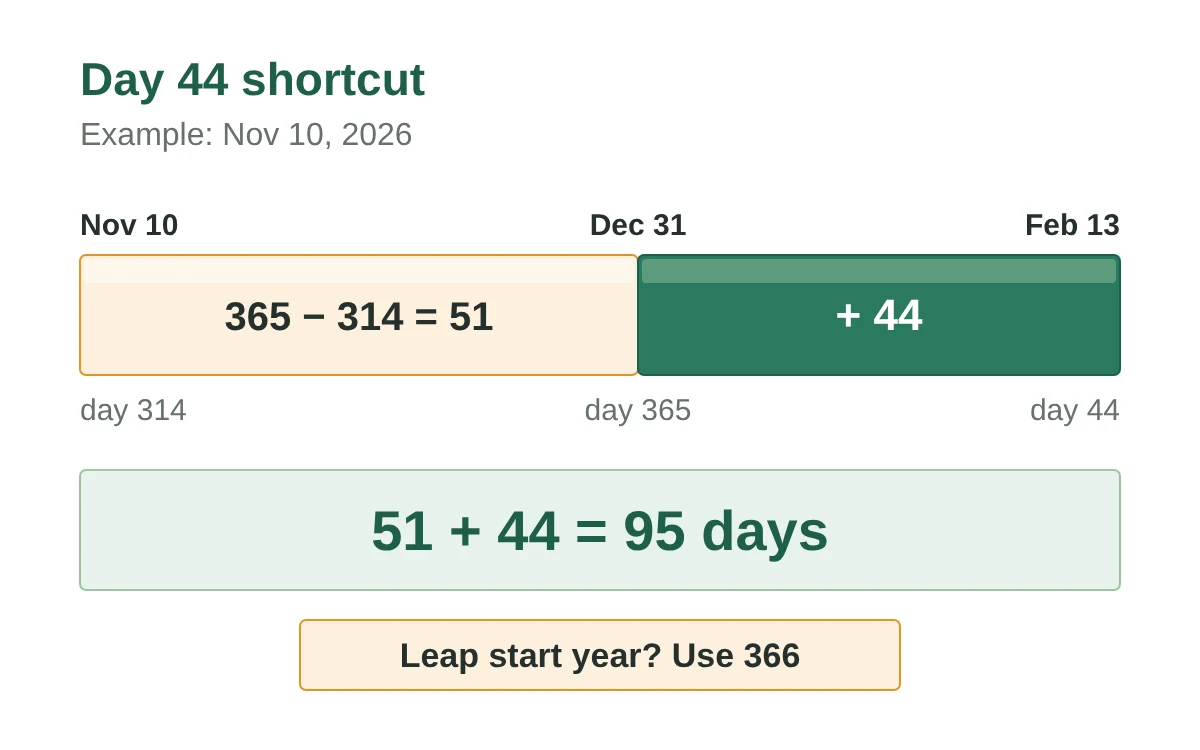
February 13 is day 44 of the year in every year, because January has 31 days and February 13 is 13 days further on. Leap years do not change this, since February 29 comes after the 13th. That makes a one-line method possible: days left equal the days in the start year, minus the start date’s day number, plus 44.
Using the same hypothetical start of November 10, which is day 314 of a non-leap year: 365 minus 314 is 51, and 51 plus 44 is 95. It matches. The method is faster when the start is in autumn, because you only need the day number of one date. The one trap is the year length: use 366 if the start year is a leap year.
Try this: Pick any date this autumn, look up its day number, then work out the days to February 13 with the formula. Check it against the live counter’s figure for that date.
Weeks and weekdays to February 13th
Dividing by 7 gives weeks and a remainder. In the worked example, 95 days is 13 weeks and 4 days. For the weekday count, do not multiply by 5/7 and round, because that is only an estimate. Instead, multiply the whole weeks by 5, then count the weekdays in the leftover days by name.
Here the starting day is a Tuesday, so the count begins on Wednesday, November 11. Thirteen weeks cover 65 weekdays. The leftover days are Wednesday, Thursday, Friday and Saturday, which add 3 more, and the Saturday adds nothing because it is the target. That makes 68 weekdays. To convert the weeks to days the other way round, see 8 weeks to days.
Public holidays are a separate issue. A weekday count does not remove them, so subtract any holidays that fall in your window if you are counting working days.
Why the weekday keeps moving
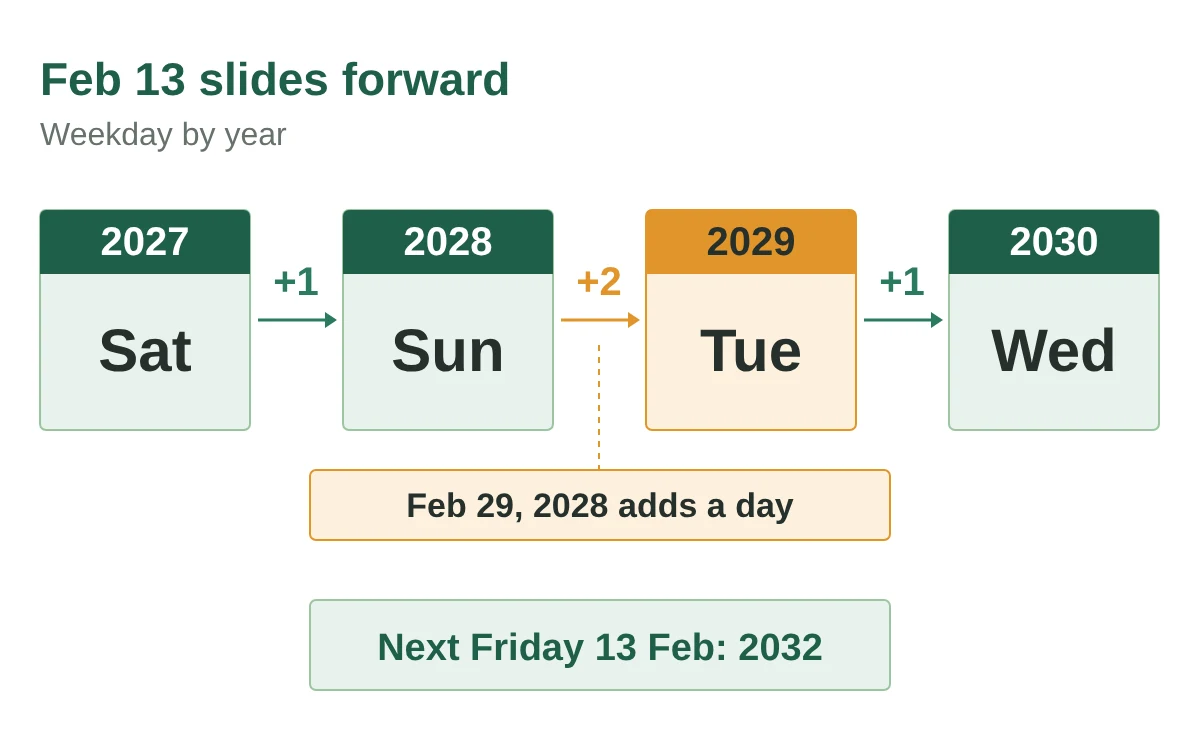
February 13 moves forward one weekday each year, but jumps two after a leap year, because February 29 is added after the 13th. So 2027 is a Saturday, 2028 a Sunday, then 2029 skips Monday and lands on Tuesday. 2030 is a Wednesday.
This explains a pattern with Friday the 13th. February 13 fell on a Friday in 2026, and the next time is 2032, then 2037. Gaps of 6, 5 and 11 years are the standard rhythm of the 28-year calendar cycle. If you want to see how far away the next February 13 is from a particular year, the leap-year jump is the part to watch.
What February 13th is known for
It has no national holiday in the United States, but it carries plenty of observances. The Roman festival of Lupercalia was held from February 13 to 15, and Parentalia, honouring ancestors, began on February 13. Both are among the ancient February rites that lie behind Valentine’s Day timing.
In modern use, February 13 is World Radio Day, an observance proclaimed by UNESCO. It is also known as Galentine’s Day, a celebration of friendship that was invented in the TV show Parks and Recreation and has since become a real event. In 2027, it also sits one day before Valentine’s Day on a Sunday, which is followed by Presidents’ Day on Monday, February 15 in the United States.
Planning backwards from the date
The useful way to plan a countdown is to work backwards from the target date, not forwards from today. For a Saturday event, the Friday before is often the last practical day for deliveries, so set your real deadline there. A 10-day mark is a good checkpoint for anything that needs to be ordered or posted. The 10 days from now page shows what a date ten days out looks like.
Three-day weekends cost more and book earlier. In 2027, Valentine’s Day on a Sunday plus the Monday holiday means restaurants and short trips that weekend fill sooner than usual. Setting a booking reminder about a month ahead is a safer bet than waiting for the last fortnight. For a similar countdown to a nearby date, try days until February 28.
Try this: Choose the Friday before February 13 as your real deadline, then set reminders at 30 days, 14 days and 3 days before it.
Time zones and clock changes
Because the target is midnight on your clock, people in different places reach February 13 at different moments. The gap between the first and last time zones to reach a date is 26 hours. Someone in Auckland is already in February 13 while someone in Honolulu is still in February 12. If you are counting toward a shared event, such as a call or a livestream, use the time zone of the event, not your own.
Clock changes can also alter the hour count. From late November to February 13, North America and Europe have no change, so the hours equal the days times 24. If you start the count before the autumn change, which falls in late October in Europe and early November in the US, the span includes one 25-hour day. The count of days is unaffected, but the hour total is one higher.
Frequently asked questions
What day of the week is February 13th?
It depends on the year. February 13, 2027 is a Saturday, 2028 is a Sunday, 2029 is a Tuesday and 2030 is a Wednesday. The weekday moves forward one step a year, or two after a leap year.
Does the countdown include February 13th itself?
The live count runs to the start of February 13 on your own clock, so the day itself is not counted as a day remaining. When the number reaches zero, the date has arrived.
How many weekdays are there until February 13th?
Multiply the number of whole weeks by 5, then add the weekdays in the leftover days. Remember that February 13, 2027 is a Saturday, so the target day adds nothing to the weekday total.
Is February 13th a public holiday?
No, it is not a federal holiday in the United States and has no national day off in most countries. In 2027 it falls on the Saturday of Presidents' Day weekend in the US, which makes it part of a three-day weekend.