
How Many Days Until February 6th?
Calendar
Countdown chart
The live widget above counts the exact time left until the next February 6 using your own device clock and time zone, so it is the number to trust. This page explains how that number is built, how to verify it by hand, and the places where two correct-looking answers can differ.
Because February 6 recurs every year, “next February 6” always means the first one that has not yet started in your time zone. Once the date arrives, the countdown rolls forward to the following year.
Count it by hand in under a minute
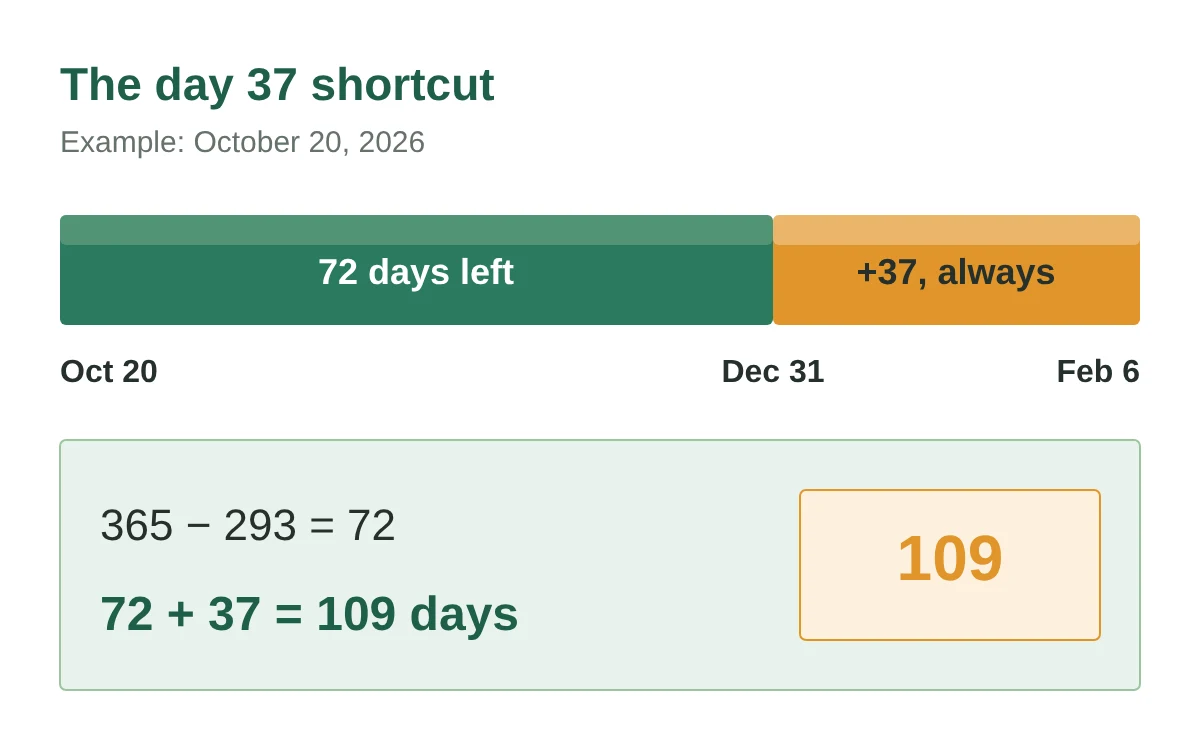
The classic method adds up the leftover days of the current month, every full month in between, and then 6. A faster route uses the fact that February 6 is always day 37 of the year: take the days left in the current year and add 37.
Here is a worked example with a hypothetical starting date of October 20, 2026:
- October 20 is day 293 of the year (273 days through September, plus 20).
- A common year has 365 days, so 365 minus 293 leaves 72 days to December 31.
- Add 37 to reach February 6: 72 + 37 = 109 days.
The month-by-month method agrees: 11 days left in October, plus 30 for November, 31 for December, 31 for January and 6, which is 109. Running both methods is a cheap error check.
Why February 6 never lands on the same weekday
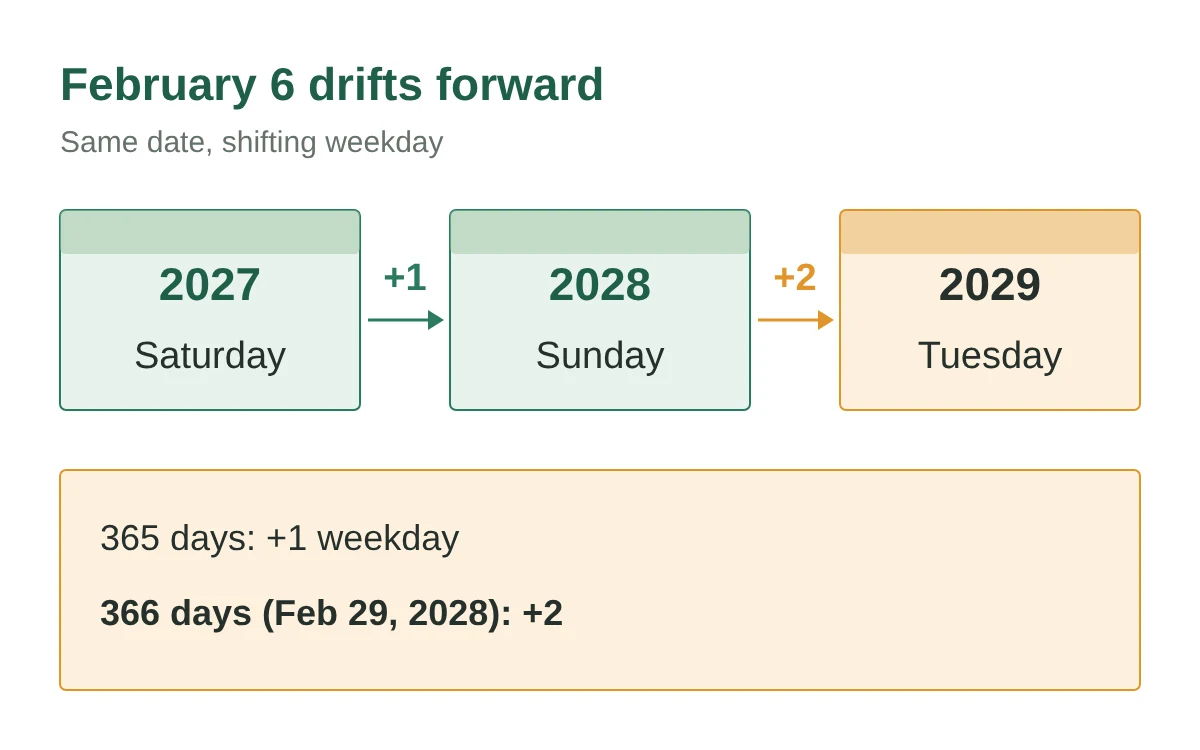
The weekday of February 6 advances by one each year, or by two when a leap day sits between two occurrences. It shifts forward by 1 day each year (or 2 days after a leap year). The gap between February 6 of one year and the next is 365 days, except when the following February 29 falls in between.
- 2027: Saturday
- 2028: Sunday
- 2029: Tuesday (the leap day of 2028 causes the double step)
One edge case catches people out: leap day only matters for the span if your start date falls between February 7 and February 29 of a leap year. Start on any other day and the count to the next February 6 is untouched by it.
Counting weeks and weekdays
Divide the day count by 7: the quotient is full weeks and the remainder is loose days. In the example above, 109 days is 15 weeks and 4 days. For a quick conversion between weeks and days, see how many days are in 8 weeks.
For weekdays, multiply the full weeks by 5, then count the weekdays among the leftover days. Counting from the day after October 20 (a Tuesday), the example gives 15 × 5 = 75, plus 3 weekdays in the last four days, for 78. Calendar-day and weekday counts diverge by about 30 percent, and neither one subtracts holidays. December 25 and January 1 would each remove another working day from that example.
Try this: Pick any date six weeks out and say its weekday aloud before checking. Remainders of 1 to 6 days after a full-week count shift the weekday forward by exactly that many, which makes weekday prediction nearly instant.
What February 6 is known for
The headline observance is Waitangi Day in New Zealand. It marks the signing of the Treaty of Waitangi in 1840. It became a nationwide public holiday in 1974 after a short period under the name New Zealand Day. Since 2013 the holiday has been “Mondayised”: the public holiday is observed on the following Monday if 6 February falls on a Saturday or Sunday.
That rule matters for planning. In 2027 (Saturday) and 2028 (Sunday), New Zealand workplaces and schools get the Monday off instead.
Other dates attached to February 6, for context:
- Sámi National Day, marked in Norway, Sweden, Finland and Russia
- Ronald Reagan Day in the United States, honouring his 1911 birth
- The anniversary of Queen Elizabeth II’s accession in 1952
None of these are federal or bank holidays in the US or UK, so a February 6 deadline there is a normal business day when it falls on a weekday.
Planning around the date
Early February is often close to the Super Bowl. It has been the second Sunday in February since Super Bowl LVI. If February 6 falls on a Saturday, that second Sunday is the very next weekend, which is worth knowing before booking venues or travel.
February 6 also sits just after month-end deadlines of January 31, so projects with “end of January” targets often slip right up to it. The days between are a handy buffer. For neighbouring dates, see the countdowns to February 1 and February 7, or the broader days until February page.
Try this: Set a checkpoint at the halfway day. Divide your total count by 2 using the live widget’s number, add that to today, and put it in your calendar as a progress review.
The time zone trap
A countdown to “February 6” means midnight at the start of that date, in a specific place. Auckland runs on UTC+13 in February, so Waitangi Day starts there roughly 18 hours before it starts in New York and 21 before Los Angeles. If you are counting to an event in New Zealand, February 6 has already begun in Auckland while it is still February 5 for you.
The widget uses your device’s zone. To count to a different location’s midnight, adjust by the offset difference, or use the date calculator for explicit start and end dates.
Why different sites give different answers
Counts can legitimately differ by one. Some tools count today as a full day, others stop at the start of February 6, and some round hours up. Whether the answer is “N days” or “N days and some hours” also depends on the time of day you check. Add or subtract one day depending on whether you want to include the target day itself, and keep the same convention when you compare counts across several dates, as on the all date countdowns hub.
Frequently asked questions
How many days until February 6?
The live countdown above the article gives the exact figure for your own clock and time zone. To check it by hand, add the days left in this month, the full months between, and 6.
What day of the week is February 6 in 2027?
February 6, 2027 is a Saturday. It then moves to Sunday in 2028 and jumps to Tuesday in 2029, because 2028 is a leap year.
What day of the year is February 6?
It is always day 37, in leap years and common years alike. Leap day comes later in the month, so it never shifts this date.
Is February 6 a public holiday?
In New Zealand, yes: it is Waitangi Day. In most other countries it is an ordinary day, though it carries a few smaller observances such as Sámi National Day.