
How Many Days Until February 1st?
Calendar
Countdown chart
The live counter above gives the exact answer for your own clock and time zone, and it updates as the day turns over. If you want to check it by hand, use one fixed number: February 1 is always day 32 of the year, so the remaining days are 32 minus today’s day number (or the rest of the year plus 32, once January has passed).
The rest of this page covers the details that make hand counts go wrong: whether today is included, how to turn days into weeks and weekdays, why the weekday of February 1 shifts the way it does, and which observances and deadlines sit on this date.
Why two sites can give different answers
The most common gap is a one-day difference, and it has nothing to do with arithmetic. A countdown to “February 1” normally targets 00:00 at the start of that date. Until then the clock is running toward the date, so the day you are standing in is not counted. A static calculator often counts calendar days inclusively, treating today as day one, and reports a number that is one higher.
Neither is wrong. They answer different questions: “how many midnights until it starts” versus “how many calendar squares are involved”. Pick the one that matches your purpose. For a deadline that ends at the close of February 1, inclusive counting is safer. For waiting for something that begins that morning, use the exclusive count.
Time zones add a second source of drift. A page that counts in UTC will tick over at a different hour than your local midnight, so for several hours each day it can disagree with your wall calendar.
The day-of-year shortcut
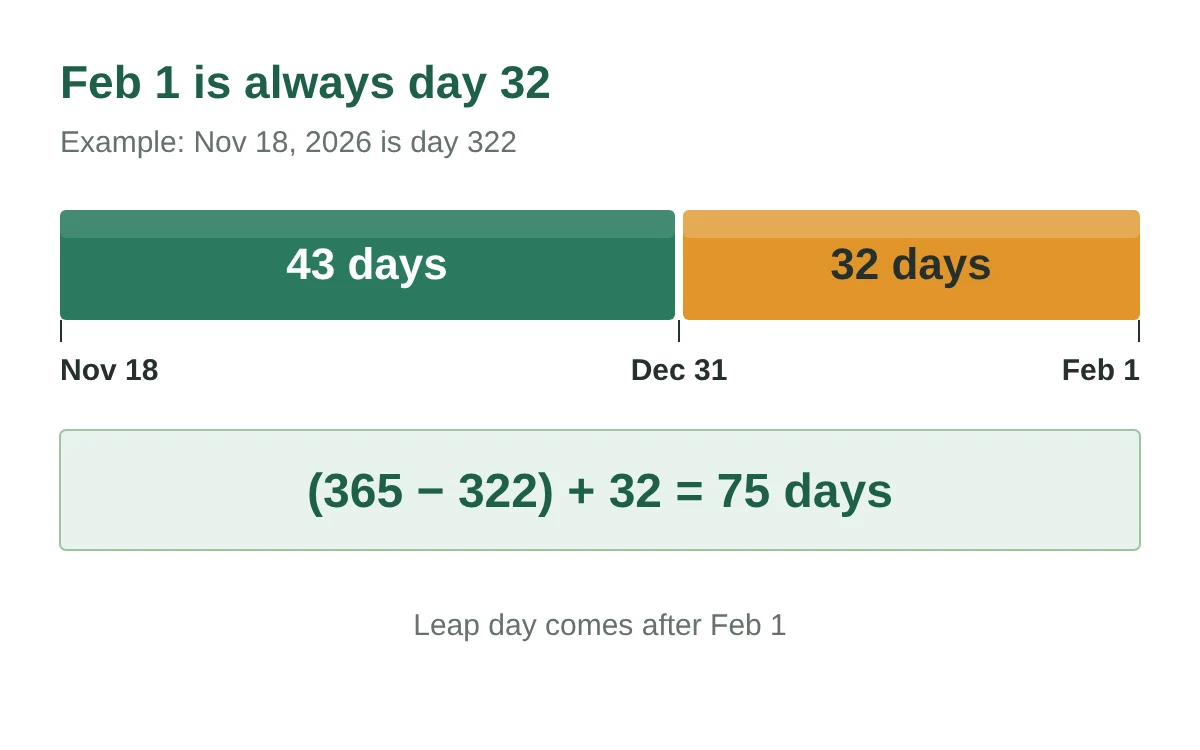
January always has 31 days, so February 1 is the 32nd day of the year in every year, leap or not. The leap day sits at the end of February, after the target, so it never touches this date. That fixed anchor gives you a one-line formula.
If you are still before February 1 this calendar year: days remaining = 32 minus today’s day number. If you are past it: days remaining = (365 minus today’s day number) plus 32, using 366 in place of 365 when the current year is a leap year and you are already past February 29.
Day numbers are easy to estimate by month. Cumulative days at the end of each month are 31, 59, 90, 120, 151, 181, 212, 243, 273, 304, 334 and 365. Add the day of the month to the previous month’s total and you have your number.
A worked example by hand
Take a hypothetical starting date of November 18, 2026. The month-by-month method works in four steps:
- Days left in November: 30 minus 18 = 12.
- Add all of December: 12 + 31 = 43.
- Add all of January: 43 + 31 = 74.
- Add 1 to land on February 1: 75 days.
Check it with the shortcut. November 18 is day 322 (304 plus 18). Then 365 minus 322 is 43, plus 32 is 75. Both methods agree. Running two methods is the cheapest way to catch a miscounted month.
For a calculation between any two dates, including ones that span a leap day, the date calculator does it without the bookkeeping.
Counting weeks and weekdays
Dividing by 7 gives weeks plus leftover days. In the worked example, 75 days is 10 weeks and 5 days. The leftover matters more than people expect, because it tells you the weekday of the target: starting on a Wednesday, 5 extra days lands on a Monday, which is correct for February 1, 2027.
For weekdays, count the full weeks first (5 weekdays each), then check only the leftover days. Here that is 50 weekdays from the full weeks, plus 3 from the leftover Thursday, Friday, Saturday, Sunday and Monday. That makes 53 working days if February 1 counts, 52 if it does not. Subtract public holidays that fall on weekdays, such as December 25 and January 1, to get true working days.
Try this: Pick any date from now to February 1. Divide the day count by 7, note the remainder, and step forward that many weekdays from today’s weekday. If you do not land on the weekday of February 1, recount.
The weekday of February 1 shifts in a pattern
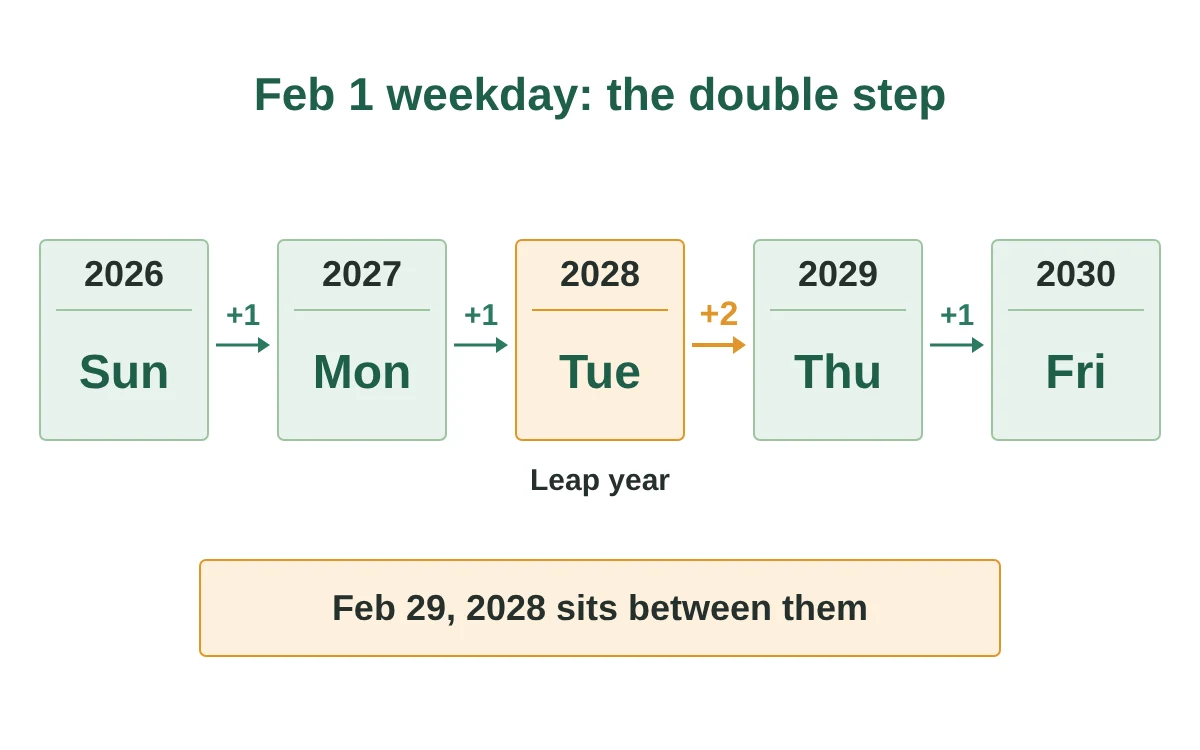
February 1 normally moves forward one weekday each year. After a leap year it moves two. The reason is where the leap day falls: the gap between February 1 of one year and February 1 of the next includes February 29 only when that leap day sits between them, which means the jump of two happens after February 1 of the leap year itself.
February 1, 2027 is a Monday, 2028 is a Tuesday, 2029 is a Thursday, and 2030 is a Friday. Notice that 2028 to 2029 is the double step. This also means February 1 and March 1 share a weekday in common years but not in leap years, which is why a month-start calendar for February looks so tidy in a non-leap year.
If you are also planning toward the end of winter, the March 1 countdown is the natural companion count.
What February 1 is known for
In the United States, February 1 is National Freedom Day, an observance that commemorates the signing of the 13th Amendment, which abolished slavery in 1865. It is an observance rather than a federal holiday, so offices and schools stay open. It is also the first day of Black History Month in the US, per the national observance listings.
Seasonally, Imbolc is marked on February 1 in Ireland and the UK, a traditional Celtic date at the midpoint between the winter solstice and the spring equinox. In Ireland it is tied to St Brigid’s Day, now a public holiday. Groundhog Day follows the next day, February 2.
In 2027, Lunar New Year falls shortly after: Saturday, February 6. The date moves every year, so a countdown to February 1 is a useful early marker if you are planning travel or family gatherings around it. A one-week step further is the February 7 countdown.
Deadlines that cluster around the 1st
Month starts attract due dates: rent, subscription renewals, insurance premiums and utility cycles often reset on the 1st. Because it lands on a Monday in 2027, anything due “by the first” effectively has to be settled the previous Friday if you are paying by a method that does not process on weekends.
January 31 deadlines also matter. When the 31st falls on a weekend, as it does in 2027 (a Sunday), many filings tied to it, such as year-end tax forms in the US, normally roll to the next business day. That makes February 1 the practical date in 2027, though you should confirm against the issuing agency, because rollover rules differ by form and country.
Planning backwards from February 1
Counting down is most useful when you convert it into milestones. A date that is a whole number of weeks away is easier to schedule than a raw day count: 8 weeks is 56 days, which you can check on the 8 weeks to days page, and 12 weeks is 84 days.
Work backward from February 1 in 7-day blocks and give each block one task. The week boundaries keep their weekday, so a Monday deadline always has Monday checkpoints, which makes recurring habits and review meetings simple to set up. Month-based goals are harder to divide evenly; if you want to anchor the plan to the start of the year first, see the January 1, 2027 countdown.
Try this: Write February 1 at the top of a page. Step back in 7-day blocks until you reach today, label each block with a Monday date, and assign each a single task.
If you only need the nearest weekday rather than the full countdown, the days until Friday page covers that kind of short-range count.
Frequently asked questions
Does the countdown to February 1 include today?
The live countdown runs to the first moment of February 1 on your own clock, so it does not count February 1 itself. Many static pages add today as a full day, which is why two sites can differ by one. Decide whether you want days remaining or days inclusive before comparing numbers.
What day of the week is February 1 in 2027?
February 1, 2027 is a Monday. In 2028 it moves to Tuesday, then jumps two days to Thursday in 2029 because of the February 29 in 2028.
Is February 1 always the 32nd day of the year?
Yes. January has 31 days in every year, so February 1 is day 32 in both common and leap years. The leap day comes later in the month, so it never affects this date.
Is February 1 a public holiday?
Not in the United States, where it is an observance (National Freedom Day) and the start of Black History Month. In Ireland, St Brigid's Day is a public holiday on the first Monday of February, or on February 1 itself when it falls on a Friday.