
How Many Days Till February?
Calendar
Countdown chart
The exact number of days until February is shown by the live countdown above, which reads your own clock and time zone. The target is the first instant of February 1, which is midnight at the end of January 31, so the number is the count of whole days between your current date and that moment.
If you want to check it yourself, or see why two sites can disagree by a day, the sections below cover the arithmetic. It takes about ten seconds once you know the one number to remember.
The one-subtraction shortcut
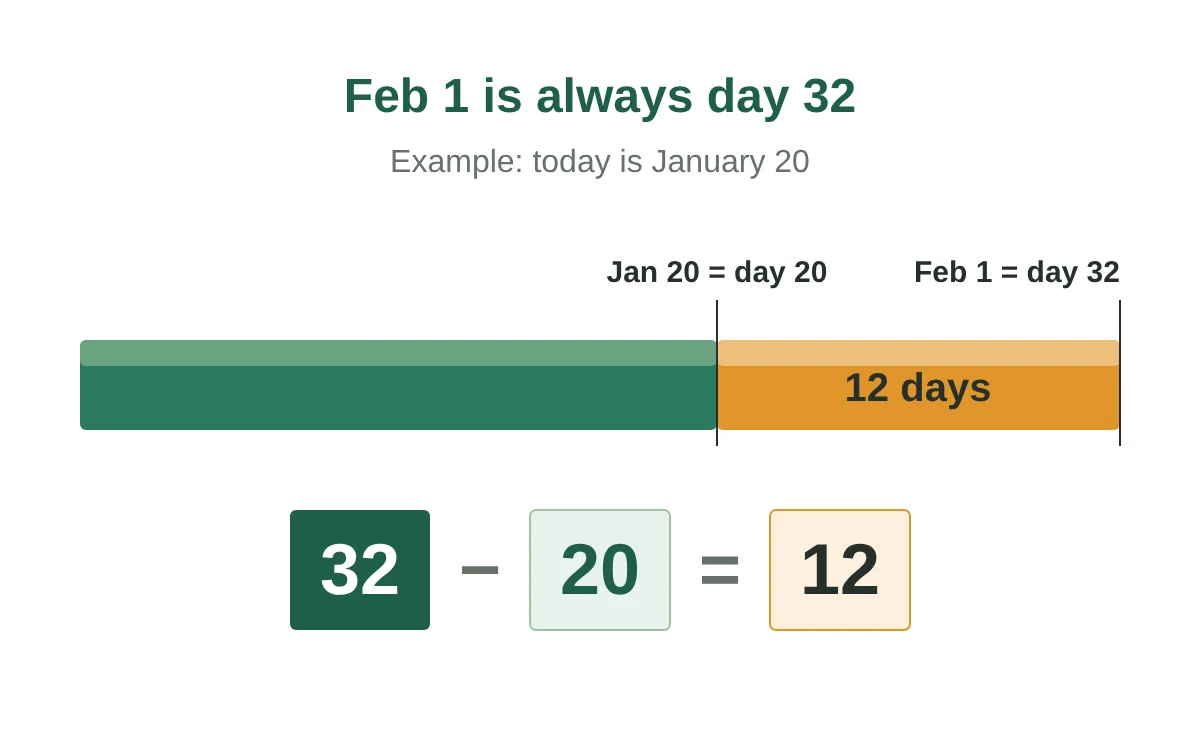
February 1 is always day 32 of the year, because January has 31 days. That is the only fact you need. Find today’s day of the year, subtract it from 32, and you have the days remaining until February 1 of the same year. Say a date falls on day 20 of the year (January 20). Then 32 minus 20 gives 12.
This works because day-of-year numbering removes month lengths from the problem. You never have to remember which months have 30 or 31 days, only where your date sits in the year. A date in January needs no other step, and a date in November or December is handled by the rollover rule below.
Most people instead count month by month, which is where mistakes creep in. A single subtraction against 32 leaves far less room for error.
A worked example by hand
Take a purely hypothetical starting date of October 12 in a non-leap year. Count what remains of October (31 minus 12 is 19), then add all of November (30), all of December (31), all of January (31), and one more day to land on February 1. That gives 19 + 30 + 31 + 31 + 1 = 112 days.
You can confirm it with the shortcut. October 12 is day 285 of a non-leap year (273 days through September plus 12). Once the year has ended, you add the year length and the 32: 365 + 32 minus 285 also gives 112. Two routes agreeing is the quickest sanity check.
Try this: Pick any date in the next three months, work it out once month by month and once with the 32 shortcut. If the results differ, you have found your slip before the calendar does.
For dates after January, the shortcut becomes year length plus 32 minus day-of-year. Use 366 for the year length if the current year is a leap year, and 365 otherwise.
When the count really hits zero
The countdown ends at 00:00 on February 1, not at the end of that day. This is the most common source of off-by-one disagreement. On January 31, a counter may display “1 day” for hours even though February begins at the next midnight. Some pages round that up, others round down, and a few count “days left including today”.
The convention here is a calendar difference: today’s date to February 1. That matches how people use the phrase, since on January 31 most would say February is “tomorrow”, or 1 day away. If you need the exact moment, the hours and minutes matter more than the day figure, and how long until midnight works the same logic for the final stretch of any day.
Time zones and daylight saving
February 1 does not arrive everywhere at once. Auckland passes midnight into February roughly 21 hours before Los Angeles does, and the gap across the whole globe reaches a full day. A countdown that uses a fixed server time zone will be wrong for you at the edges, which is why the widget above uses your device clock.
Daylight saving can quietly change an hour-based countdown. In the US and Europe, clocks fall back in late October or early November, which makes one day 25 hours long. If your start date is before that change, a raw hour count and a calendar-day count can disagree by an hour. Once you are past it, there is no clock change between you and February 1, so the arithmetic stays clean.
February’s length and the leap year pattern
February has 28 days, or 29 in a leap year. The next leap day is February 29, 2028, so the stretch from February 1 to March 1 is 28 days in 2027 and 29 days in 2028. That matters if you are counting past the start of February, for instance toward the end of the month with days until February 28 or the first of March with days until March 1.
The leap rule has a twist worth knowing. Years divisible by 4 are leap years, except century years, which must also be divisible by 400. So 2000 was a leap year, and 2100 will not be.
February also starts on a different weekday each year. February 1, 2027 is a Monday, and February 1, 2028 is a Tuesday, because a 365-day year shifts the weekday by one. A leap year shifts the next one by two.
Weeks, weekdays and weekends
Divide the day count by 7 to get whole weeks, and the remainder is the leftover days. The remainder also tells you how many extra weekday slots exist beyond whole weeks, since every full week holds exactly 5 weekdays and 2 weekend days. A plain countdown never shows that split, but it is easy to build.
For working days, multiply the whole weeks by 5, then walk through the leftover days one by one, skipping Saturday and Sunday. Public holidays such as New Year’s Day and, in some countries, Martin Luther King Jr. Day or Australia Day fall outside this simple count, so subtract them separately.
Try this: Write your day count as weeks plus leftover days (for example, 9 weeks and 6 days), then list only the weekdays in the leftover days. Add that to 5 times the weeks.
If it is already February
Once February has started, the countdown points at the following year. From any day in February, the gap to the next February 1 is 365 days minus the days already elapsed, or 366 if February 29 falls in between. This is also why a page that says “days until February” in March can show a number above 300 and still be correct.
For a date-based version, the page for February 1 gives you the same target as a fixed date. If you are working to a different anchor, such as the year’s end, days until January 1, 2027 or days until December show how the same method behaves on other boundaries.
Checking any gap yourself
When you want to compare two arbitrary dates, rather than counting to February specifically, the date calculator handles the days between, including leap years, and lets you add or subtract days from a date. The 32 shortcut still beats it for speed with this one target, but a calculator is the right tool whenever the start and end dates are both unusual.
Frequently asked questions
How many days are there until February 1?
The live countdown above gives the exact figure for your clock and time zone. The target is midnight at the start of February 1, so the count reaches zero the moment January 31 ends.
Does the count include today?
A standard countdown does not. It measures the gap between now and the start of February 1, so today counts only as the part of it that remains. If you want 'days left including today', add one.
Is it different if I am in another time zone?
Yes. February begins at different moments around the world, so a person in Sydney reaches it many hours before a person in Los Angeles. A live widget that reads your device clock handles this automatically.
What happens to the count once February has started?
It rolls over to the next February 1. Counting from any date in February to the following February 1 takes 365 days in most years, or 366 if a leap day falls in between.