
How Many Days Until July?
Calendar
Countdown chart
The number of days until July is the number of midnights between now and 00:00 on July 1. The live countdown above calculates it from your own clock and time zone, so it is correct the moment you load the page. This article explains how to check it by hand and where the common mistakes hide.
Most people only need the headline figure, but a few details change the answer by a day: whether today is counted, which time zone sets the finish line, and whether a leap day sits in the way. Each is covered below.
The day-of-year shortcut
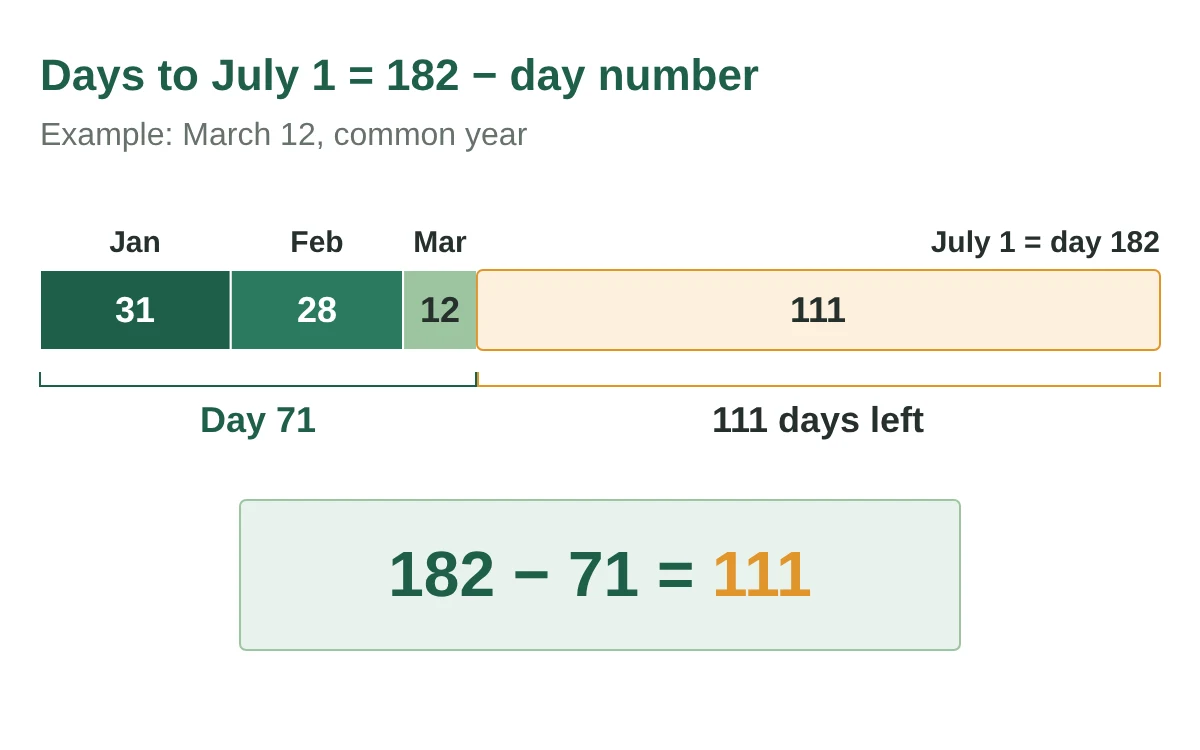
Every date has a position in the year, from 1 on January 1 to 365 on December 31. In a common year, July 1 is day 182, because the first six months add up to 181 days (31, 28, 31, 30, 31, 30). In a leap year it is day 183.
That gives you a one step formula: days until July 1 = 182 minus today’s day number. No month by month adding, no fingers. The only work is finding today’s day number, and you can do that by adding the month totals before the current month to the date.
A handy memory anchor: the first half of the year has 181 days and the second half has 184. July 1 is where the longer half begins, which is also why the second half feels like it has more room than the first.
A worked example
Take a hypothetical starting date of March 12 in a common year. March 12 is day 71 (31 for January, 28 for February, plus 12). Then 182 minus 71 gives 111 days until July 1.
Now check it the slow way. March 12 to March 31 is 19 days. Add 30 for April, 31 for May and 30 for June, which brings you to June 30 after 110 days. One more step lands on July 1: 111. Both methods agree, which is the point of doing it twice.
For a start date in June there is an even shorter rule: days until July 1 equals 31 minus the date. From June 10 that is 21 days. It works because June has 30 days and you need one extra step to cross into July.
Try this: Pick any date in April, work out its day-of-year number, and subtract it from 182. Then count forward by month lengths to confirm. If the two answers differ, you almost certainly dropped or doubled a day at a month boundary.
Where the leap day matters
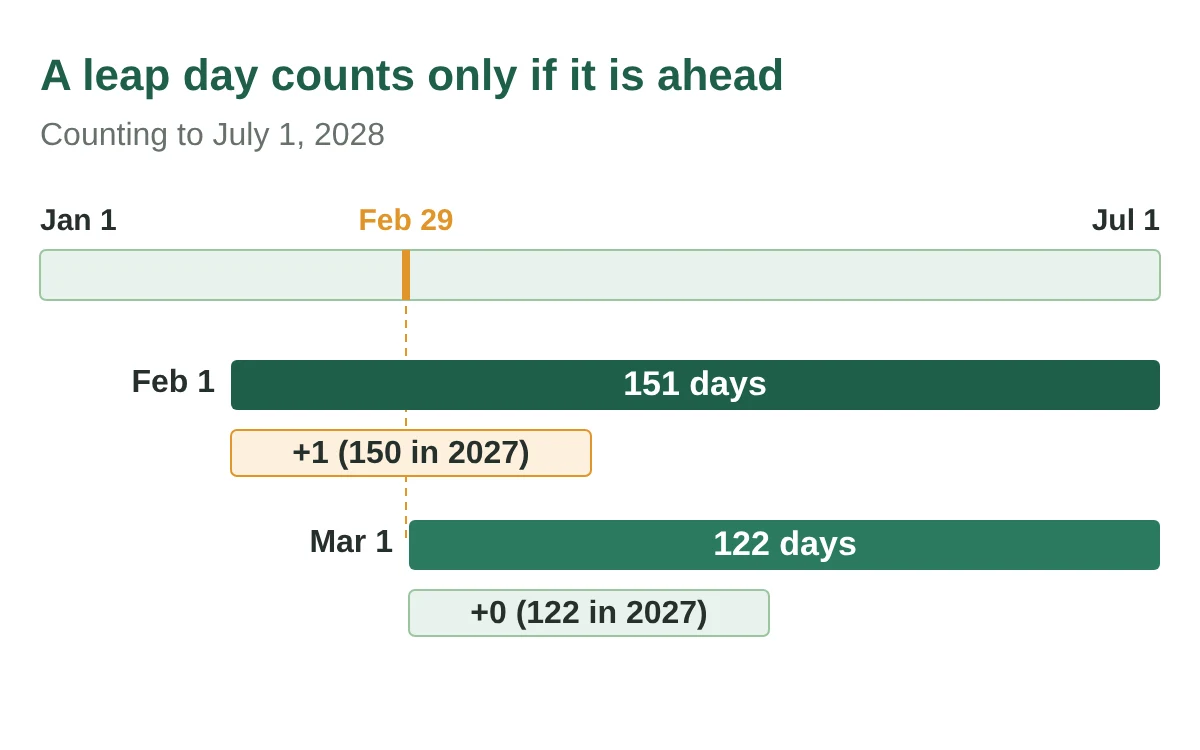
February 29 only affects the count if it sits between you and July 1. Start counting in January or February of a leap year and the answer is one higher than in a common year. Start on March 1 or later and the leap day is already behind you, so it makes no difference at all.
This is why the “182” rule needs one adjustment and no more. If your start date is after February, use 182 for every year. If it is in January or February of a leap year, use 183. When the start date is in the autumn, the leap day belongs to the following February and plays no part.
Time zones and the midnight cutoff
July 1 begins at midnight local time, so the finish line moves around the planet. A person in Auckland reaches July 1 many hours before a person in Los Angeles, and both are right. A countdown that runs on a server clock set to UTC can show a different day count from yours for several hours every day.
The live widget above reads your device’s clock, which is why it matches your own calendar. If you are planning for someone elsewhere, such as a launch, a flight or a family event, work out their local midnight first. Our date calculator is useful when you need to compare two specific dates rather than a rolling countdown.
Why two sites can disagree by a day
Search for this question and you will find answers that differ by a day or more. Usually the cause is the counting convention. A strict count measures from today’s midnight to July 1’s midnight. A “sleeps” count or an “including today” count adds one. Some pages also show stale numbers that were cached on an earlier date.
The other cause is rounding. At 11 pm, the time left is a fraction of a day over the whole days. Showing days and hours together, as the widget does, avoids that ambiguity because nothing is rounded up or down.
Try this: Decide your own convention before you plan around the number. If you want “how many mornings until July 1,” use the standard count. If you want “how many days can I use, starting today,” add one.
When it is already July
On any day from July 2 onward there is no upcoming July 1 this year, so the count targets next year’s. That number is close to a full year, and it can look wrong if you expected the current month. On July 1 itself, tools differ: some show zero, others jump straight to next year.
If you actually want a day inside the current July, a specific date is clearer. How many days until July 4th is the most searched example. If you are still in early summer, the neighbouring pages how many days until June and how many days until August follow the same logic.
Hours, minutes and the daylight saving surprise
Multiplying days by 24 to get hours is accurate only when no clock change falls in between. In places that observe daylight saving, counting from late autumn to July crosses the spring change, so the real elapsed hours are one fewer than days times 24. In the southern hemisphere the opposite can happen: a count that crosses the autumn change gains an hour.
For a quick estimate the difference is irrelevant. For a precise hour count, such as a deadline or an event start, let the widget do it, because it works from actual clock time rather than a fixed 24 hours per day. For short spans, time conversions covers the unit maths.
Weekdays, weeks and business days
Dividing the day count by 7 gives whole weeks plus a remainder, and that remainder tells you which weekday July 1 falls on relative to today. If the remainder is 2 and today is Tuesday, July 1 is a Thursday. The weekday of July 1 also shifts forward by one each year, or by two when a February 29 falls in between.
Business days are trickier than 5 out of every 7. Public holidays inside the span reduce them, and July itself has several that vary by country: Canada Day on July 1, the Fourth of July in the United States, and many fiscal years that start on July 1. When the first of July is a fiscal or contract deadline, count working days separately and treat the calendar figure as an upper bound. For nearby milestones, how many days until August 1st gives you the next month boundary to compare against.
Frequently asked questions
How many days until July 1?
The live countdown above gives the exact figure for your clock and time zone. By hand, subtract today's day-of-year number from 182 (or 183 if the year with the July 1 in question is a leap year).
Does the count include today?
The standard answer does not. It counts midnights between now and the start of July 1, so today is excluded. Counting today as a full day adds one, which is what some sites mean by 'including today'.
How many days are in July?
July has 31 days, so the end of July is 30 days after July 1. July and August are the only back to back months that both have 31 days.
What happens to the countdown once July has started?
A well built countdown rolls over to July 1 of the following year, so it shows a number close to a full year. If you want a date inside the current July, use a specific day countdown instead.