
How Many Days Till the 4th of July?
Calendar
Countdown chart
The exact number of days till the 4th of July is in the live countdown above. It runs on your own clock and time zone, so it is correct for where you are right now. The rest of this page covers what the widget cannot: how to check the number yourself, what day of the week the holiday lands on, and how to plan around it.
July 4 recurs every year, so the countdown always points at the next one. Once the date arrives, the next target is a full year away, either 365 or 366 days depending on whether a February 29 sits in between.
Count it by hand in 30 seconds
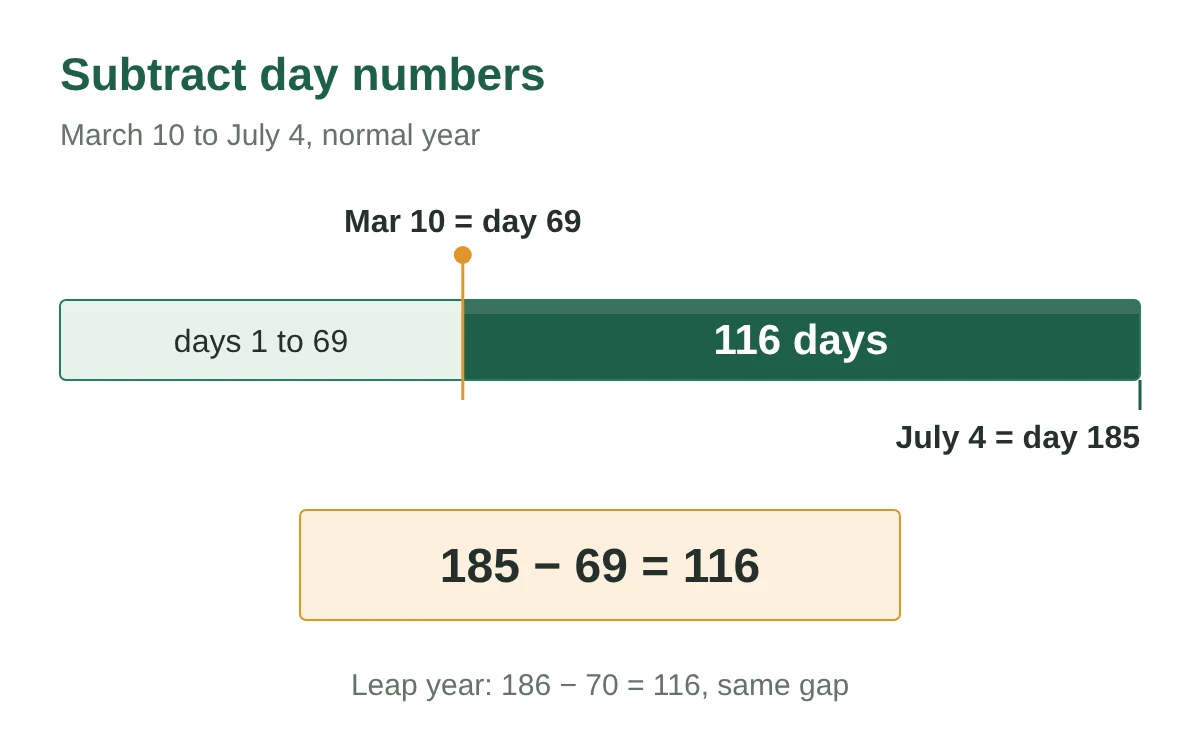
The fastest method uses the day-of-year number. In a normal year, July 4 is day 185. In a leap year it is day 186. Subtract the day-of-year of your start date from that, and you have the answer.
Month-end totals make this easy to do in your head: January ends on day 31, February on 59, March on 90, April on 120, May on 151, June on 181. Add one to each from March onward in a leap year.
Worked example with a made-up start date of March 10 in a normal year: March 10 is day 69 (90 minus the 21 days left in March). Then 185 minus 69 is 116 days. Check it the slow way: 21 days left in March, plus 30 in April, 31 in May, 30 in June, plus 4 gives 116. Same answer.
Try this: Pick any date in the next month, find its day-of-year with the month-end totals above, subtract it from 185, then compare with the date calculator. If you are off by one, you probably counted the start day itself.
The off-by-one trap
Most disagreements between countdown pages come from one choice: whether today counts. Subtracting dates gives the gap between midnights, so that is the number of nights you will sleep before the day begins. A page that adds “including today” will show one more.
Time zones add a second wrinkle. A countdown to the start of July 4 reaches zero at midnight, but fireworks happen after dark, often 20 hours or more later. If your real target is the evening show, the countdown hits zero a long time before the thing you are waiting for. For a finer view, the time-of-day countdowns help with the last day.
Why the weekday keeps shifting
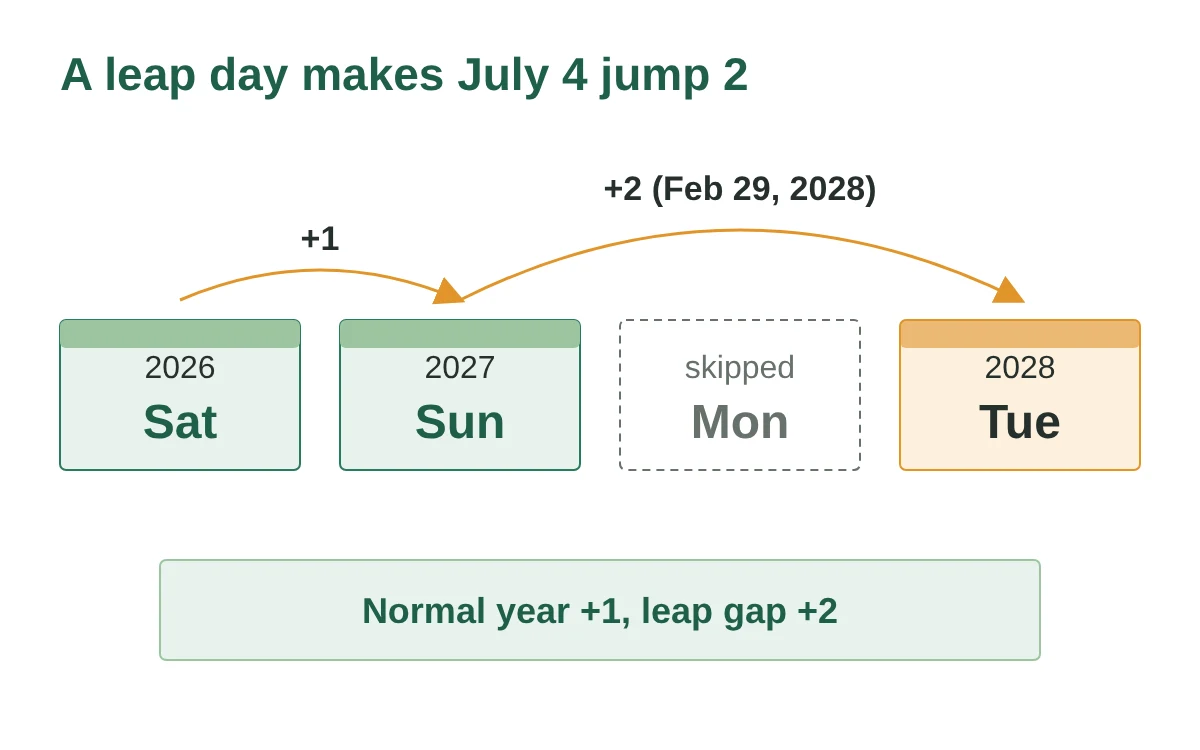
July 4 moves forward one weekday each year, because 365 days is 52 weeks plus one day. In a leap-year gap it moves two. That is why a Sunday in 2027 becomes a Tuesday in 2028, since February 29, 2028 falls between the two dates.
The leap day matters only if it sits between the two July 4s. For the span from one July 4 to the next, the extra day is counted if it falls in the February in between. This is also why the weekday cycle takes 28 years to repeat in most stretches.
If you are planning a long weekend several years ahead, the weekday pattern tells you more than a calendar app will at a glance. A Tuesday or Thursday holiday invites a bridge day. A Saturday or Sunday one raises the observed-holiday question.
When the day off actually lands
For US federal employees, a July 4 on Saturday is observed on the preceding Friday, and one on Sunday is observed on the following Monday. In 2027, July 4 falls on a Sunday, so the federal day off is Monday, July 5. If you are counting down to the day off rather than the date, use the July 5 countdown for that year.
Private employers, schools and banks do not all follow the federal rule. Some give the Friday, some the Monday, and some give nothing extra. Confirm with your own employer before booking travel on the assumption that the observed day is yours.
The holiday itself has a history worth knowing. Congress voted for independence on July 2, 1776, and approved the final text of the Declaration on July 4. That is the date that stuck.
Weeks and weekdays to July 4
Weeks are easy: divide the day count by 7 and keep the remainder. Our 116-day example is 16 weeks and 4 days. The remainder days are the ones that follow the last full week, so they tell you the weekday for free: add the remainder to your starting weekday. If March 10 were a Tuesday, adding 4 lands on Saturday.
Weekdays take one more step. Multiply the full weeks by 5, then count the weekdays among the leftover days. In the example, that is 16 times 5 plus Wednesday, Thursday and Friday, which gives 83 working days if you start counting the day after March 10. Subtract any holidays that fall on weekdays in between, such as Memorial Day, which falls on the last Monday of May.
- Full weeks times 5 gives the base weekday count.
- Count only the leftover days that fall Monday to Friday.
- Remove weekday holidays inside the range.
What else sits around July 4
A few dates cluster near it, and they affect planning. June 19 is a federal holiday, so you may want the Juneteenth countdown alongside this one. The last day of June and July 1 matter for another reason: the fiscal year starts on July 1 in most US states, so budget and contract deadlines often cluster just before the holiday. The June 30 countdown is useful for that.
The season is also less obvious than it looks. Early July is typically near the hottest stretch of the year in the Northern Hemisphere, even though the June solstice is already two weeks behind. Earth is also at its farthest from the Sun around the first few days of July, which shows how little distance has to do with summer heat.
Planning backward from July 4
Working backward from the date is more useful than watching the number fall. Pick the milestone, then subtract. A catered party often needs a headcount several weeks out, and fireworks and venue bookings can fill up earlier than that. Travel prices tend to climb as the date nears, and the holiday weekend is one of the busiest of the year for road and air travel.
Use the day-of-year trick in reverse. If 185 is the target in a normal year, then 185 minus 21 is day 164, which falls on June 13 (151 for May plus 13). The date calculator does the same subtraction for any gap, such as 8 weeks or 84 days before the holiday. For a rough gut check, the days until July page gives you the distance to the first of the month.
Try this: Choose three milestones for your July 4 plan (for example invitations, shopping, setup). Subtract 10, 5 and 1 weeks from the date and write the resulting calendar dates on your calendar today.
Frequently asked questions
How many days are there from January 1 to July 4?
July 4 is day 185 of a normal year and day 186 in a leap year. That makes it 184 days after January 1 in a normal year, or 185 days in a leap year.
Does July 4 always fall on the same weekday?
No. It moves forward one weekday each year, or two weekdays when a February 29 falls between one July 4 and the next. For example, a Sunday July 4 in 2027 is followed by a Tuesday in 2028.
Is the day off on July 4 or the day after?
For US federal employees, a Saturday July 4 is observed on Friday and a Sunday July 4 is observed on Monday. Private employers and schools set their own rules, so check with yours.
Why does my countdown differ from another site by one day?
Usually one counts the current day as a full day and the other does not. Time zone is the other cause: a countdown that runs on your own clock flips at your local midnight, not someone else's.