
How Many Days Until June 13th?
Calendar
Countdown chart
The live countdown above shows the exact number of days, hours and minutes until the next June 13, calculated from your own device clock and time zone. To verify it by hand, use the day-of-year method below: subtract today’s day number from the length of the year, then add 164, the day number of June 13.
Because the figure changes every day, this page explains how to work it out rather than printing a number that would be stale by tomorrow. You will also find the weekday pattern for upcoming years, the observances tied to the date, and a few traps that make hand counts come out one day off.
The day-of-year shortcut
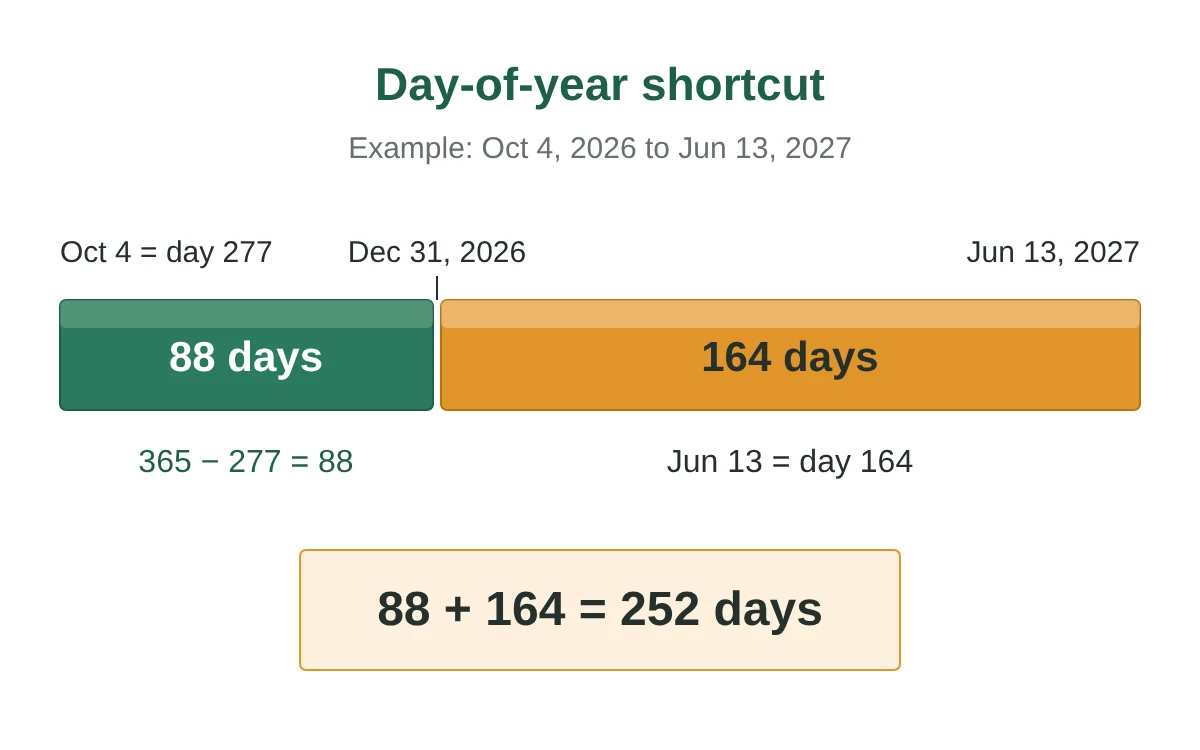
Counting month by month invites mistakes, because months have uneven lengths. A cleaner method uses day-of-year numbers. June 13 is day 164 of a normal year (31 + 28 + 31 + 30 + 31 = 151 days through May, plus 13). In a leap year it is day 165.
The method has three steps:
- Find today’s day-of-year number (for example, October 4 is day 277 in a normal year).
- Subtract it from 365 to get the days left in the current year (365 minus 277 is 88).
- Add 164 for June 13 of the following year.
Take a hypothetical start of October 4 in a year followed by a normal year: 88 + 164 gives 252 days. Check it the slow way: 27 days left in October, 30 in November and 31 in December make 88, and January 1 to June 13 adds 164 more (counting from December 31 as day zero). The two routes agree.
Try this: Pick any date in your calendar, compute its day-of-year number from memory using the month-end totals (31, 59, 90, 120, 151), and run the three steps. Then compare with the live widget. Two or three rounds and the totals become automatic.
Why your count and the widget can differ
The most common disagreement is an off-by-one, and it comes from what “until” means. The widget counts to the instant June 13 begins at your local midnight. If you count the calendar squares on a wall calendar, you may include today, or June 13 itself, or both. Pick one convention and stay with it. Subtraction of two dates, as in the method above, counts the gap between them, which is what the widget shows.
Time zones add a second wrinkle. A calendar date does not last 24 hours worldwide: from the first moment June 13 begins in UTC+14 to the last moment it ends in UTC-12, it exists somewhere on Earth for 50 hours. If you are timing a message to someone far away, the right question is when June 13 starts for them, not for you. The date calculator is useful for checking the gap between two specific dates.
Clock changes cause a smaller quirk. If your countdown crosses a spring clock change, the hours total comes out one short of 24 times the days, because that day has only 23 hours. The reverse happens across the autumn change. Day counts are unaffected, since they follow the calendar.
Counting weeks and weekdays to June 13
Divide the day count by 7. The quotient is whole weeks and the remainder is spare days. That remainder also tells you something useful: if it is zero, your start day and June 13 fall on the same weekday. Our 252-day example is exactly 36 weeks, so both ends land on the same day of the week.
For weekdays (Monday to Friday), use full weeks times 5, then walk through the leftover days one by one. A count of 252 days has 36 full weeks, which means 180 weekdays and 72 weekend days. Leftover days are the only part that needs checking, and there are never more than six of them.
Public holidays are not removed by this method. If you are counting working days for a project, subtract your local holidays separately, and remember that holiday calendars differ by country and employer. For round-number conversions, 8 weeks in days shows the same multiply-by-seven logic.
Which weekday June 13 lands on
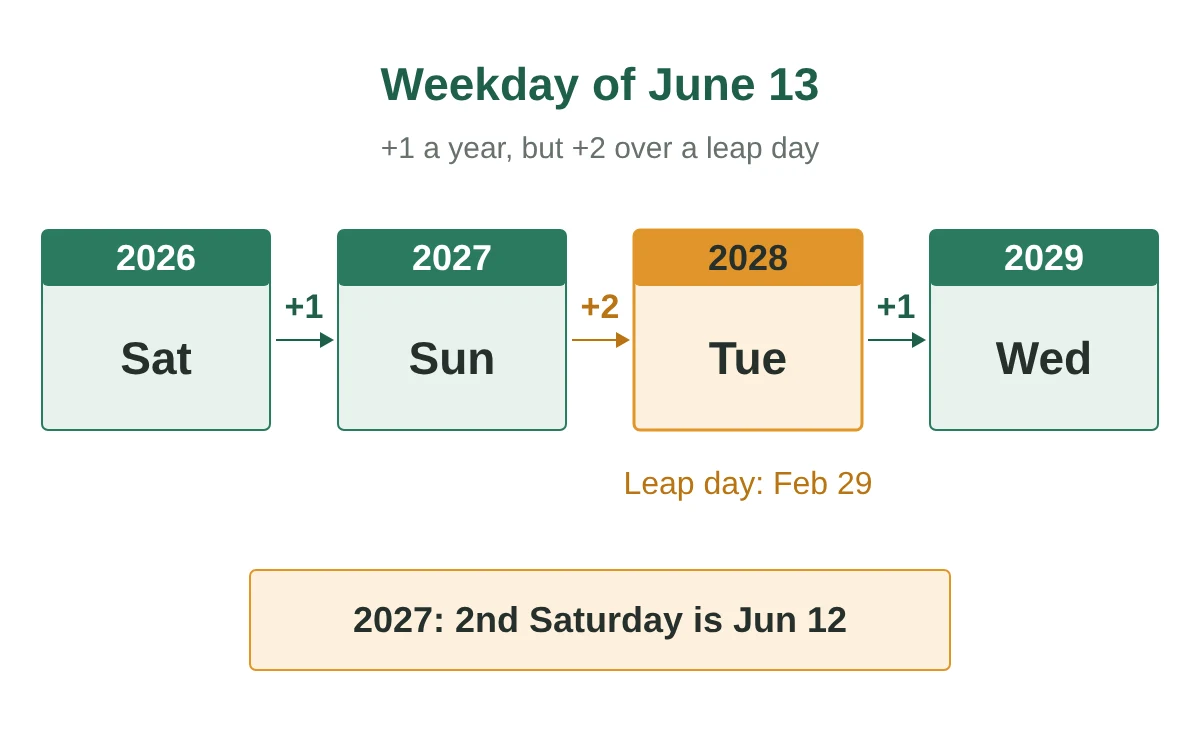
The weekday of a fixed date moves forward by one each year, or by two when a leap day sits in between. That makes it predictable years ahead:
- 2026: Saturday
- 2027: Sunday
- 2028: Tuesday (leap year, so it jumped two)
- 2029: Wednesday
- 2030: Thursday
- 2031: Friday
The Friday in 2031 is a Friday the 13th, which is the only June 13 in this run to carry that label. The previous one was in 2025.
This pattern matters for floating observances. Anything defined as the second Saturday of June can fall between June 8 and June 14, so it lands on June 13 only in some years. In 2027, June 13 is a Sunday, which means the second Saturday is June 12, and any event tied to that rule would sit a day earlier. If you are planning around a floating event, check the rule, not just the date. The June 12 countdown covers that neighbouring day.
What June 13 is known for
June 13 is crowded with minor observances, but a few have real substance. The United Nations proclaimed it International Albinism Awareness Day, adopted by the General Assembly on December 18, 2014, with effect from 2015, focused on the human rights of people with albinism.
Religiously and culturally, June 13 is the feast of Saint Anthony of Padua. He died at the gates of Padua on 13 June 1231. In Lisbon, where he was born, the date is a municipal holiday, with street festivals running through the night of June 12. Spain and Venezuela also mark San Antonio on this date.
Lighter entries include Sewing Machine Day, which marks June 13, 1790, when Thomas Saint filed a British patent. Several others, such as World Gin Day and National Rosé Day, are floating Saturday observances rather than fixed dates, as explained above. Note that June 13 is not a public holiday in the United States, the UK or most other countries, so it will not change work or school schedules by itself.
Planning around the date
Because June 13 falls in the northern hemisphere’s late spring, about a week before the solstice, it is popular for weddings, graduations and early summer travel. In the southern hemisphere the same date is late autumn. Whichever applies, booking windows often open earlier than people expect: venues and flights for a mid-June weekend tend to fill many months ahead.
Work backwards from the date instead of forwards from today. Set a milestone at 12, 8, 4 and 1 weeks out, and convert each to an actual date with the calculator. Weeks are better planning units than days because they keep milestones on the same weekday.
Nearby dates can matter more than June 13 itself. In the United States, the second-quarter estimated tax payment is normally due on June 15, two days later, and Flag Day is June 14 (see the June 14 countdown). Juneteenth follows on June 19, covered in the June 19 countdown. If your plan touches any of these, a single week of margin protects you from weekend shifts.
Try this: Choose the weekday you want to be fully ready, then count back in whole weeks from June 13 to place four checkpoints. Write each date next to the task it unlocks, and check each against the live widget when you reach it.
Counting to a personal date instead
The same arithmetic works for any recurring date, including a birthday that falls on June 13. If that is your case, the birthday countdown handles the leap-day edge cases for you. For a date that moves around, such as a floating Saturday observance, count to the actual calendar date for that year rather than to “June 13”, or the result will be off by up to six days.
Frequently asked questions
How many days until June 13?
The live countdown above gives the exact figure for your own clock and time zone. To check it by hand, subtract today's day-of-year number from 365, then add 164 (or 165 if the June 13 you are counting to is in a leap year).
What day of the year is June 13?
June 13 is day 164 in a normal year and day 165 in a leap year. The extra day comes from February 29, which pushes every later date forward by one.
Does the countdown include June 13 itself?
Normally no. The count runs to the start of June 13 (midnight, local time), so on the date itself it reads zero days. If you want to include both the first and last day, add one.
Is June 13 ever a Friday the 13th?
Yes, when June 13 falls on a Friday. That happened in 2025 and will happen again in 2031, based on the repeating weekday pattern of the calendar.