
How Many Days Till June 5th?
Calendar
Countdown chart
The live counter above gives the exact answer for your device’s clock and time zone, counted to the first moment of June 5 where you are. Because June 5 returns every year, the widget always aims at the next one, so the number you see is the one that applies to you today.
The rest of this page covers what the counter can’t show: how to verify the number yourself in under a minute, where counts commonly go wrong, and how to turn the wait into weeks, weekdays and a workable plan.
The fastest way to count by hand
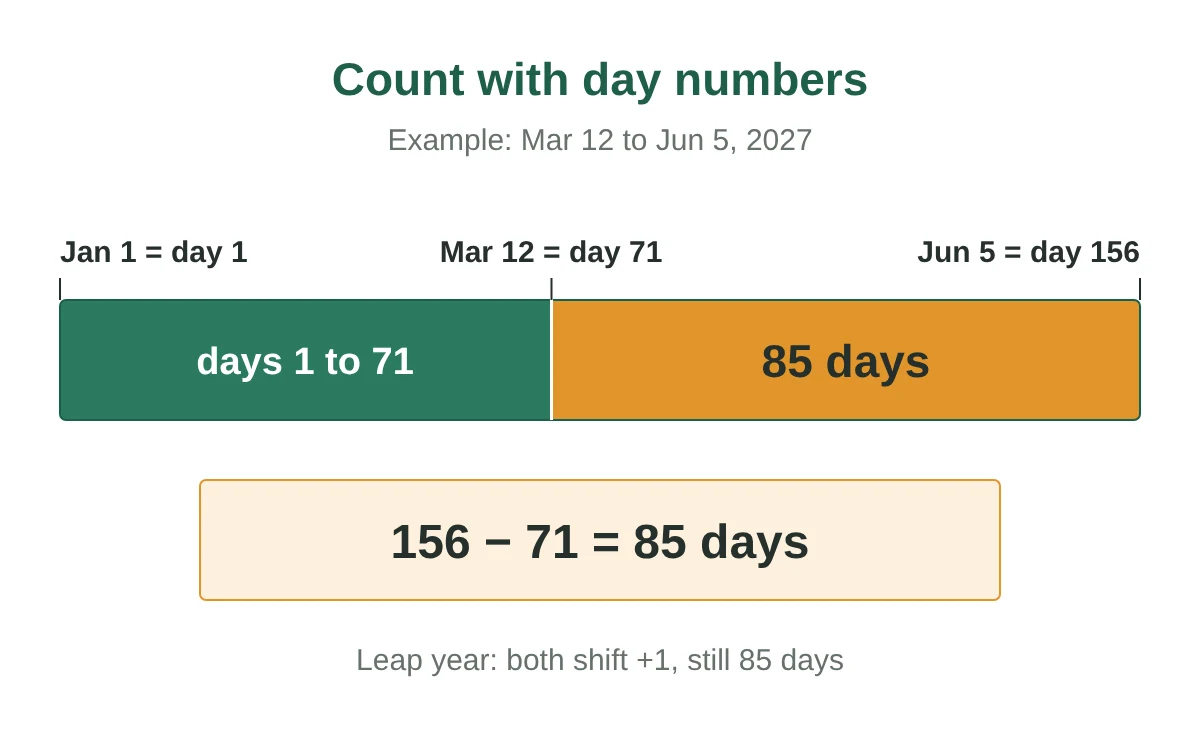
Skip the month-by-month addition. Every date has a day-of-year number, and June 5 is day 156 in a common year and day 157 in a leap year (the extra day is February 29). Subtract the day number of your starting date and you are done.
Take a hypothetical start of March 12 in a common year. March 12 is day 71 (31 + 28 + 12), so the gap is 156 minus 71, which is 85 days. The slow method agrees: 19 days left in March, plus 30 in April, plus 31 in May, plus 5.
When the start is in a different year, add the days left in the starting year first. From a hypothetical December 15, 2026 (day 349 of 365), that is 16 days to year end plus 156 into the next year, which gives 172.
- Find the day-of-year of your start date.
- Subtract it from 156 (or 157 if the June 5 in question falls in a leap year).
- If the dates sit in different years, add the days remaining in the first year instead.
Try this: Pick any date a few months away, work out its day-of-year, and subtract from 156. Then check the answer against the date calculator. Two or three rounds and you will stop needing the table.
Why 6/5 can mean May 6
Written as 6/5, the date is June 5 in the United States and May 6 in most of the rest of the world. If you are counting for a shared event, a flight or a form with someone abroad, confirm which one is meant before you trust any number. The gap between the two readings is 30 days, which is exactly the sort of error that survives a quick glance.
Spelling the month out (“5 June” or “June 5”) removes the problem. The ISO format, 2027-06-05, is also unambiguous because the year comes first and the month always precedes the day.
Which weekday June 5 lands on
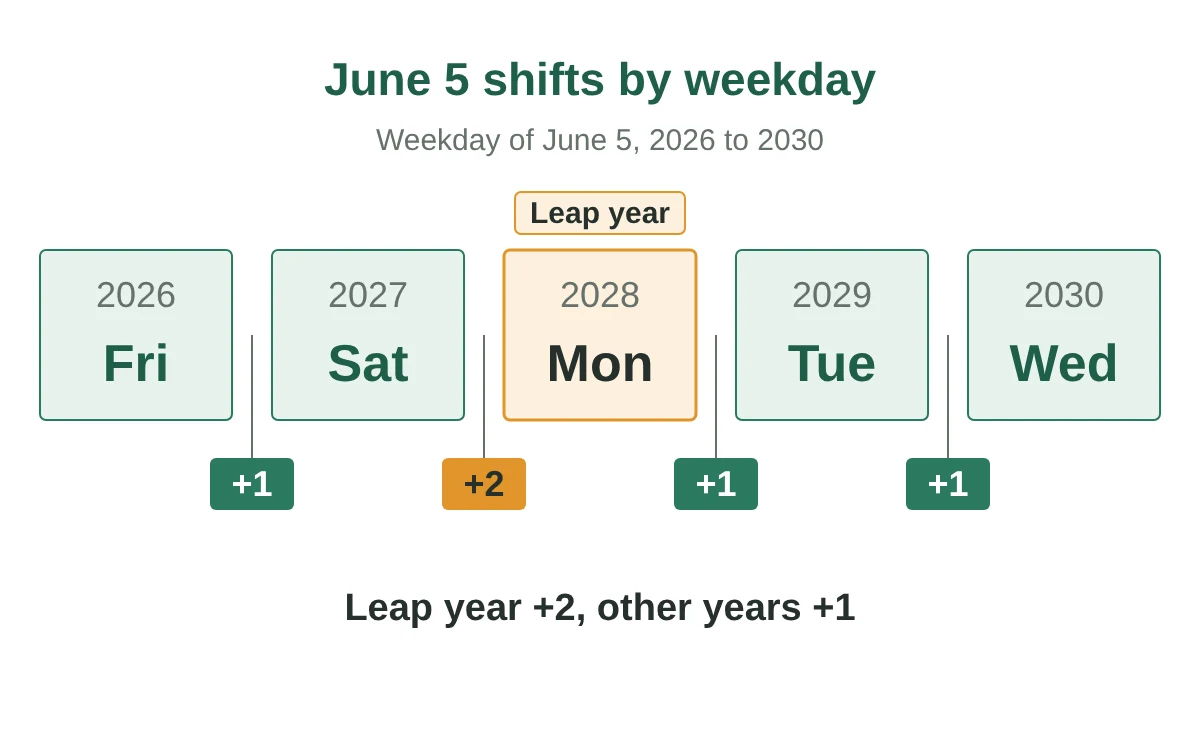
June 5 moves forward one weekday each year, and two weekdays after a year containing February 29. That gives a short run you can remember: Saturday in 2027, Monday in 2028 (a leap year), Tuesday in 2029 and Wednesday in 2030.
The weekday matters more than the number of days. A Saturday June 5 means the practical deadline for anything involving offices, banks or deliveries is the Friday before, one day earlier than the countdown suggests. On a Monday, the working weekend before it is effectively lost. If your plan depends on a specific weekday, the neighbouring dates (June 4 and June 6) are worth checking too.
Counting weeks and weekdays to June 5
Convert the total to weeks first: divide by 7 and keep the remainder. The 85 days in the earlier example are 12 weeks and 1 day. Those 12 full weeks hold exactly 60 weekdays, whatever day you start on, so only the leftover day needs checking.
Here is the part most people miss: the leftover days are the last days before the target, not the first. Counting forward from the day after your start, the final stretch ends on June 5 itself. If June 5 is a Monday to Friday, add one weekday for a single leftover day. If it is a weekend day, add none. With a remainder of several days, look at the weekdays of the final few dates leading up to June 5.
Public holidays still have to be subtracted by hand, since they differ by country and region. For a week-based view of a nearby date, the weeks until June 1 page shows the same method on a different target.
Time zones and the midnight cutoff
A date countdown ends at 00:00 on June 5 local time, so on the morning of June 4 the clock already reads under a day, while the date itself still shows June 4. Whether you say “1 day” or “0 days” at that point depends on whether you round the remaining time up or count calendar dates. Neither is wrong, but mixing them causes off-by-one disagreements.
If the event happens at a specific time on June 5, say an evening start, the real wait is longer than the date count by that many hours. A time-of-day page such as how long until midnight handles the last day better than a day count can.
Travel adds another wrinkle. An event held in another time zone starts on June 5 by its own clock, which can be June 4 or June 6 on yours. Set your countdown to the event’s location, not yours, if the moment matters.
What June 5 is known for
The best-known fixture is World Environment Day. The United Nations established it at the 1972 Stockholm Conference on the Human Environment, and it has been held annually on 5 June since 1973, led by the UN Environment Programme. Each year has a different host country and theme, and in 2026 the host is Azerbaijan.
The same date is also the International Day for the Fight against Illegal, Unreported and Unregulated Fishing. In Denmark it is Constitution Day (Grundlovsdag), commemorating the 1849 constitution. Historically, the Six-Day War began on June 5, 1967.
One common mistake: National Donut Day in the United States is the first Friday of June, not a fixed June 5. It lands on June 5 only in years when that date is a Friday, so don’t plan around it without checking the year. Seasonally, June 5 sits in meteorological summer in the Northern Hemisphere and meteorological winter in the Southern, about two weeks before the June solstice.
Planning backwards from June 5
A countdown works best when it is cut into checkpoints instead of watched as one long number. Pick the real deadline (often the weekday before, as noted above), then place markers at 90, 60, 30 and 7 days out. The 90 days from now page shows what a 90-day lead looks like for any starting date.
Long waits are easier to read in weeks. Anything beyond about 100 days is best tracked as a weekly checklist, which also lines up neatly with weekday-based work schedules. For a whole-month view of the same stretch, see how many days until June.
Try this: Write down the weekday June 5 falls on, then count back 7, 14 and 28 days from the Friday before it. Those three dates are your natural checkpoints, and each lands on the same weekday.
Frequently asked questions
What is the quickest way to calculate how many days are left until June 5?
June 5 is day 156 of the year in a common year and day 157 in a leap year. Find the day-of-year number of your start date and subtract it from 156 (or 157). If the start falls in an earlier year, add the days remaining in that year instead.
Does 6/5 mean June 5 or May 6?
In the United States 6/5 means June 5, while most other countries read it as 5 May... which is written 6/5 only in the day-first style meaning 6 May. The two readings are 30 days apart, so confirm the format before trusting a count. Writing 'June 5' or using ISO style (2027-06-05) removes the ambiguity.
What is World Environment Day and when did it start?
World Environment Day is observed every 5 June and is led by the UN Environment Programme. It was established at the 1972 Stockholm Conference on the Human Environment and has been held annually since 1973, with a different host country and theme each year.
Is National Donut Day always on June 5?
No. National Donut Day in the United States falls on the first Friday of June, so it lands on June 5 only in years when that date is a Friday.