
How Many Days Until June 3rd?
Calendar
Countdown chart
The live countdown above gives the exact answer for your clock and time zone, down to the second. It always targets the next June 3, so the figure rolls over to the following year once the day has passed. If you want to check it or reproduce it without a tool, the method takes about thirty seconds.
June 3 is a fixed-date day, which makes it easy to handle. Its weekday changes from year to year, but its position in the year barely moves: it is day 154 in a normal year and day 155 in a leap year.
Why two sites can disagree by one day
Counts to the same date often differ by exactly one, and neither is wrong. They use different conventions. An exclusive count measures the gap between today and June 3 and does not count either end. An inclusive count also counts the day you are standing on, so it comes out one higher.
The live widget counts to the first moment of June 3, local time. Until that moment arrives, June 2 is the last day you see on a calendar, so a countdown that reads “1 day” means June 3 begins at the coming midnight. If a deadline or event is at a specific hour on June 3, add that hour to the count. The countdown to the start of the day will understate the wait.
Count it by hand
The fastest manual method uses day-of-year numbers. June 3 is day 154 in a non-leap year (31 + 28 + 31 + 30 + 31 + 3) and day 155 in a leap year. Find the day number of your starting date, then subtract.
Here is a hypothetical example. Say the start date is March 10, in a year that is not a leap year. March 10 is day 69 (31 + 28 + 10). So 154 minus 69 gives 85 days. You can check it the long way: 21 days left in March after the 10th, plus 30 for April, 31 for May, plus 3 into June, which is also 85.
The one trap is a leap day. If your span crosses February 29, add one. The simplest test is whether the year of June 3 is divisible by 4 (2028 is the next such year), and whether your start date falls before March 1 of that same year.
Try this: Pick any date three months from now. Work out its day-of-year number, subtract it from 154, then check the result with the date calculator. Do this twice and the method becomes automatic.
Weekdays and weeks to June 3
Raw days are rarely what a plan needs. To convert, divide the day count by 7. The whole number is your full weeks, and the remainder is the number of loose days.
For weekdays, multiply the full weeks by 5, then look only at the leftover days. In the hypothetical 85-day span from a Monday, March 10, there are 12 full weeks (60 weekdays) and 1 leftover day. That leftover day always has the same weekday as your start day, so it is a Monday and adds one more weekday. The total is 61 weekdays.
Two cautions apply. First, decide whether your start day counts, because it changes the leftover day. Second, public holidays between now and June 3 are not subtracted by this shortcut. In the United States, for example, Memorial Day falls on the last Monday of May, which lands just before June 3 and removes a working day in most years.
Why June 3 moves through the week
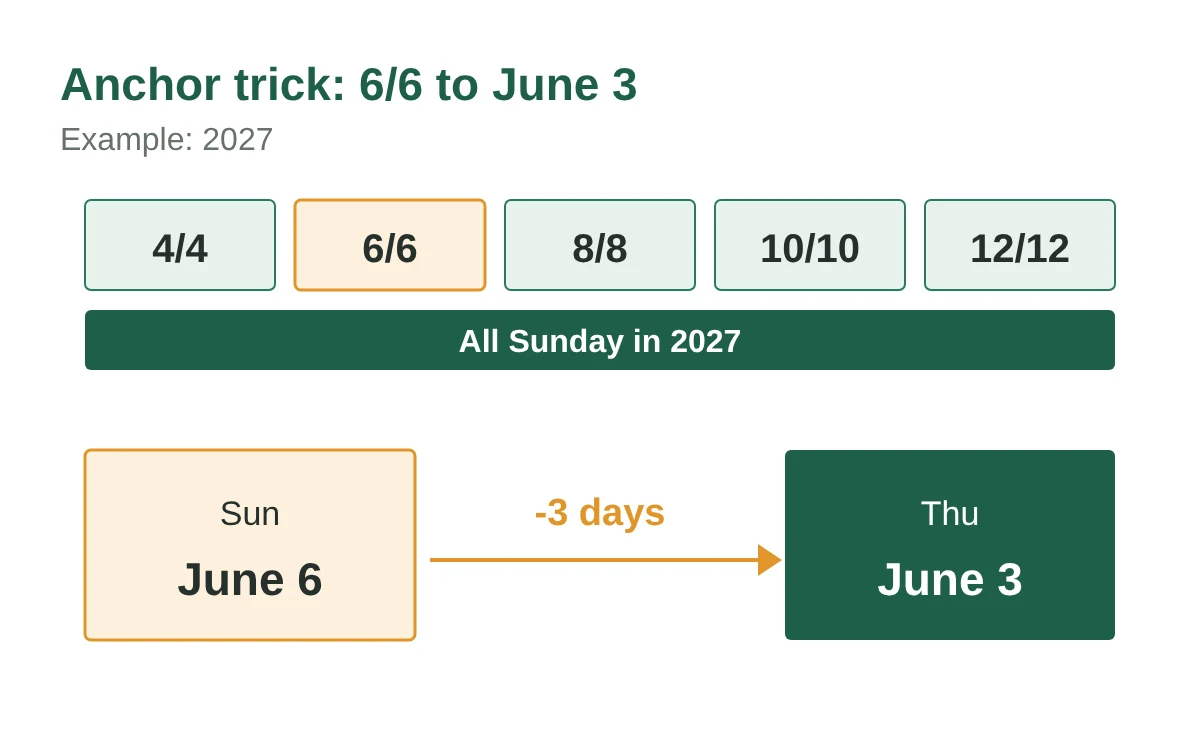
June 3 lands one weekday later each year, and two weekdays later after a leap day. The pattern in the coming years runs like this:
- 2027: Thursday
- 2028: Saturday (the jump of two comes from February 29, 2028)
- 2029: Sunday
- 2030: Monday
There is a handy memory anchor here. June 6 always shares its weekday with the “doomsday” dates 4/4, 8/8, 10/10 and 12/12. June 3 is three days earlier than that, so if you know one of those weekdays, you know June 3’s.
The clock-change catch
If you count in hours, do not multiply days by 24. Between late autumn and June, most northern hemisphere regions spring forward once, so one day in the span lasts 23 hours. The live widget handles this automatically because it reads your clock rather than assuming 24-hour blocks. A hand-built “days × 24” figure can be off by an hour.
What June 3 is known for
The best-documented observance is World Bicycle Day. The United Nations General Assembly declared 3 June World Bicycle Day through resolution A/RES/72/272 in 2018, and the first World Bicycle Day was celebrated on 3 June 2018. It is a UN observance, not a public holiday, so offices and schools stay open.
Other days attach to June 3 on international calendars, including Chimborazo Day, World Clubfoot Day and World Cider Day. Global Running Day falls on the first Wednesday in June, so it only shares June 3 in years when June 3 is a Wednesday. Many lighter “national day” listings also use the date, but those are informal and vary by source.
In Thailand, June 3 is the birthday of Queen Suthida and is marked as a public holiday. On the seasonal side, June 3 sits inside meteorological summer in the northern hemisphere and meteorological winter in the south. The astronomical solstice comes later in the month.
Planning backwards from June 3
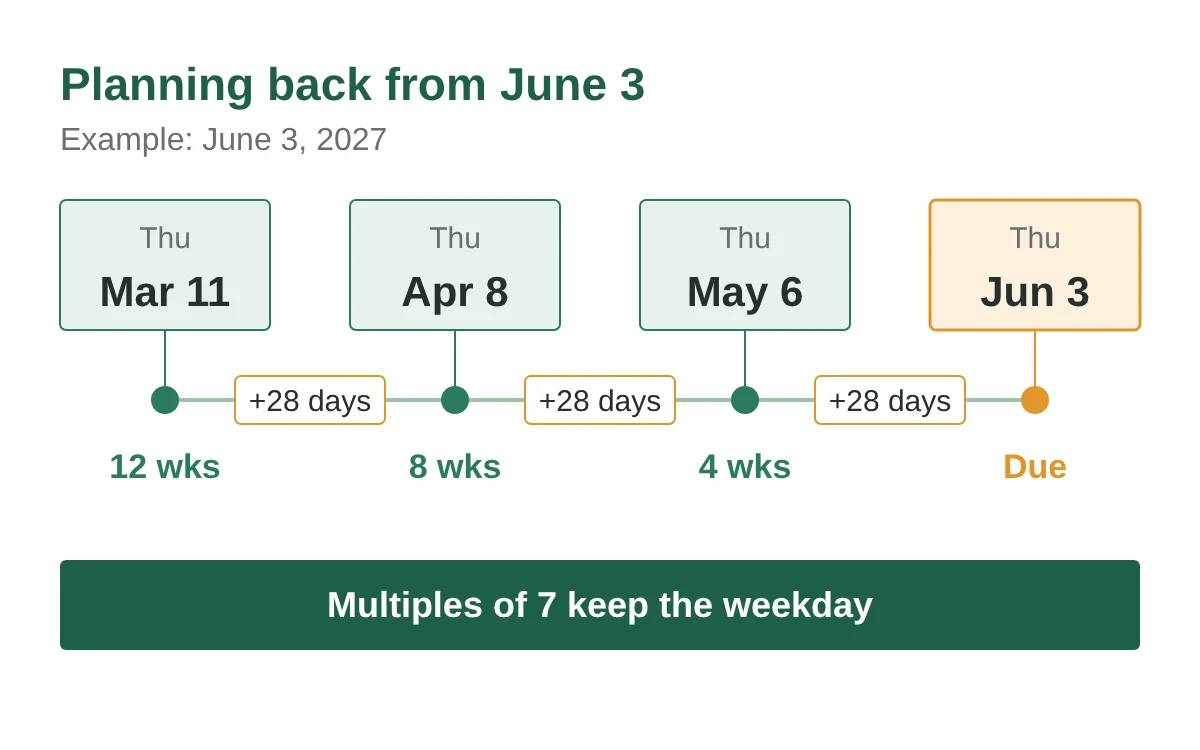
A countdown is more useful as a set of checkpoints. Divide the total by milestone sizes that match your task: 12 weeks out for a big project, 8 weeks out for a booking or deposit, 4 weeks out for final details. Eight weeks is 56 days, which the 8 weeks to days page confirms in a second. Mark the date eight weeks before June 3 and it will fall on the same weekday as June 3 itself, because any multiple of 7 days preserves the weekday.
That property is the neat trick behind all backward planning. A deadline exactly 4, 8 or 12 weeks before June 3 is always a Thursday when June 3 is a Thursday, so recurring weekly events line up without extra checking.
Try this: Choose the project you want finished by June 3. Subtract 56 days, then 28 days, and put both dates in your calendar as “half-way” and “final push” checkpoints.
Neighbouring dates and related counts
If your event spans a few days, the countdowns for the dates around it use the same method. You can check the nearby ones at June 1 and June 4. If you only need a rough sense of scale, the months until June page gives it in whole months, which is looser but quicker to say out loud.
For anything with a sharp cut-off, always confirm the hour and time zone, not just the date. A date can be June 3 in Auckland while it is still June 2 in Los Angeles.
faq:
- q: “What day of the week is June 3?” a: “It changes every year. June 3 is a Thursday in 2027, a Saturday in 2028, a Sunday in 2029 and a Monday in 2030. It moves forward one weekday per year, or two after a leap day.”
- q: “Is June 3 a public holiday?” a: “Not in most countries. It is World Bicycle Day, a UN observance, but offices and schools are normally open. Thailand marks it as a public holiday for the Queen’s birthday.”
- q: “How do I count the weekdays until June 3?” a: “Divide the days remaining by 7, multiply the full weeks by 5, then add any weekdays among the leftover days. Public holidays are not removed by this method, so subtract those separately.”
- q: “Does the countdown include June 3 itself?” a: “The live countdown runs to the start of June 3 in your local time zone. Some tools add one by counting today or the target day as well, which is why published figures can differ by a day.”
Frequently asked questions
What day of the year is June 3?
June 3 is day 154 in a normal year and day 155 in a leap year. Subtracting a start date's day-of-year number from that figure gives the days remaining.
Is there a quick way to work out which weekday June 3 falls on?
June 3 falls three weekdays before the doomsday dates 4/4, 6/6, 8/8, 10/10 and 12/12, which all share one weekday in a given year. If April 4 is a Tuesday, for example, June 3 is a Saturday.
Will the date 8 weeks before June 3 fall on the same weekday?
Yes. Eight weeks is 56 days, and any multiple of 7 days keeps the weekday unchanged. The same holds for 4 and 12 weeks, so checkpoints land on matching weekdays.
Can I turn the days until June 3 into hours by multiplying by 24?
Not always exactly. If a daylight saving change falls inside the span, one day is 23 or 25 hours long, so days × 24 can be off by an hour. A countdown that reads your device clock accounts for this automatically.