
How Many Days Until June 23rd?
Calendar
Countdown chart
The exact number of days until June 23 is shown in the live widget above, calculated from your own device clock and time zone. It always aims at the next June 23, so you never need to type in a year. The rest of this page covers what the widget cannot: how to check the answer by hand, how to turn it into weeks and working days, and what the date is known for.
June 23 is day 174 of a normal year and day 175 in a leap year. That single fact powers the fastest manual method, and it explains why the same date lands on a different weekday every year.
How to count it by hand
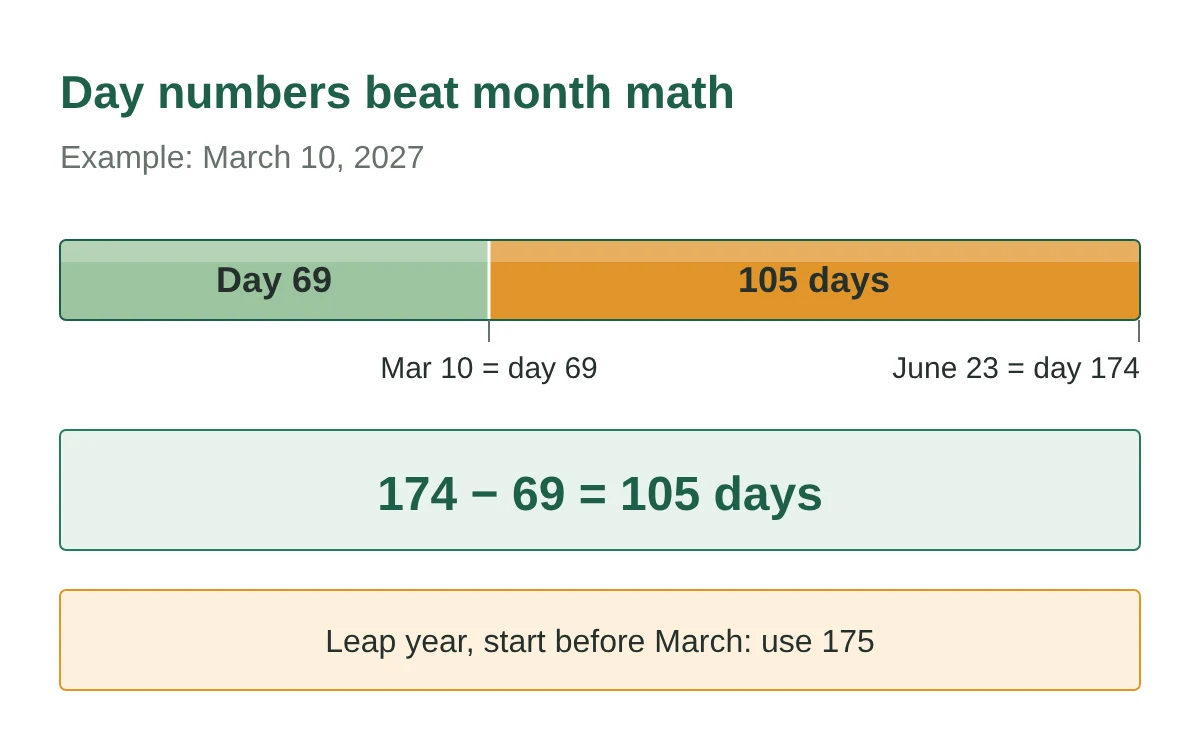
The slowest method is adding up month lengths. The faster one uses day-of-year numbers. Take the day-of-year of your starting date, subtract it from 174 (or 175 if the year is a leap year and your start date is after February), and you have the answer.
Here is a worked example with a made-up start date of March 10 in a non-leap year. March 10 is day 69 (31 + 28 + 10). Then 174 minus 69 is 105 days. The month-by-month check agrees: 21 days left in March, plus 30 in April, plus 31 in May, plus 23 in June, which is also 105.
The common mistake is the leap-day trap. If your start date is in January or February of a leap year, June 23 is day 175, not 174. If you start after February 29, the leap day is already behind you and the difference comes out the same either way. For any messy range, the date calculator does the subtraction for you.
Try this: Pick any date in the next month and work out the gap to June 23 using day numbers (June 23 = 174). Then check it against the live widget. If you are off by one, you almost certainly mixed up counting rules.
Why your count and someone else’s can differ by one
A countdown to a date really counts to the first instant of that date, which is midnight at the start of June 23 in your time zone. The widget works that way. If you want to know how many days you have before the day begins, that is the number. If you want to include June 23 itself as a full day, add one.
Time zones create the other disagreement. Someone in Auckland reaches June 23 many hours before someone in Los Angeles, so two correct countdowns can show different day counts at the same moment. A shared event with a fixed start time is better counted to that moment, not to midnight. The Central time page is handy for checking what hour it is in a given zone.
Weeks and weekdays to June 23
Dividing by 7 gives full weeks and a remainder, and the remainder tells you the weekday shift. If the gap is 105 days, it is exactly 15 weeks, so you start and finish on the same weekday. A remainder of 3 means June 23 falls three weekdays later in the week than the day you started.
For working days, multiply the full weeks by 5, then walk through the leftover days one by one. In the 105-day example that is 15 × 5 = 75 weekdays, with nothing left over. When a remainder exists, only the leftover days need checking, which is far quicker than scanning a calendar.
Public holidays then come off the weekday total. In the United States, Memorial Day (the last Monday in May) and Juneteenth (June 19) sit in the final stretch before June 23. The June 19 countdown shows how close that one is.
What June 23 is known for
June 23 is crowded with observances, but few are public holidays. International Olympic Day marks the founding of the International Olympic Committee in 1894, and it was officially created in 1948. International Widows’ Day was formally adopted by the UN General Assembly on 21 December 2010. The UN also marks Public Service Day on this date, and International Women in Engineering Day was established in 2014.
Some countries treat the date as genuinely special. Luxembourg celebrates its National Day on June 23, tied to the Grand Duke’s official birthday. Estonia observes Victory Day and Jaaniõhtu, and Latvia marks Jāņi. If you are counting down to a trip, check local holiday closures, because shops and transport may behave like it is a Sunday.
There is no standard tax or school deadline attached to June 23 in the major English-speaking countries, so any deadline you are counting toward is likely your own or your employer’s.
The Midsummer connection
June 23 is St John’s Eve, the evening before the feast of Saint John the Baptist, and it is strongly connected with Midsummer. Bonfires are common across parts of Europe, including Spain, Estonia, Latvia and Cornwall’s Golowan Festival.
The solstice itself usually falls on June 20 or 21, so June 23 is not the astronomical peak. The date is a medieval church calendar anchor, not a sky event. Sweden and Finland do not use June 23 either: their Midsummer Eve moves to the Friday that falls between June 19 and 25, which in 2027 is June 25.
The weekday pattern across years
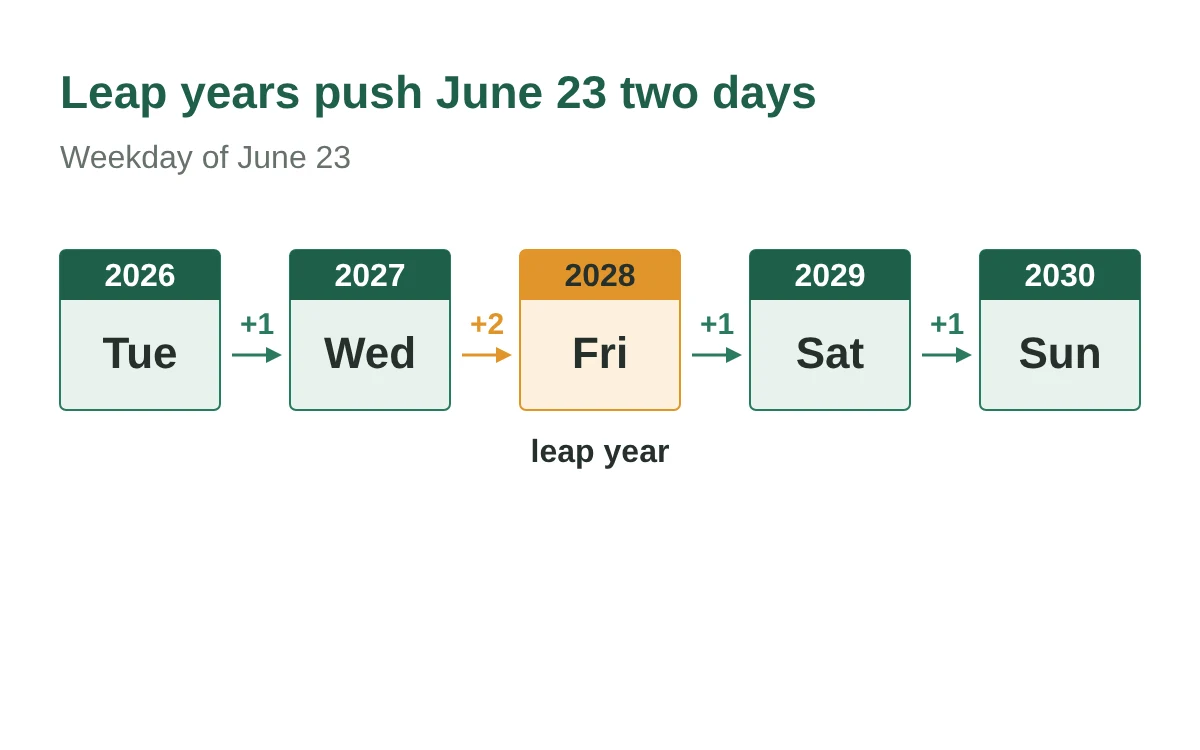
June 23 moves forward one weekday each year, or two after a leap year, because the leap day falls before it. That is why a Wednesday in 2027 becomes a Friday in 2028 (not a Thursday), then a Saturday in 2029 and a Sunday in 2030.
This is useful for planning ahead. If June 23 is a Friday, you are looking at a long weekend for anyone with Monday flexibility. If it is a Sunday, it is the day before a working week. A date that sits on a Tuesday or Wednesday, like 2027, tends to be a poor fit for weekend events, so book early or aim for the nearest Saturday. The neighbouring dates, June 24, are worth comparing if you have flexibility.
Planning backward from June 23
Counting down works better when you split it into stages. A gap of about 90 days is a natural planning window for bookings, applications and training plans, so mark the date that is 90 days before June 23 and treat it as your first milestone. Most deadlines that matter (flights, venue holds, visa appointments) fall in this stretch.
A better scheme is to work backward in halves. Set a checkpoint at the midpoint, then at the midpoint of what remains, and so on until the last week. This gives you fewer, more meaningful dates than a daily or weekly list, and each checkpoint has a clear purpose.
Try this: Write down your goal for June 23, then set three checkpoints by halving the remaining time twice. Put each in your calendar with a one-line description of what must be done by then.
For a broader view of the days leading up to it, the June countdown shows where the month sits in the year.
Frequently asked questions
How many days until June 23?
The live countdown above the article gives the exact figure for your own clock and time zone. It always targets the next June 23, so once the date passes it rolls over to the following year.
Is June 23 a public holiday?
Not in the United States, the UK or most countries. It is a public holiday in Luxembourg (National Day) and Estonia (Victory Day), and the eve of St John's Day is widely celebrated across Europe.
What day of the week is June 23?
It changes each year. June 23 falls on a Wednesday in 2027, a Friday in 2028, a Saturday in 2029 and a Sunday in 2030.
How many days from June 23 to the end of the year?
In a normal year June 23 is day 174, which leaves 191 days to December 31. In a leap year it is day 175, which leaves 191 days as well, because the extra day is added to both sides.