
How Many Days Until June 6th?
Calendar
Countdown chart
The live widget above gives the exact answer, calculated from your own clock and time zone. It counts down to the start of the next June 6, and once that day arrives it moves on to the following year, so it never shows a negative number.
The rest of this page covers what the widget can’t: how to get the same answer on paper, how to know the weekday of any June 6 without a calendar, and the few spots where two correct counts can disagree.
Counting to June 6 by hand
There are two reliable methods. The first is month stepping: take the days left in your current month, add the full months in between, then add 6. The second is day numbers: June 6 is day 157 of a normal year (151 days through May, plus 6), so subtract your start date’s day number from 157.
Take a hypothetical start of March 15 in a non-leap year. Month stepping gives 16 days left in March, plus 30 for April, plus 31 for May, plus 6, which is 83. Day numbers give March 15 as day 74 (31 + 28 + 15), and 157 minus 74 is also 83. Running both methods is a cheap error check.
Try this: Pick any start date you like, work out the count with both methods, and see if they match. If they differ, the usual culprit is February’s length or a miscounted 30/31 month.
The weekday trick: June 6 is a Doomsday
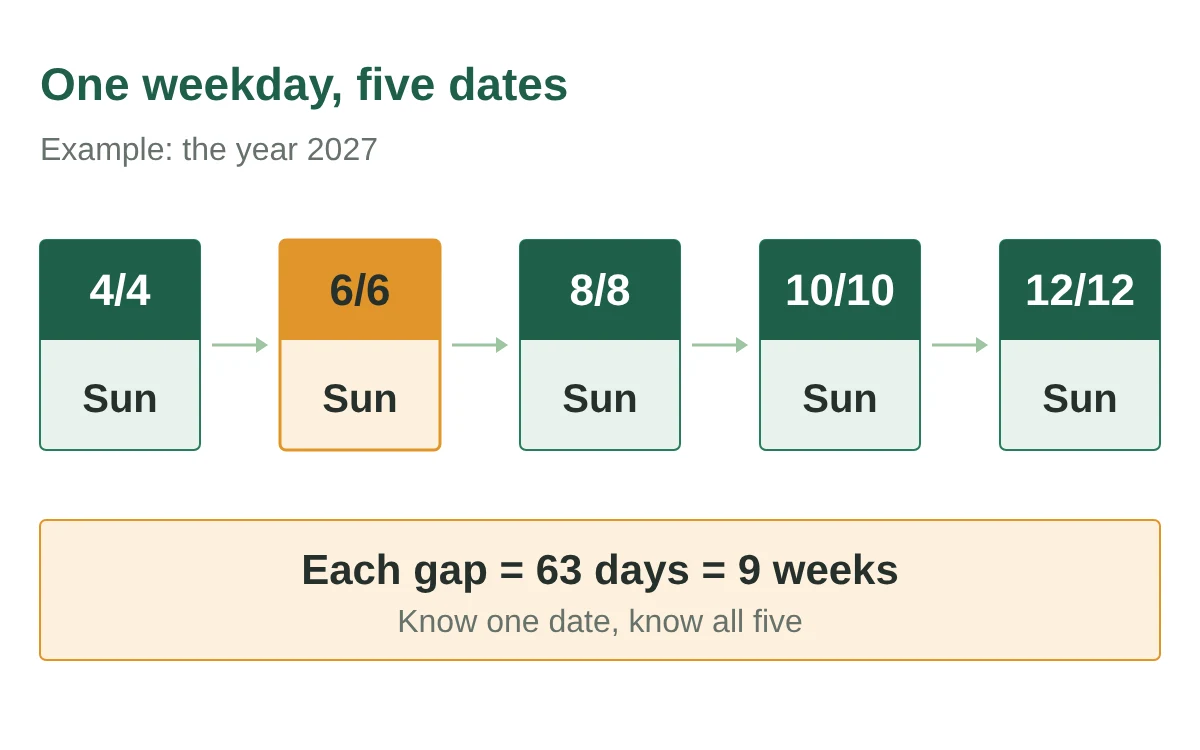
Calendar mathematicians use a pattern called the Doomsday rule. In any year, 4/4, 6/6, 8/8, 10/10 and 12/12 all land on the same weekday. So June 6 and August 8 are always the same weekday, and so are April 4 and December 12.
That also explains how the date drifts. A normal year shifts it forward one weekday, a leap year shifts it two. It is a Sunday in 2027, then a Tuesday in 2028 because February 29, 2028 adds the extra step. After that it runs Wednesday in 2029 and Thursday in 2030. If you already know a neighbouring date’s weekday, the June 4 countdown or June 7 countdown is a short step away.
Weeks and weekdays to June 6
Divide your day count by 7. The quotient is full weeks and the remainder is loose days. For the 83-day example, that is 11 weeks and 6 days. If you only want the weeks, the weeks until June 1 page shows the same idea for a nearby date.
Weekdays need one more step: multiply the full weeks by 5, then count the Monday-to-Friday days in the leftover stretch. Assume the example starts on a Monday. The 11 full weeks hold 55 weekdays. The 6 leftover days run Tuesday to Sunday, which adds 4 more. That gives 59 weekdays, counting from the day after the start up to and including June 6. The classic mistake is counting both endpoints, which can add one phantom day. Decide first whether the start day and June 6 are in or out.
Hours, time zones and the daylight saving catch
The widget counts to midnight at the start of June 6 in your zone. A friend in another zone sees a different number of hours, and sometimes a different day count, for the same moment. Whoever is farthest east reaches June 6 first.
Daylight saving causes a quieter problem. If clocks change between now and June 6, one calendar day is 23 or 25 hours long. Multiplying days by 24 then misses by an hour. The day count stays correct, but any hour or minute total should come from the widget, not from arithmetic. For converting between units, time conversions covers the standard ratios.
Leap years and day numbers
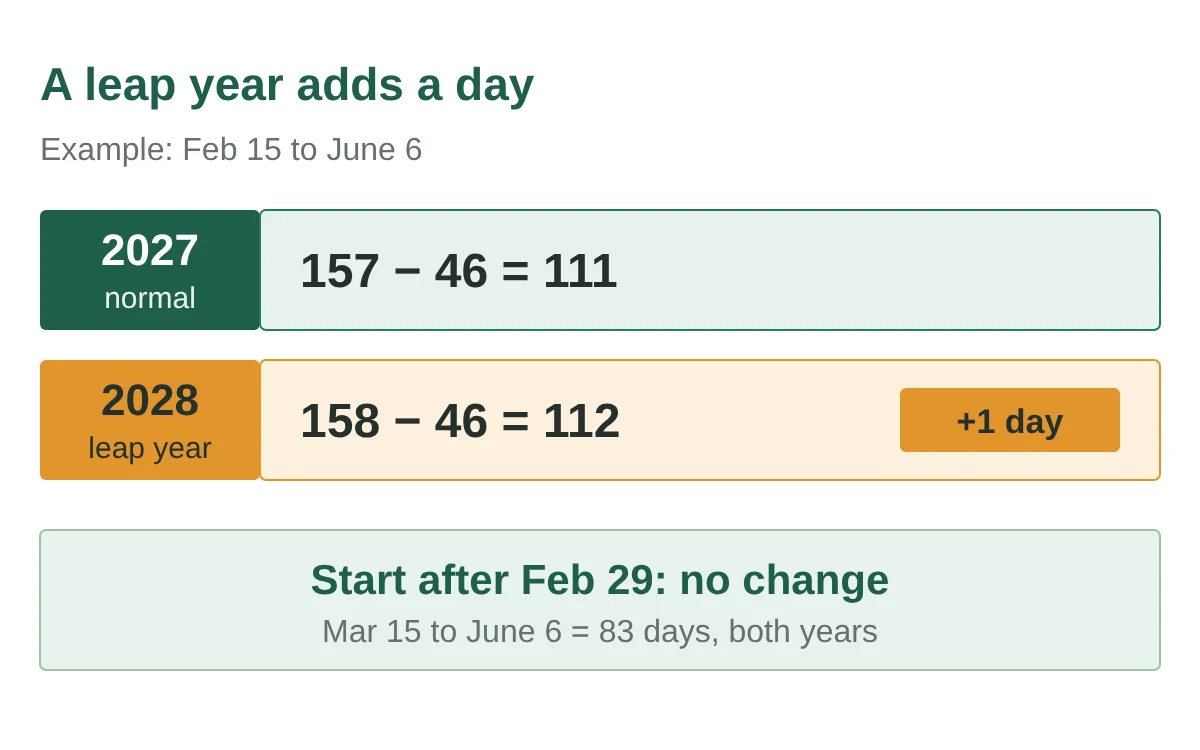
June 6 is day 157 in a normal year and day 158 in a leap year. The 157 shortcut therefore only works if the span you are measuring sits in a non-leap year, or you adjust by one after February 29.
This matters when you count across a year boundary. If the target year is a leap year and your start date falls before February 29 of that year, the real answer is one day more than a non-leap calculation suggests. If your start date is after February 29, the extra day is already behind you and nothing changes.
What June 6 is known for
Two of the most widely recognised events fall on this date. D-Day, the Allied landings in Normandy during the Second World War, took place on June 6, 1944, and the anniversary is commemorated every year. The “D” simply stands for “day”.
In Sweden, June 6 is National Day. It honours Gustav Vasa’s election as king in 1523 and the adoption of the 1809 constitution. It was named the National Day in 1983 and became a public holiday in 2005. South Korea marks Memorial Day (Hyeonchungil) on the same date.
Informal observances also land here, including National Yo-Yo Day and National Drive-In Movie Day in the United States. These are awareness days, not official holidays, so offices and schools do not close for them. June 6 also carries no federal tax deadline in the US.
One calendar quirk: Sweden’s holiday is fixed to the date, so in years when June 6 falls on a weekend, as it does in 2027, no weekday off results. Sweden replaced Whit Monday with it, which was always a Monday.
Planning around the countdown
Milestones work better than a single end date. Use the date calculator to work backwards from June 6: 100 days before, 10 weeks before, 30 days before. Each becomes a checkpoint for travel booking, event invitations or a personal goal.
Multiples of 7 are the most practical checkpoints, because they land on the same weekday as June 6. A deadline set 8 weeks out (see 8 weeks in days) falls on a Sunday when the target is a Sunday, which makes it easy to schedule around.
If June 6 is attached to a personal date, such as an anniversary or a birth, the birthday countdown works the same way and reads the date from your input. For the whole month at once, the days until June page shows the start of the month as a reference point.
Try this: Write down June 6’s weekday for the target year using the Doomsday rule, then check it against the widget. Do it for three different years and the pattern will stick.
Frequently asked questions
Does the countdown include June 6 itself?
The live count measures the gap between now and midnight at the start of June 6 in your time zone. That means June 6 is not counted as a full day you still have to wait through. If you want to include the day itself, add one.
What day of the week is June 6?
It moves forward one weekday each year and two after a leap year. June 6 is a Sunday in 2027, a Tuesday in 2028, a Wednesday in 2029 and a Thursday in 2030.
Is June 6 a public holiday?
It is a public holiday in Sweden (National Day) and in South Korea (Memorial Day). It is not a US federal holiday or a UK bank holiday.
Why does the hour count sometimes differ from days times 24?
If a daylight saving change falls between now and June 6, one day in the span has 23 or 25 hours. The total number of hours then shifts by one compared with a simple multiplication.