
How Many Days Until November 13th?
Calendar
Countdown chart
The live countdown above gives the exact answer to “how many days until the 13th of November” on your own clock and time zone, down to the second. It always aims at the next November 13, so once the date begins it rolls over to the following year. The rest of this page is for checking that number by hand, converting it into weeks and weekdays, and avoiding the small mistakes that make two countdowns disagree.
November 13 is a fixed date with a few useful properties, and most of them make mental math easier than you would expect.
Count it by hand in under a minute
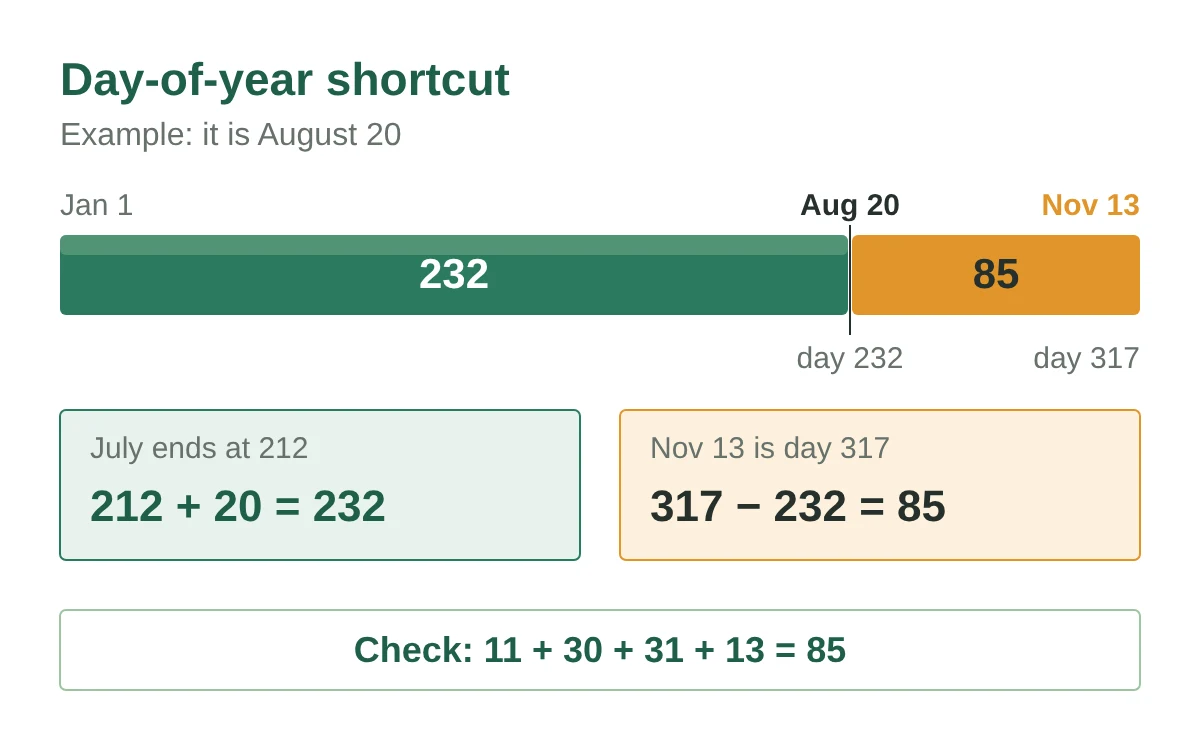
The fastest method uses day-of-year numbers. November 13 is day 317 in an ordinary year and day 318 in a leap year. Find the day-of-year of your start date, then subtract it from 317 (or 318). The memorised month-end totals are 31, 59, 90, 120, 151, 181, 212, 243, 273 and 304, for the end of January through October.
Worked example with a hypothetical start of August 20: July ends at 212, so August 20 is day 232. Then 317 minus 232 is 85 days. Check it the slow way: 11 days left in August, 30 in September, 31 in October, 13 in November, which also gives 85.
A shortcut for any start in November: it is simply 13 minus the start day. For any start in October, add 31 to that arithmetic: (31 minus the start day) plus 13.
Try this: Pick any date three months out, work out its day-of-year from the month-end totals above, and subtract it from 317. Then compare with the widget’s logic using the date calculator. Two or three rounds make the method automatic.
Weeks and weekdays to November 13
Divide the day count by 7. The whole number is the weeks, and the remainder tells you how many days the target date sits past the same weekday as your start. In the hypothetical 85-day example, that is 12 weeks and 1 day, so November 13 falls one weekday after the starting weekday.
Weekdays are quicker than most people expect. Each full week holds exactly 5 weekdays, so multiply the weeks by 5 (12 weeks gives 60). Then walk through only the leftover days. If the example started on a Monday, the single leftover day is a Tuesday, giving 61 weekdays if you count November 13 and exclude the start day.
Be clear on whether the target day itself counts. Business-day counts usually include it only if you need the work done on that day. Public holidays are not subtracted by this method, so take those off separately.
Why two countdowns can disagree by a day
Countdown tools differ on three small choices. Some count to the start of the target date, some to its end. Some treat today as a full day, and some judge “today” by UTC instead of your local clock. The result is a one-day gap that looks like an error but is really a definition.
The biggest trap is the rollover. On the day itself, one tool may show zero, another may jump to the next year, and a third may show the previous year as a negative. The widget on this page uses your device clock and targets the next occurrence, so it answers “how long until the date begins” rather than “how many days are in between”.
If the answer matters for a deadline, check the start moment. A countdown to midnight is different from one to 9 a.m. on the same date. For the clock-time version of the question, see how long until midnight.
Daylight saving and the hours count
Days and hours do not always convert cleanly. In the United States, clocks go back on the first Sunday of November, which is always before the 13th. Any countdown that starts earlier in the year and shows hours will cross a 25-hour day, so the hours figure is one more than days times 24.
Europe changes clocks on the last Sunday of October, so the same effect applies there, although the dates differ. Southern Hemisphere countries have their own schedule. A countdown that works with calendar dates, not raw hours, is immune: the day count stays whole.
If you need hours, trust a tool that uses your time zone’s rules. Multiplying days by 24 is correct only when no clock change falls in between.
What November 13 is known for
World Kindness Day is observed on November 13, and it has been marked since 1998. It is a good example of a date people plan small acts around, from office notes to school activities. It is not a public holiday anywhere, so there are no closures to plan for.
The date has no fixed tax or school deadline that applies broadly, so check your own institution’s calendar rather than relying on a general rule. Local filing dates, term dates and contract deadlines vary by country, state and employer.
Seasonally, it is late autumn in the Northern Hemisphere and late spring in the Southern Hemisphere. In the Northern Hemisphere, the date comes a couple of days after Veterans Day and Remembrance Day on November 11. You can compare with the November 11 countdown if you are planning around both.
Patterns that make the date easy to anchor
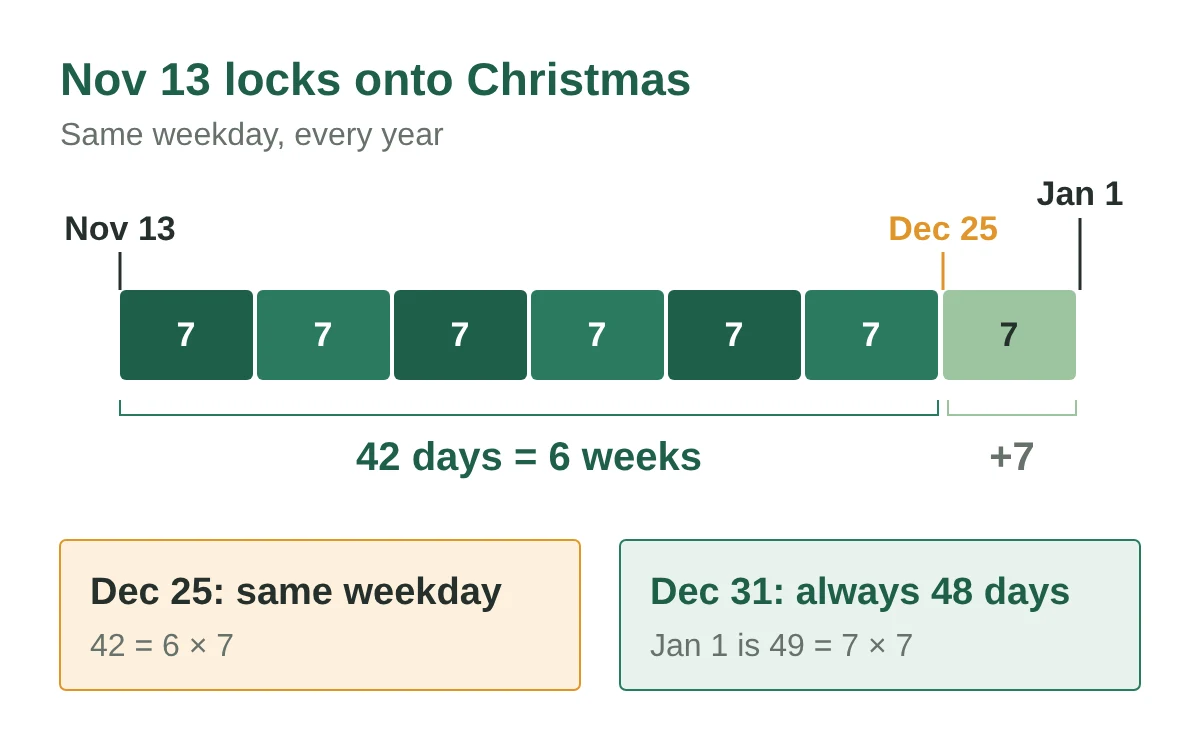
November 13 is always exactly 42 days before December 25, which is six weeks to the day. That means Christmas falls on the same weekday as November 13 every year. Counting 49 days forward reaches January 1, also a whole number of weeks.
The count to the end of the year is fixed at 48 days, in every year. That is useful for year-end budgeting: from November 13 you always have the same runway.
Thanksgiving in the United States, the fourth Thursday of November, lands between 9 and 15 days after November 13. Whenever you see the 13th, you know the holiday is closer than two weeks away. For a nearby checkpoint, compare with the November 25 countdown.
Friday the 13th and how the weekday cycles
The weekday of November 13 advances by one each ordinary year and by two after a leap day. A Friday the 13th in November therefore returns on a pattern: 2015, 2026 and 2037. That is an 11-year gap, and it is a common spacing for November specifically.
If your date lands on a Friday and you want to count down to that weekday in general, the days until Friday page does it. For November 13 itself, the widget above always shows the exact weekday for the next occurrence.
Planning ideas for the countdown
Set milestones as fractions of the count, not as fixed days. Marking the halfway point, the final quarter and the last 14 days spreads effort better than a daily tally. Because November 13 sits before the main December rush, it works as an early anchor for gifts, travel bookings and year-end projects.
Work backwards for deadlines. If something takes 10 working days, subtract those from the weekdays figure, not from the plain day count. Allowing for weekends is the most common planning gap.
Try this: Take the day count shown in the widget, divide it by 4, and write the date each quarter-point falls on. Put those four dates in your calendar as check-ins.
For a wider view of the lead-up, the December countdown shows how much of the year remains after this date. Use the all date countdowns index to find any other date.
Frequently asked questions
What happens to the countdown after November 13 passes?
A well-built countdown switches to the next November 13 as soon as the date begins on your clock. If you need a count to a specific year, use the date calculator and enter the full date.
How many days are left in the year after November 13?
Always 48, in leap years and ordinary years alike, because the remainder of November (17 days) plus all of December (31) never changes. February 29 sits earlier in the year, so it does not affect this.
Is November 13 the same weekday every year?
No. The weekday moves forward by one each ordinary year and by two after a February 29. The same weekday returns after 5, 6 or 11 years, depending on where the leap years fall.
Does the countdown include November 13 itself?
The live widget counts to the moment November 13 begins at midnight on your clock. That means the date itself is not counted as a full day you wait through.