
How Many Days Until November 1st?
Calendar
Countdown chart
The live widget above gives the exact answer: it counts from the current moment on your device’s clock to the start of the next November 1 in your own time zone. That count ends at 00:00 local time, so it reaches zero at the first second of the date, not at the end of it.
The rest of this page covers what the widget does not show: how to check it by hand, how to convert it to weeks and weekdays, and a few quirks that make two calculators disagree.
The by-hand method for counting to November 1
The shortest route is day-of-year arithmetic. November 1 is day 305 of a common year and day 306 of a leap year, because the ten months before it hold 304 days in a common year. Look up the day number of your starting date, subtract it from 305 (or 306), and you have the gap.
A second shortcut uses month blocks. Any date from the 1st of September to November 1 is exactly 61 days (September has 30 days, October has 31). From the 1st of October it is always 31. From the 1st of any earlier month, add the full months in between. The days until September 1 page is a handy anchor for the first block.
The leap day only matters if February 29 sits between your start and November 1. In a leap year, a start date in March or later is unaffected, so the “305” rule works unchanged for it. Only starts in January or February need the 306 adjustment.
A worked example with a hypothetical date
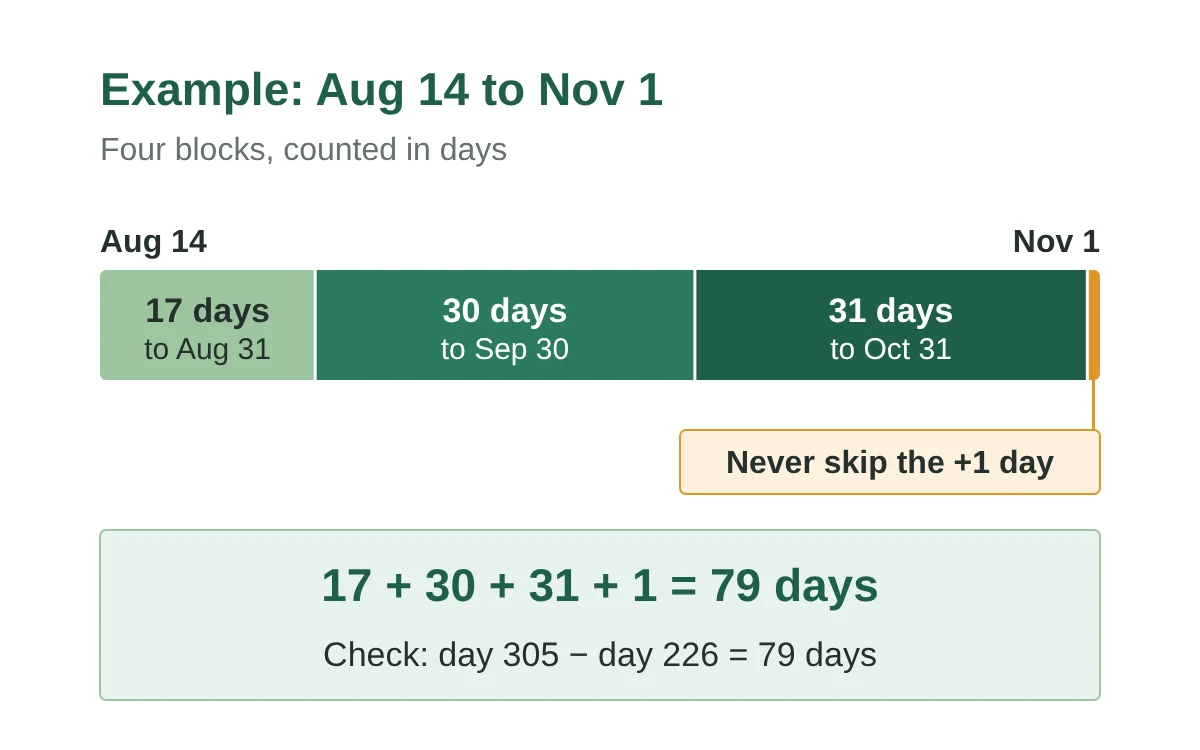
Say the starting date is August 14 (a made-up date, not today). In a common year, Jan to Jul adds up to 212 days, so August 14 is day 226. Then 305 minus 226 gives 79 days.
Check it with the block method: 17 days finish August, 30 more cover September, 31 more cover October, and 1 more lands on November 1. That is 17 + 30 + 31 + 1 = 79. Both methods agree.
The usual mistake is dropping that final “+1” and landing on October 31. If your by-hand answer is one short of the widget, that is almost always the cause.
Try this: Pick any date three months from now and count to November 1 twice, once by day-of-year subtraction and once by month blocks. If the two answers differ, recheck the month lengths.
Counting weeks and weekdays
Divide the day count by 7. The quotient is whole weeks and the remainder is loose days. In the example above, 79 days is 11 weeks and 2 days. The page on weeks until November 1 does this conversion for you.
For weekdays, multiply the full weeks by 5, then look at what day of the week the leftover days land on. Suppose the starting day is a Monday (as August 14, 2028 is). The 11 full weeks hold 55 weekdays. The 2 leftover days are Tuesday, October 31 and Wednesday, November 1, which add 2 more, so the total is 57 weekdays counting November 1 itself. Holidays are not subtracted, so work-day plans need a separate check.
For longer or odd spans, the date calculator handles any pair of dates and adds or subtracts days.
Why a day count can be off by an hour
Multiplying days by 24 to get hours breaks when a clock change falls inside the span. In the United States, clocks go back on the first Sunday of November, which can be anywhere from November 1 to November 7. When November 1 is itself a Sunday, the change happens at 2 a.m. that day, so that date is 25 hours long.
Counting to midnight at the start of November 1 is unaffected in the US, because midnight comes before the change. A countdown to a time later that morning would be an hour longer than days times 24.
In the UK and EU the change comes earlier, on the last Sunday of October. Any count to November 1 that starts before that Sunday crosses it, so the hours total is one more than 24 times the days. The widget uses your local rules, so it handles this correctly. See the page on how long until midnight for how the midnight rollover itself works.
The 11/1 trap
In the United States, 11/1 means November 1. Across most of Europe, Latin America and Asia, the same string reads as 11 January. A shared invitation or a deadline written this way can be off by about ten months.
For anything international, write the month as a word (“1 Nov” or “November 1”) or use the ISO form, 2027-11-01, which reads the same everywhere.
Try this: Look at the last three dates you received in messages or forms. Rewrite each one with the month spelled out and see whether any was ambiguous.
What November 1 is known for
November 1 is All Saints’ Day in Western Christianity, with All Souls’ Day following on November 2. It is a public holiday in a long list of countries, including France, Italy, Spain, Poland, Austria, Belgium and Portugal. In Mexico, Día de Muertos is observed on November 1 and 2, with the first day traditionally honouring children who have died.
The date also sits on the old Celtic festival of Samhain, which runs from the evening of October 31, and it is Algeria’s national day. In the Roman calendar, the first of a month was the Kalends, from which the English word “calendar” comes.
In the US it is not a federal holiday. It is simply the morning after Halloween, which is why seasonal candy and decorations tend to be marked down that day.
A fixed point for planning backwards
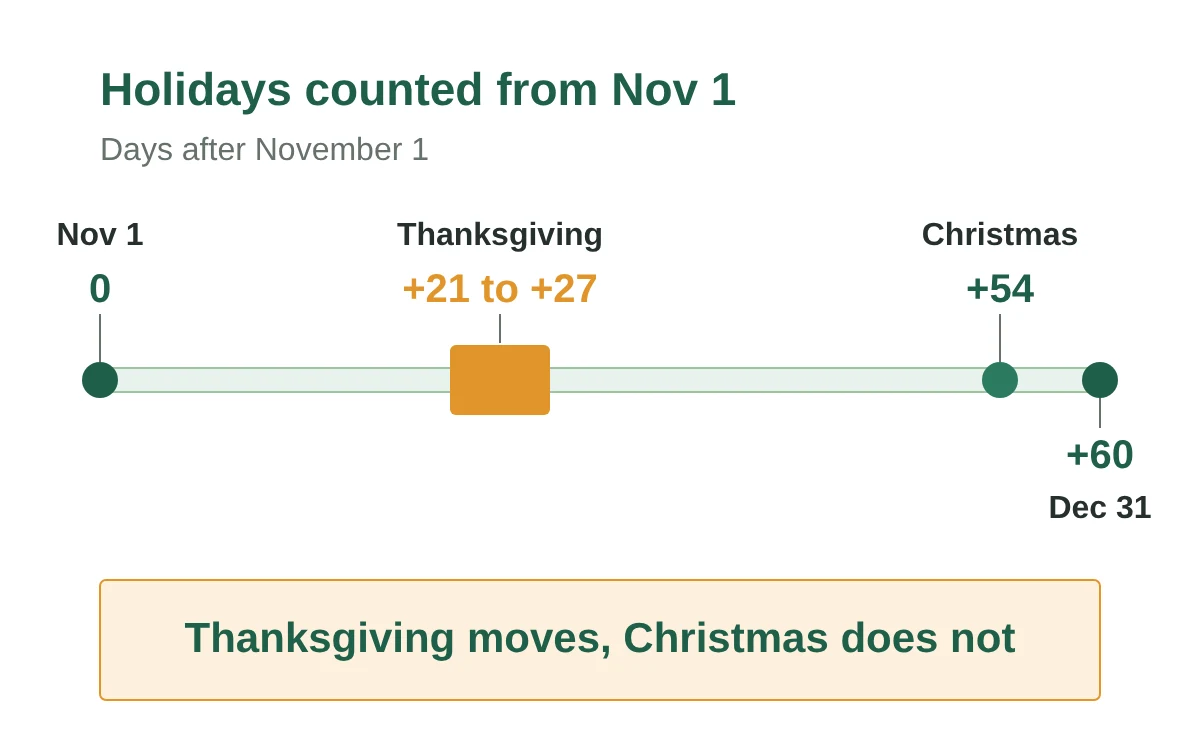
Because the calendar after November 1 never changes length, it gives you reliable constants. Christmas Day is always exactly 54 days later, and December 31 is always 60 days later. Thanksgiving in the US falls between 21 and 27 days after, since it is the fourth Thursday and that Thursday lands between November 22 and 28.
That makes November 1 a useful checkpoint. Shipping deadlines, gift budgets and travel bookings can all be set as “X days before November 1” and still hold from year to year. The count to the first of the following month, on the days until December page, is the natural next step.
US health insurance marketplace enrolment has traditionally opened on November 1, so some people treat it as an admin deadline. Check the current year’s dates with the official source, since they can change.
Planning ideas for the countdown
Work out the number of weekends left rather than days. Weekends are the real planning units for projects, and the number is usually small enough to feel actionable. Convert your widget count to weeks and set one milestone per fortnight.
If the month itself matters more than the day, the months until November page frames the same wait in months. And if you are counting toward a nearby date, November 2nd is a day later, so add one to your result.
Frequently asked questions
What day of the week is November 1?
It moves forward one weekday each year, or two after a leap year, so it cycles through all seven days over time. For example, it falls on a Monday in 2027 and a Wednesday in 2028.
Does the countdown include today?
The live widget counts whole days from your current moment to midnight at the start of November 1 on your own clock. Some sites add one by counting today, so the same date can show different numbers. Check the rule a calculator uses before comparing results.
Is November 1 a public holiday?
Not in the United States, but it is in many other countries. All Saints' Day is a public holiday in France, Italy, Spain, Poland, Austria, Belgium and Portugal, among others. Algeria also marks a national day on November 1.
What is the day number of November 1 in the year?
It is day 305 in a common year and day 306 in a leap year. That number is the key to the quick subtraction method for counting by hand.