
How Many Weeks Until November 1st?
Calendar
Countdown chart
The live counter above shows the exact answer in weeks and days, calculated from your own clock and time zone. By hand, the method is short: count the days left until November 1, divide by 7, and read the quotient as whole weeks and the remainder as extra days. The rest of this page covers the details that make hand counts go wrong, and how to plan around the result.
Most week counts online are accurate but presented differently, so two correct pages can seem to disagree. Knowing how the numbers are built lets you pick the version that suits your purpose.
Why week counts disagree
A count of days is exact. A count of weeks is a division with a remainder, and the remainder gets handled differently from site to site. Some show “48 weeks and 3 days”. Others show “49 weeks” because they rounded up. The same moment can produce both, and neither is wrong.
Pick the style by purpose. For a deadline, use whole weeks and keep the leftover days visible. For a rough sense of distance, rounding is fine. Another source of mismatch is the target year. Once November 1 has passed, a countdown correctly switches to the following year, and a site that did not update can show a number that is off by a full year.
Count it by hand with day numbers
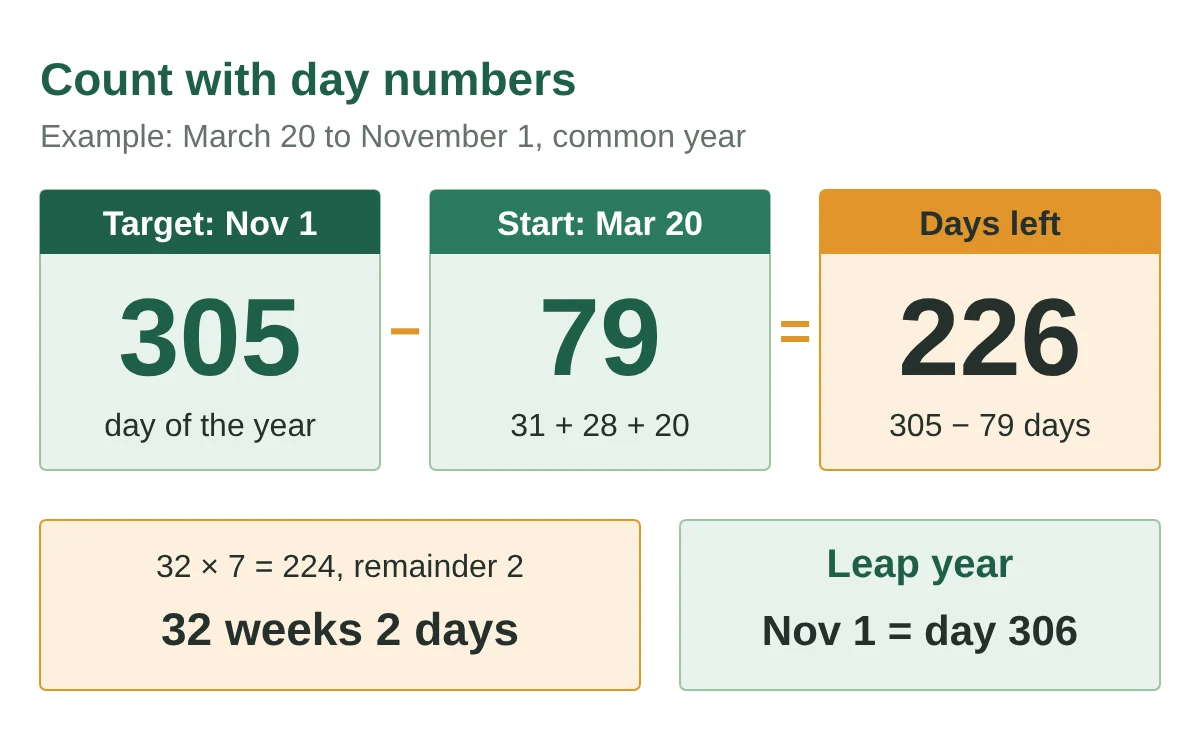
The cleanest method uses day-of-year numbers. November 1 is day 305 in a common year and day 306 in a leap year. Find the day number of your start date, subtract it from 305 (or 306), and divide by 7. Nothing in this method requires you to count month lengths one by one.
Here is a worked example with a hypothetical start of March 20 in a common year. March 20 is day 79 (31 + 28 + 20). Then 305 minus 79 is 226 days. Dividing, 226 is 32 times 7 (224) plus 2, so the answer is 32 weeks and 2 days.
If your start date falls after February in a leap year, add 1 to its day number, or use 306 as the target. The two corrections cancel, so only the target needs adjusting. Forgetting the leap day is the most common cause of a count that is a day short.
Try this: Pick any date you are curious about, find its day number, and subtract it from 305. Then divide by 7 and check your answer against the live counter above.
Counting weekdays instead
Often you want working weeks rather than calendar weeks. Multiply the whole weeks by 5, then count only the weekdays in the leftover days. In the example above, the 32 whole weeks give 160 weekdays. If the start is a Saturday, the 2 leftover days are a Sunday and a Monday, so the final Monday adds one more if you count November 1 itself.
The shortcut that fails is multiplying total days by 5/7. It gives a decimal that is close but rarely right, because the leftover days could be all weekdays or all weekend. Public holidays then come off the total. They vary by country, so subtract them by hand from the weekday figure.
The date calculator handles days between dates if you would rather skip the arithmetic, and the days countdown for this date shows the figure in days.
Which weekday November 1 lands on
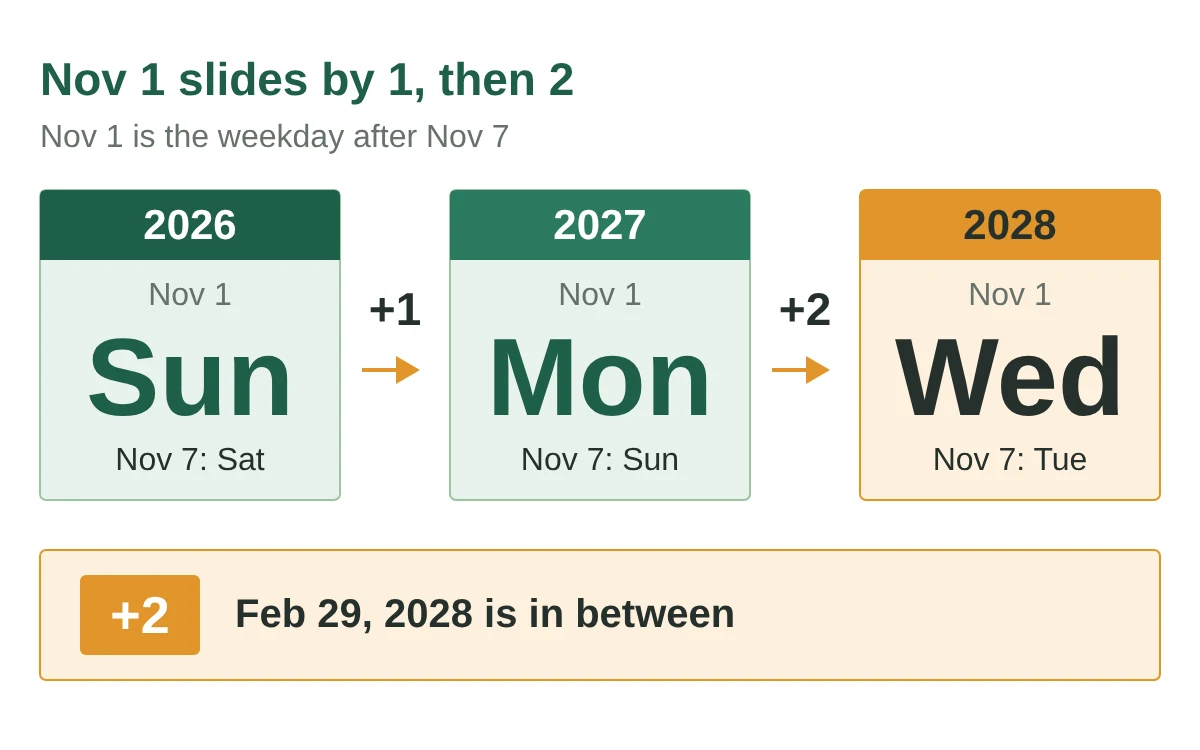
Here is a trick for working out the weekday without a calendar. November 7 is one of the “doomsday” dates, a set of dates in each year that all share a weekday. So November 1 is always the weekday after the one November 7 falls on. If November 7 is a Sunday, November 1 is a Monday.
Year to year, the date slides forward. The gap between one November 1 and the next is 365 days, which is 52 weeks and 1 day, so the weekday advances by one. When a leap day lies in between, the gap is 366 days and it advances by two. That is why a November 1 on a Monday in one year becomes a Wednesday after a leap year.
Time zones and clock changes
The countdown ends at midnight at the start of November 1 in your local time zone. Someone one zone east reaches the date earlier than you do, so a shared countdown only matches if everyone uses the same reference clock.
Clock changes add a second wrinkle. Counting in hours instead of calendar days can be off by one hour when a daylight saving change sits inside the range. Most of Europe ends daylight saving on the last Sunday of October, which is before November 1. Counting in calendar dates avoids the problem, which is why whole weeks are the safer unit.
In the United States, daylight saving ends on the first Sunday of November. In years when November 1 itself is a Sunday, the change happens on that very day.
What November 1 is known for
In the Western Christian calendar, November 1 is All Saints’ Day. It is a public holiday in many countries, including France, Italy, Spain and Poland. In Mexico and across Latin America, Día de los Muertos is observed on November 1 and 2, and All Souls’ Day follows on November 2.
It is also Algeria’s Revolution Day, and several Indian states mark their formation day on November 1, including Karnataka and Kerala. In the United States, the federal health insurance marketplace has traditionally opened enrollment for the coming year around this date, so check the current year’s dates on the official site.
Planning around the countdown
Work backward from the date and use the weeks as blocks. A 12-week plan, for example, ends with a clean 84-day span you can check against 84 days from now. For shorter plans, 90 days from now works as a quarter-sized block, and 8 weeks in days gives 56 days.
November 1 is also useful as a milestone for the holiday stretch. US Thanksgiving falls on the fourth Thursday, which is between 21 and 27 days after November 1, so a plan that finishes on November 1 leaves three to four weeks of cushion before it.
Try this: Write November 1 on the last row of a weekly list, then fill in the rows above it, one per week. Mark the weeks with a holiday or a trip so you can see how many are really free.
For the weeks leading up to it, the countdown to October 1 is a handy halfway marker, and the December 1 countdown covers the month after.
Once November 1 passes
After the date goes by, the next one is about 52 weeks away, so any weeks count you have saved becomes stale overnight. If you track a yearly goal toward November 1, re-check the target year, not just the number.
The most reliable habit is to keep the target as a full date, including the year, rather than as “November 1”. The month-level view on how many months until November helps for long ranges, while the weeks view suits anything under a year.
Frequently asked questions
How many weeks until November 1?
The live counter above gives the exact figure on your own clock, shown as whole weeks plus leftover days. To check it yourself, find the days remaining and divide by 7. The quotient is the whole weeks and the remainder is the extra days.
Is November 1 always the same day of the week?
No. It moves forward one weekday each year, or two after a leap day falls in between. It always lands on the weekday after the one November 7 has, which is a quick way to work it out.
Why does another site show a different number of weeks?
Most differences come from rounding. One site may drop the leftover days and another may round up to the next whole week. A few also count to a different year's November 1.
How many weeks are there between November 1 of one year and the next?
There are 52 weeks and 1 day, or 52 weeks and 2 days when a February 29 falls in between. That is why the date drifts one weekday later each year.