
How Many Days Until November 14th?
Calendar
Countdown chart
The live countdown above gives the exact answer to how many days till November 14, calculated from your own clock and time zone. It aims at the next November 14 to arrive, so it rolls over to the following year once the date has passed. The rest of this page covers how to get the same number by hand, how to count weekdays, and what the date marks.
The date is fixed, but the weekday is not. That small detail changes how you plan around it, and it is where most counting mistakes start.
Which November 14 the countdown aims at
A countdown to a recurring date needs a rule for “next”. The sensible rule is that the target is the first November 14 that has not yet started. During the day of November 14 itself, the count to the start of the date has already passed zero, so the target jumps a full year ahead.
This catches people who check on the day itself and expect to see zero. If you want a countdown that is still running on the day, aim it at the end of the date (11:59 PM) instead. Your own clock matters too: someone in Tokyo reaches November 14 many hours before someone in Los Angeles, so two people can see different whole-day counts at the same moment.
The 318 shortcut
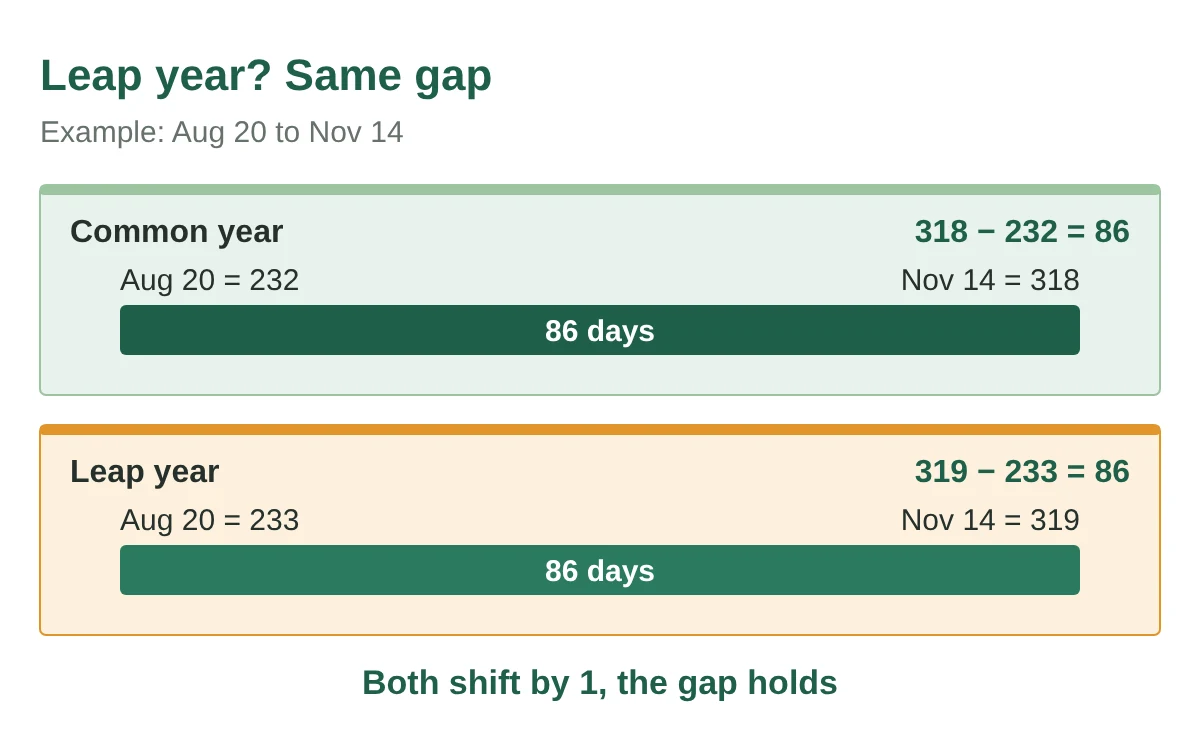
November 14 is day 318 of a common year and day 319 of a leap year. Subtract your starting day number from 318 and you have the answer for any start date earlier in the same year, with no month-by-month adding. Only the leap-year case needs the extra step: after February 29, both your start day and November 14 shift by one, so the difference stays the same.
The second useful number is 47. From November 14 to December 31 there are always 47 days, in any year. That makes the date a handy anchor for year-end planning: it is 41 days before Christmas Day and 47 days before the new year, whichever year you are in.
Try this: Pick any date from last week and look up its day-of-year number. Subtract it from 318 and compare the result with the live counter. If they match, you have the shortcut down.
A worked example by hand
Take a hypothetical start date of August 20 in a common year. Count the days left in each month, then add the target day:
- Rest of August: 31 minus 20 gives 11
- September: 30
- October: 31
- November 1 to November 14: 14
That is 11 + 30 + 31 + 14 = 86 days. The shortcut agrees: August 20 is day 232, and 318 minus 232 is 86.
The usual mistake is to count both the start day and the end day. Counting from August 20 to November 14 with both ends included gives 87, which is the number of calendar dates touched, not the number of days that must pass. The elapsed-days answer is the one a countdown shows.
Counting weekdays and weeks
Dividing 86 days by 7 gives 12 weeks and 2 days. For weeks, that is the whole answer. For weekdays, you cannot multiply by 5/7 and round, because the leftover days matter. The reliable method is to take 5 weekdays per full week, then count the weekdays in the leftover stretch by name.
In the example, say August 20 is a Friday in 2027. Counting from the next day, 12 full weeks cover 60 weekdays. The leftover 2 days are Saturday, November 13 and Sunday, November 14, which are both weekend days. The total is 60 weekdays, not the 61 that the rough 5/7 estimate suggests.
For other ranges, the date calculator handles weekdays and add-or-subtract logic in one place. For a sense of scale, 8 weeks is 56 days, so a range of about two months is easy to estimate before you count precisely.
Why the weekday keeps shifting
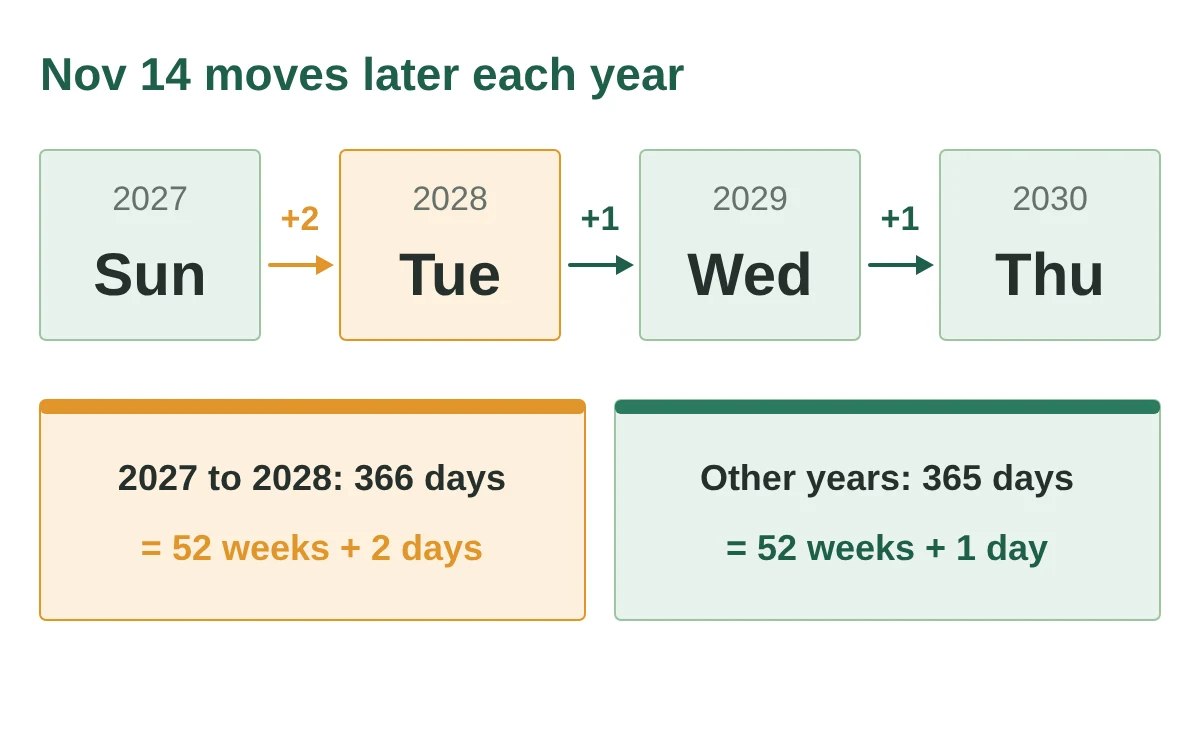
A non-leap year is 52 weeks plus one day, so a fixed date moves one weekday later each year. A leap day pushes the shift to two. November 14 follows that pattern:
- 2027: Sunday
- 2028: Tuesday (the leap day in February 2028 adds the extra step)
- 2029: Wednesday
- 2030: Thursday
The practical consequence is that a Sunday target means any working-day deadline “by November 14” really lands on the Friday before, 2 days earlier than the calendar date suggests. When a date falls on a weekend, subtract before you plan, not after.
Try this: Write down the weekday of November 14 for the next four years from the list above, then circle any that fall on a Saturday or Sunday. Those are the years where your real deadline is earlier.
When the hour count looks one hour off
Multiplying days by 24 gives the wrong hour total whenever a daylight saving change sits inside the period. In the United States, clocks go back on the first Sunday of November, which in 2027 is November 7, a week before the target. A count that starts between mid-March and early November therefore contains 25 hours on that one day, so it has one more hour than days times 24.
If the count starts before the spring change, the two shifts cancel and the totals match. This is why a live counter reading from your own time zone is more trustworthy than a static table. If you need other unit totals, the time conversions page covers the standard factors.
What November 14 is known for
World Diabetes Day falls on November 14. It was launched in 1991 by the International Diabetes Federation and the World Health Organization, and the date marks the birthday of Sir Frederick Banting, who co-discovered insulin. The United Nations designated it an official UN day in 2006.
In India, November 14 is Children’s Day (Bal Diwas), held on the birthday of Jawaharlal Nehru, the country’s first Prime Minister, who was born in 1889. India has marked the day on his birthday since 1964, and schools commonly hold festivals and cultural programmes. The date is also the birthday of King Charles III, born in 1948.
In the Northern Hemisphere it is late autumn, and in the Southern Hemisphere it is late spring. It is not a public holiday in the United States, and no federal tax deadline falls on it, so any deadline you have tied to the date comes from your own school, employer or contract.
Planning around the countdown
Because November 14 usually lands in the middle of the run-up to year-end, it works well as a checkpoint. It sits 11 days before US Thanksgiving in 2027 (November 25), so the countdown doubles as a gauge for travel bookings. If you are also tracking neighbouring dates, the pages for November 11 and November 18 sit on either side.
For longer planning, split the countdown into stages rather than watching the total fall. Divide the full gap into quarters and give each quarter one deliverable. For a fixed Sunday target, set the real due date to the Friday before. If the occasion is a birthday or event, working back from the date in whole weeks keeps the schedule easy to read.
Frequently asked questions
How many days are left in the year after November 14?
Always 47, in leap years and common years alike. November 14 is day 318 of a common year and day 319 of a leap year, and the year has 365 or 366 days, so the gap is the same.
Does a countdown to November 14 include the day itself?
Most countdowns measure to the start of the date (midnight), so November 14 itself is not counted as a full day. If you count the date as a day you will be present for, add one.
What day of the week is November 14 in 2027?
Sunday. The weekday then moves to Tuesday in 2028, Wednesday in 2029 and Thursday in 2030, because a leap day in 2028 adds an extra step.
Why does my hour count differ from days times 24?
A daylight saving change inside the period adds or removes an hour. A countdown that crosses the November clock change in your region has one more hour than days times 24, unless it also crosses the spring change.