
How Many Days Until October?
Calendar
Countdown chart
The answer to “how many days until October” is on the live counter above, calculated from your own clock and time zone. It counts down to the first instant of 1 October, which is midnight at the start of that day, so the number you see is the days left before October begins, not the days left before it ends.
To check it yourself, subtract today’s day-of-year number from 274 (or 275 in a leap year). The rest of this page explains why that works, where counters disagree, and how to avoid the usual slips.
Which October does the count aim for
“October” has no single date, so every countdown has to pick one. The standard choice is the start of the next 1 October. If you want the 15th, the 31st or a deadline inside the month, the count is a different number. How many days until October 1st is the same target as this page, and the other day-specific pages cover the rest of the month.
Timing also matters once the month begins. From 2 October onward, the next 1 October is almost a full year away, so a counter that “resets” is behaving correctly. It has not broken.
Why two countdowns can disagree
Search a few countdown sites on the same day and you may see answers that differ by one, sometimes two. This is almost never an arithmetic error. It comes from three choices:
- Whether today counts as a full day or is skipped.
- Whether the target is midnight at the start of 1 October or the end of that day.
- Whose time zone defines “now”: the server’s, or yours.
The time zone point has the biggest effect. A server in Europe can already be on tomorrow’s date while your evening is still today. A counter that reads your device clock, as the widget on this page does, avoids that mismatch. When comparing against a friend in another country, expect a legitimate one-day gap.
The day-of-year shortcut
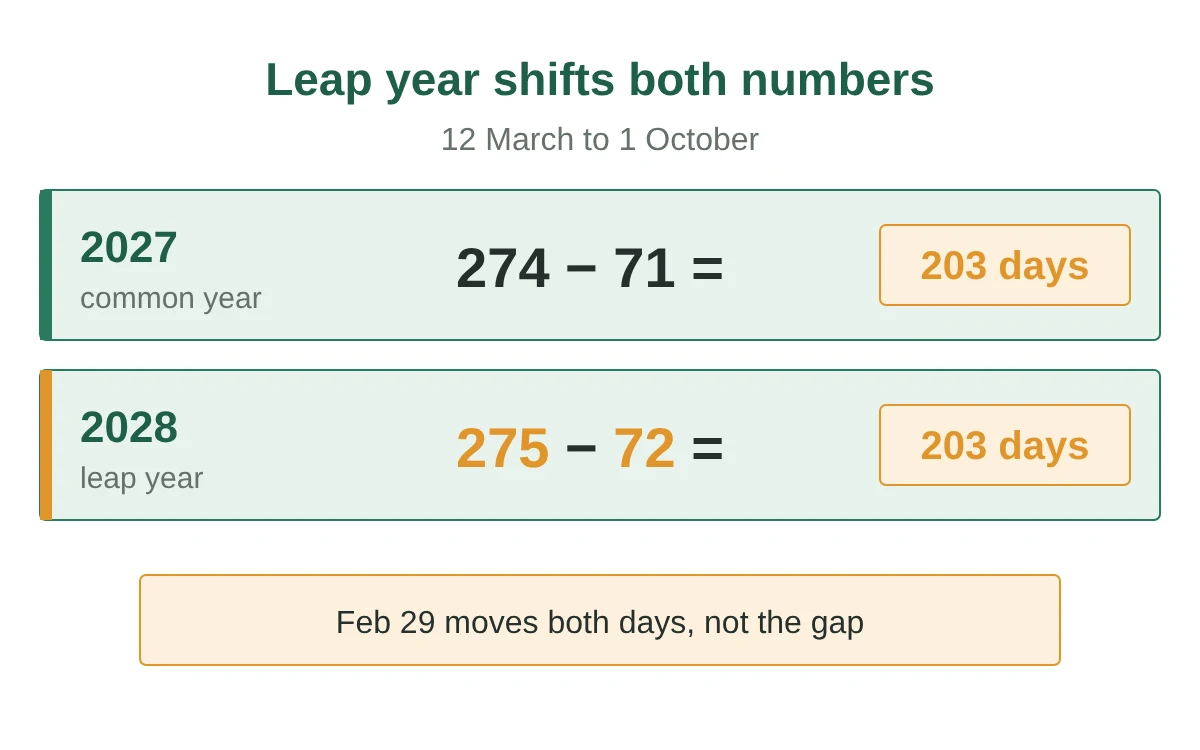
Every date has a position in the year, from 1 to 365 (366 in leap years). 1 October is day 274 in a common year, because January to September add up to 273 days. In a leap year it is day 275.
That turns the whole problem into one subtraction. Find today’s day-of-year number, subtract it from 274, and you have the days remaining. Most spreadsheets give the day-of-year directly, and you can also build it by adding up whole months and then the day of the month.
A worked example by hand
Take a clearly hypothetical start date of 12 March 2027. Here is the month-by-month method:
- Days left in March after the 12th: 31 minus 12 is 19.
- Add the full months in between: April 30, May 31, June 30, July 31, August 31, September 30. That is 183.
- Add 1 to land on 1 October itself.
- Total: 19 + 183 + 1 = 203 days.
The shortcut agrees. 12 March 2027 is day 71 (31 + 28 + 12), and 274 minus 71 is 203. Two independent routes giving the same figure is a good sign that you have not dropped a month.
Try this: Pick any date within the next fortnight. Work out its day-of-year number, subtract it from 274 (or 275 in a leap year), then compare with the widget. If you are off by one, check whether you counted the start date.
Finding the weekday without a calendar
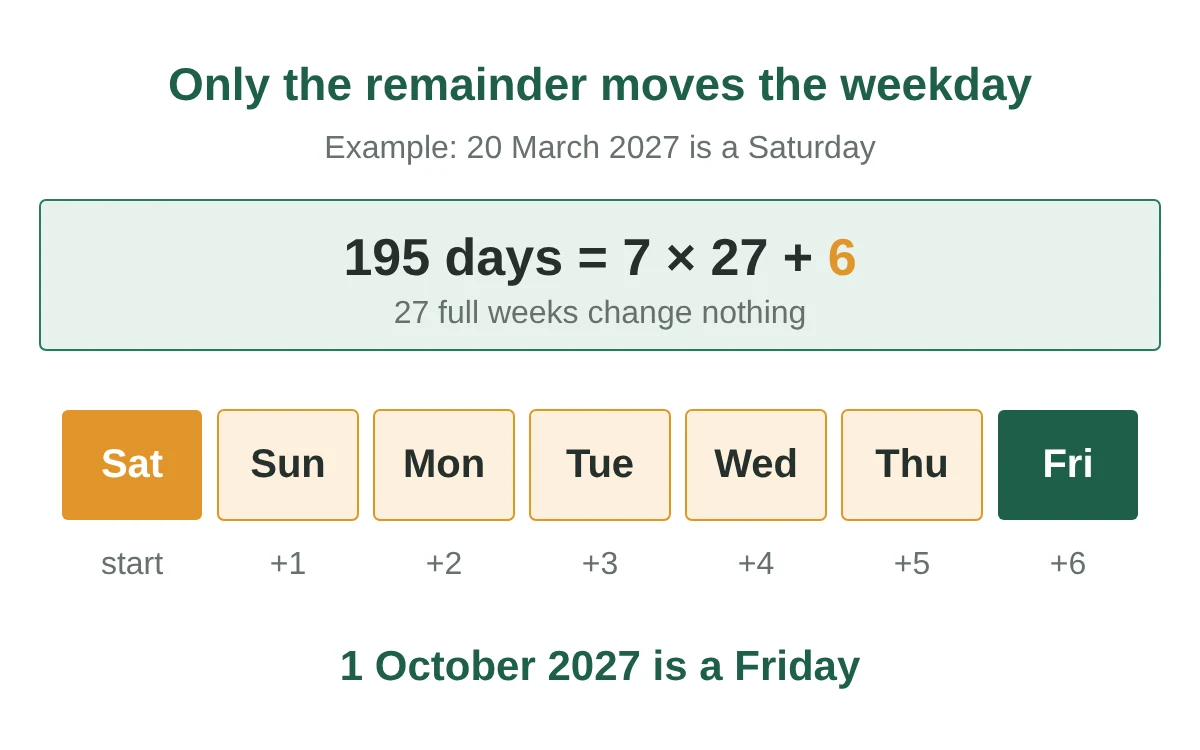
Since a week has seven days, you can get the weekday of 1 October by looking at the remainder when the day count is divided by 7. In the example above, 203 divides by 7 exactly (7 × 29), so 1 October lands on the same weekday as the start date. 12 March 2027 is a Friday, and 1 October 2027 is also a Friday.
For any count, a remainder of 1 moves you forward one weekday, a remainder of 2 moves you two, and so on. This is useful for planning, because it tells you in seconds whether the start of October falls at a weekend before you open a calendar.
Leap years and the 29 February catch
The 274 versus 275 difference only appears if 29 February falls between your start date and 1 October. If you are counting from March onward in the same year, a leap year makes no difference to the gap, since February is already behind you.
The trap is a long count that crosses a year boundary. Counting from a date in autumn to 1 October of the following year runs through February, so a leap year adds one day. A quick rule: a leap year is divisible by 4, except century years that are not divisible by 400. That is why 2100 is not a leap year, although 2000 was.
Weeks, months and weekdays
Dividing days by 30 to get months is a common shortcut, and it drifts. Months run 28 to 31 days, so a day count does not convert to months cleanly. For a proper calendar-month answer, use how many months until October, which counts whole calendar months and leftover days. For weeks, how many weeks until October 1st shows the full weeks plus the remainder.
Working days are a separate question. As a rule of thumb, multiply the number of full weeks by 5, then count the leftover days by hand. Public holidays in your region have to come off that total manually.
Try this: Take the day count from the widget, divide by 7, and keep the remainder. Multiply the whole weeks by 5 and add the weekdays in the leftover days. Compare it with a spreadsheet’s working-day function.
Hours, minutes and clock changes
Converting days to hours by multiplying by 24 is correct only if no clock change sits between now and 1 October. When daylight saving begins or ends in your region, one day in the span has 23 or 25 hours. That is why a countdown that shows hours can differ from days × 24 by exactly one hour.
For a shorter span, the date calculator lets you set a start and end date for any range. If you need a different month, the days until countdowns index has one for every month and many specific dates.
Frequently asked questions
How many days until October 1?
The live countdown above gives the exact figure for your own clock and time zone. To check it by hand, subtract today's day-of-year number from 274 (275 in a leap year).
Does the countdown include today?
The widget counts from your current moment to midnight at the start of 1 October. Many static pages count today as a full day instead, which is why published numbers can differ by one.
How many days are in October?
October has 31 days. That matters if you want to count to the end of the month rather than the start, because 31 October is 30 days after 1 October.
What happens to the countdown once October starts?
Once 1 October has passed, the next 1 October is the following year, so the count jumps to roughly a year. If you want a specific day inside October, use the page for that exact date instead.