
How Many Months Until October?
Calendar
Countdown chart
The exact answer to “how many months until October” is in the live widget above, calculated from your own clock and time zone. It is shown as whole calendar months plus leftover days, because that is the only form that stays accurate. A bare “about N months” hides up to a month of error.
The method behind that number is short enough to do in your head once you know two or three tricks. They also explain why different sites quote different answers for the same question.
The month-number shortcut
October is month 10, so the starting month’s number tells you most of the answer. Subtract it from 10 and you have the number of month boundaries between now and October 1. If you start on the 1st of a month, that subtraction is the whole answer.
For any other start day, the current month is only partly used up, so subtract one more. Starting mid-March (month 3) gives 10 minus 3, which is 7, minus 1 for the unfinished month, so 6 full months. The leftover days are what remain after you step forward those 6 months.
The shortcut only works for the next October that is still ahead. If October has already begun or passed this year, add 12 to the result, because the target moves to next year.
A worked example by hand
Take a clearly hypothetical start date of March 14, 2027, counting to October 1, 2027. Step forward whole months from the start date: March 14 plus 6 months lands on September 14. From September 14 to October 1 is 17 days (16 days to the end of September, plus 1). The answer is 6 months and 17 days.
To cross-check in days, add what is left of each month: 17 for March, then 30, 31, 30, 31, 31 and 30 for April through September, which totals 200. Add 1 to reach October 1 and you get 201 days. Our days until October page gives that count for the real date, and the date calculator handles any start and end pair you type in.
Try this: Pick any date six months from now. Subtract its month number from 10, subtract 1 if it is not the 1st, then step forward that many months and count the leftover days to October 1. Compare your result with the widget.
Why days divided by 30 drifts
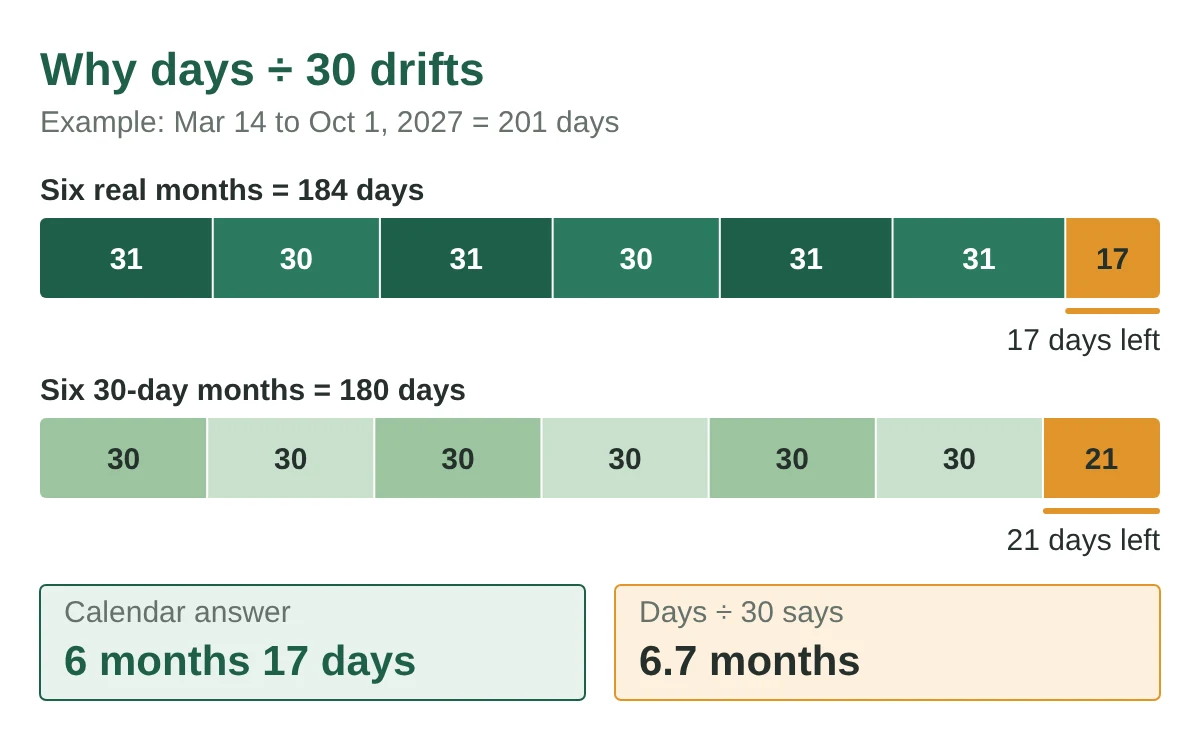
Dividing a day count by 30 feels natural, and it is the most common mistake. In the example above, 201 divided by 30 gives 6.7, which sounds closer to 7 months than 6. The true answer is 6 months and 17 days, and 17 days is just over half a month.
The error comes from months being uneven. The span from March to October contains five 31-day months and only two shorter ones, so it averages longer than 30 days. A better divisor is 30.44, the average month length across a year, and it gives 6.6 for the same example. That is much closer, but it still cannot tell you which calendar day you land on.
For quick day-to-month conversions in either direction, the 120 days to months page shows how the same ambiguity plays out.
Month-end starts and the clamping rule
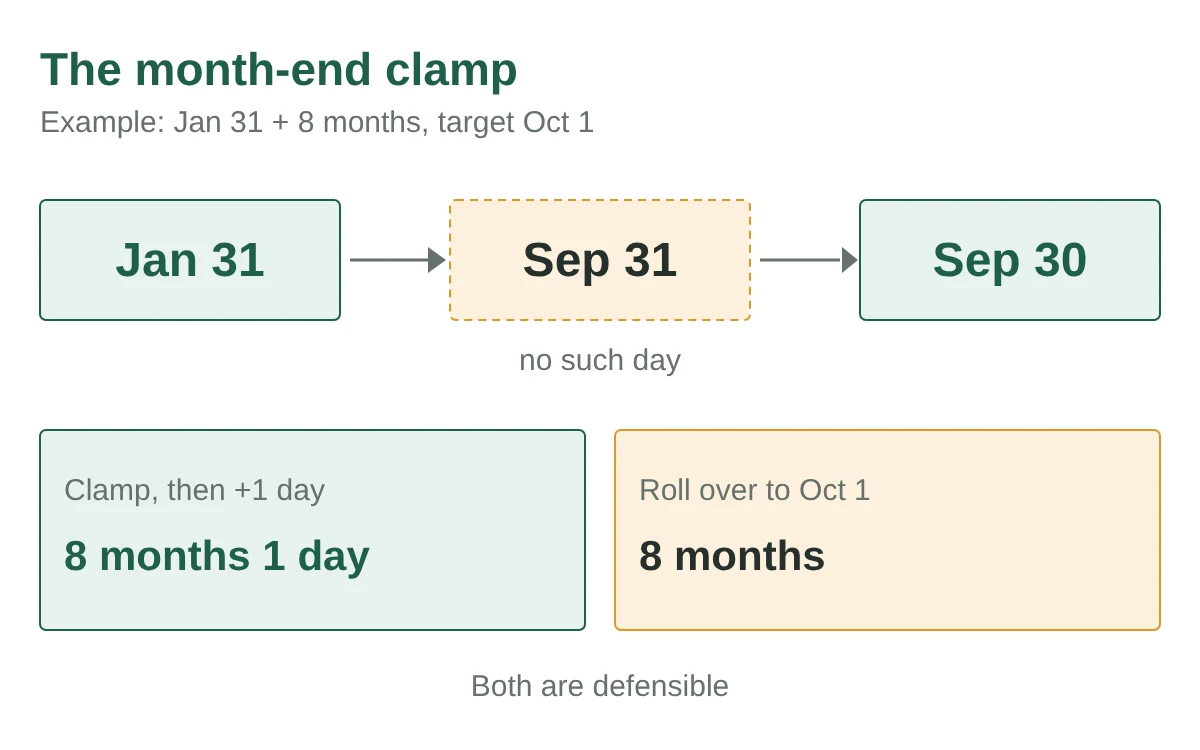
Starting on the 29th, 30th or 31st creates an edge case. Say you start on January 31 and add 8 months. That points to September 31, which does not exist. Most date libraries clamp it to September 30, then count 1 more day to October 1, giving 8 months and 1 day.
A stricter reading says January 31 plus 8 months is “end of September”, which gives the same landing. A looser reading rolls it over into October 1 itself and reports exactly 8 months. Both are defensible, which is why two counters can differ by a day at the end of the result.
The 31st is the worst start date for this. From a 31st start, any month with 30 days (or February) in the middle of the count triggers clamping. Starts on the 1st through the 28th never do.
Counting to the 1st versus a date inside October
“Until October” almost always means October 1, which is what the widget uses. If your real target is a specific day, such as a deadline, race or release, the months figure changes only when that day is in a different position than the 1st relative to your start day.
If your start day is the 14th and the target is October 20, the whole months are one more than for October 1, because September 14 plus 1 month already reaches October 14. For single dates, use a dedicated page such as days until October 1, or one of the pages for October 3 and October 9.
Try this: Write down the day number you start from and the day number of your target. If the target day is the same or later, your month count goes up by one compared with counting to the 1st.
Why October is the tenth month and named for eight
October comes from the Latin octo, meaning eight. In the early Roman calendar the year began in March, which made October the eighth month. January and February were added later, pushing it to tenth, but the name stayed.
The same shift explains September (seven), November (nine) and December (ten). It is a useful check on the month-number shortcut, since the old numbering would give you a different offset. The months until November page uses the same method one month later.
Why two counters can disagree
Three things cause most mismatches. The first is rounding: 10 months and 20 days becomes “about 11 months” on one site and “10 months” on another. The second is the target: October 1, the middle of October, and the end of October are three different answers. The third is time zones.
The widget runs on your clock, and October 1 begins at local midnight. A counter built on UTC can be hours off, and near a month boundary that can flip a day, and sometimes the months figure too. If you are close to the date, trust the one that uses your time zone and shows the exact target date.
For the final stretch, switching units helps. Once the answer is a few weeks, a day or week count is easier to plan around, and the weeks until October 1 page does that conversion.
Frequently asked questions
How many months until October?
The live widget above gives the exact figure for your clock and time zone, as whole months plus leftover days. Counted to October 1, the months figure is the number of full calendar months you can step forward before the 1st arrives.
Is the answer in months different if I count to the end of October?
Yes. October 31 is 30 days after October 1, so the end of the month is roughly one month further away. Decide whether you mean the start, a specific date inside October, or the end before comparing numbers.
Why does one site say 10 months and another say 11?
One may round a result like 10 months and 20 days up, while another truncates it to whole months. A site may also be counting to a different October date. Check whether the result is rounded or shown as months plus days.
What if it is already October?
Then the next October 1 is a year away, so a calendar-month count to it shows about 11 or 12 months. A counter may instead report that October has begun. The widget above shows the date it is counting to.