
How Many Weeks Until October 1st?
Calendar
Countdown chart
The live countdown above gives the exact answer: whole weeks plus leftover days, calculated from your own clock and time zone. It always targets the next October 1 on your calendar, so it rolls forward on its own once the date passes.
Weeks are a coarse unit, and small choices change the result. The sections below show how to check the number yourself, why different sites report different figures, and how to turn the weeks into a usable plan.
The 274 shortcut
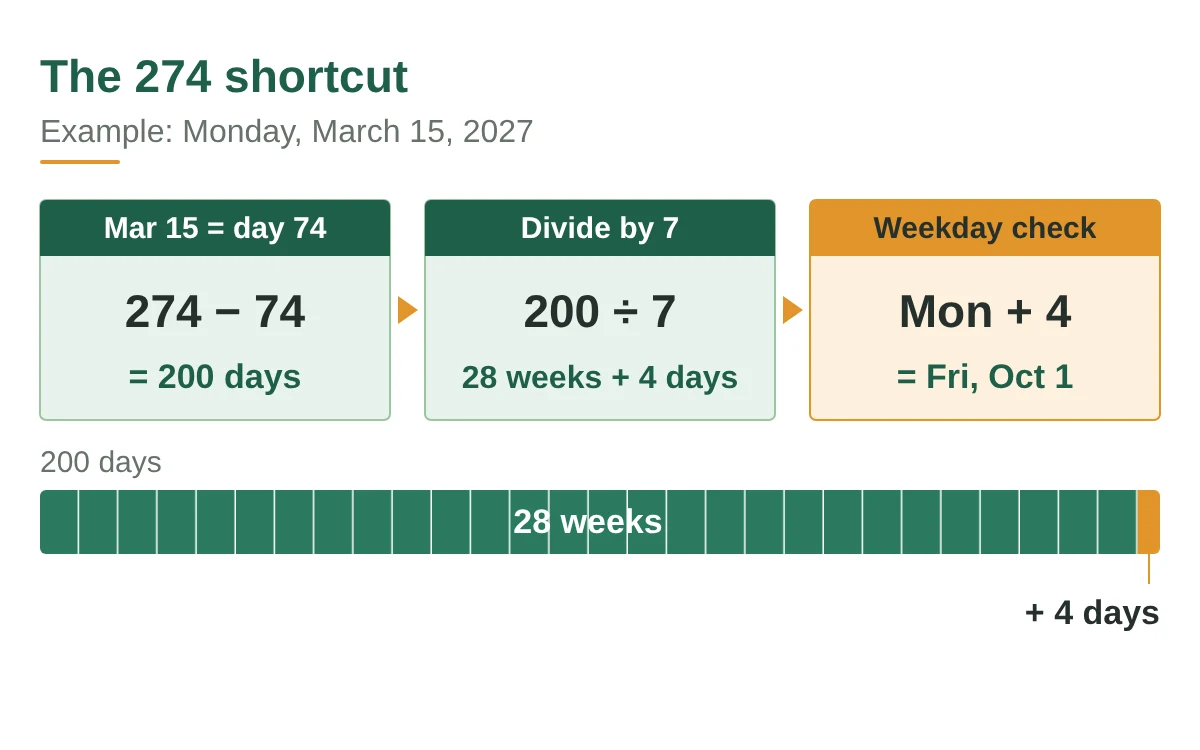
October 1 is day 274 of a normal year and day 275 of a leap year. To count by hand, find the day number of your starting date, subtract it from 274 (or 275), then divide by 7. The quotient is whole weeks and the remainder is leftover days.
A worked example with a hypothetical start: say you begin counting on March 15 in a normal year. March 15 is day 74 (31 + 28 + 15). That leaves 274 minus 74, which is 200 days. Divide by 7 and you get 28 weeks and 4 days. If March 15 fell on a Monday, adding 4 days lands on a Friday, so October 1 would be a Friday. The weekday check is a quick way to catch an arithmetic slip.
Month-start day numbers worth memorising for a normal year: Feb 1 is day 32, Apr 1 is 91, Jul 1 is 182, Sep 1 is 244. In leap years, add one to every date after February.
Why week counts disagree
Search the same question on several sites and you can get answers that differ by months. The usual causes are the target year (this October 1 or the next one), rounding down versus up, and whether “weeks” means elapsed seven-day blocks or calendar weeks.
Elapsed weeks are the clean method: total days divided by 7, remainder shown as days. Calendar-week counting is different. It counts how many Monday-to-Sunday (or Sunday-to-Saturday) rows you cross on a wall calendar, so it can be one higher than the elapsed figure. If you need a number for a countdown poster, use elapsed weeks plus days. If you need a number for a project grid, count calendar rows.
For the raw day figure behind any of this, see how many days until October 1st. To see it as months, use how many months until October.
Which weekday October 1 lands on
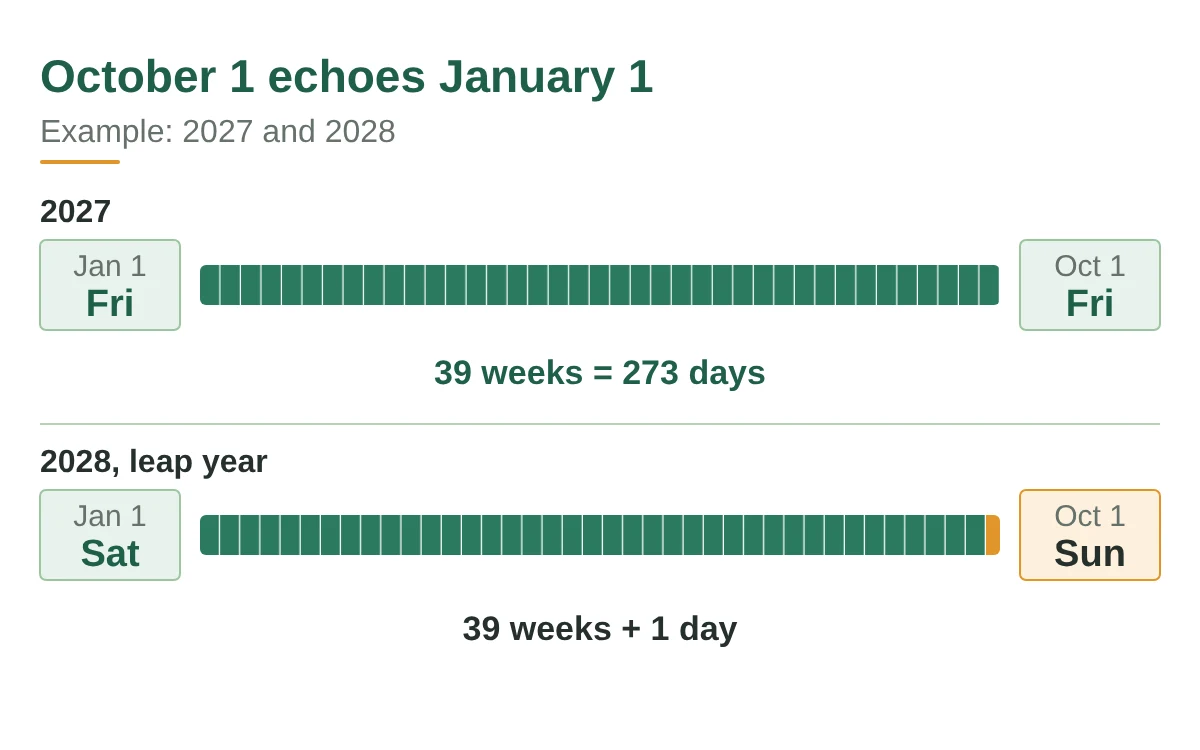
In a normal year, October 1 falls on the same weekday as January 1, because 273 days separate them, which is exactly 39 weeks. In a leap year it falls one weekday later. That is also why October 1 usually sits in ISO week 39.
From one October 1 to the next, the weekday moves forward by one day, or by two when the February in between has a 29th. For example, October 1, 2023 was a Sunday and October 1, 2024 was a Tuesday. This matters because a Saturday or Sunday October 1 moves deadlines. A Friday one gives you a full working week to finish before it.
When your start date shares a weekday with October 1, the answer is a clean number of weeks with zero leftover days. That is a handy sanity check for any result you compute.
Try this: Pick any date from last month and compute the day number, then subtract it from 274. Divide by 7 and compare the remainder with the weekday gap between your date and October 1. If they match, your method works.
Counting weekdays only
Working days are not weeks times seven, and they are not weeks times five either unless the remainder is zero. Multiply the whole weeks by 5, then walk through the leftover days one by one and count only Monday to Friday. A 4-day remainder that starts on a Saturday adds 2 working days, not 4.
Public holidays then come off the top. In the United States, Labor Day (first Monday of September) is the one that usually falls in the run-up to October 1. Other countries and employers will have their own list, so a generic business-day figure from any calculator is an upper bound.
For custom date spans, including a start date other than today, the date calculator does the day arithmetic for you.
Time zones and the moment the countdown ends
A week count flips at local midnight. Someone in Beijing reaches October 1 many hours before someone in Los Angeles, so “weeks until” can legitimately differ by a day depending on where the reader sits. The live widget uses your device time zone, which is almost always what you want.
Daylight saving time does not change a count in days or weeks, because a calendar day is counted as one unit. It does change a count in hours: if your span crosses a clock change, the total can be an hour more or less than weeks times 168. That only matters if you convert the answer into hours for something like a precise launch.
What October 1 is known for
October 1 is the start of the US federal fiscal year. Congress moved it from July 1 to October 1 under the 1974 budget act, with the change taking effect for fiscal year 1977. Fiscal years are named for the year in which they end, so the one starting this October 1 is labelled with the following year. Alabama and Michigan also begin their state fiscal years on October 1.
Internationally, it is China’s National Day, which opens a public holiday stretch often called Golden Week. It is also Nigeria’s Independence Day and Cyprus’s Independence Day. The United Nations marks the International Day of Older Persons on this date, and International Music Day also falls on it.
Lighter observances include International Coffee Day and World Vegetarian Day. October 1 is also the first day of a month packed with awareness campaigns, so it is a common launch date for annual drives.
Fiscal and quarter deadlines
For companies on a calendar year, October 1 opens the fourth quarter. That makes the weeks remaining a useful budget measure: the final stretch of third-quarter work, vendor contracts and hiring plans all wind up in the days before it. For the federal government and its contractors, the date is the first day of a new fiscal year, so it is the deadline for appropriations to be in place.
If funding has not been passed by then, a lapse can occur, which is why federal workers and grant recipients often track this date closely. Many grant cycles, university billing periods and insurance plan years also reset around it, so check any specific deadline against the issuing agency rather than assuming the 1st.
Autumn is also easy to mix up. Meteorological autumn starts on September 1, and the astronomical start (the equinox) is around September 22 or 23. October 1 falls well inside the season in both definitions.
Planning backwards in weeks
Weeks work well as milestones because they keep your weekday rhythm. Set checkpoints at 12, 8, 4 and 1 weeks before October 1, and each one lands on the same weekday as the target. That is far easier to schedule than “90 days out”, which shifts weekday by a couple of days. For an exact span in days, what is 90 days from now and how many days is 8 weeks give the equivalents.
Check the last checkpoint against nearby dates, too. If your plan runs into November, how many weeks until November 1st gives the same style of count for the next month boundary. If your deadline is a specific weekday, how many days until Friday is a quick companion.
Try this: Take the week count from the live widget and write the date that falls exactly 12, 8, 4 and 1 weeks before October 1. Put one deliverable on each date.
Frequently asked questions
How do you calculate the weeks until October 1 by hand?
Find the day-of-year number of the start date and subtract it from 274 (or 275 in a leap year, since October 1 is day 274 in a normal year). Divide the result by 7: the quotient is whole weeks and the remainder is leftover days.
Why do different websites show different week counts until October 1?
The usual causes are the target year (this October 1 versus the next), rounding down versus up, and counting elapsed seven-day blocks versus calendar rows. Calendar-week counting can come out one higher than elapsed weeks plus days.
What day of the week does October 1 fall on?
In a normal year, October 1 falls on the same weekday as January 1, because 273 days (exactly 39 weeks) separate them. In a leap year it lands one weekday later.
How many working days are in the weeks until October 1?
Multiply the whole weeks by 5, then step through the leftover days and count only Monday to Friday, so a 4-day remainder starting on a Saturday adds just 2. Public holidays such as US Labor Day then come off the total, which makes a generic calculator figure an upper bound.