
How Many Days Until September 13th?
Calendar
Countdown chart
The live widget above gives the exact answer for your own clock and time zone, so there is no number to read off this page. If you want to verify it or work it out offline, subtract today’s day-of-year number from 256. September 13 is day 256 in a common year and day 257 in a leap year.
The rest of this page covers the shortcuts that make that calculation fast, the mistakes that make two counters disagree, and what the date is known for.
How to count it by hand with a worked example
Take a hypothetical start date of March 4 in a common year. Count the rest of March (27 days), then the full months in between: April 30, May 31, June 30, July 31, August 31. That totals 180 days to reach September 1 minus the 13th still to come, so add 13. The answer is 193 days.
The month-by-month method works, but it is slow and easy to botch. The one place people slip is the month lengths: April, June and September have 30 days, and it is easy to give May or August the wrong count. A quicker method follows.
Try this: Pick any date in the next month and work out its distance to September 13 twice, once month by month and once with the day-of-year method below. If the two answers differ, recount the month lengths.
The 256 shortcut
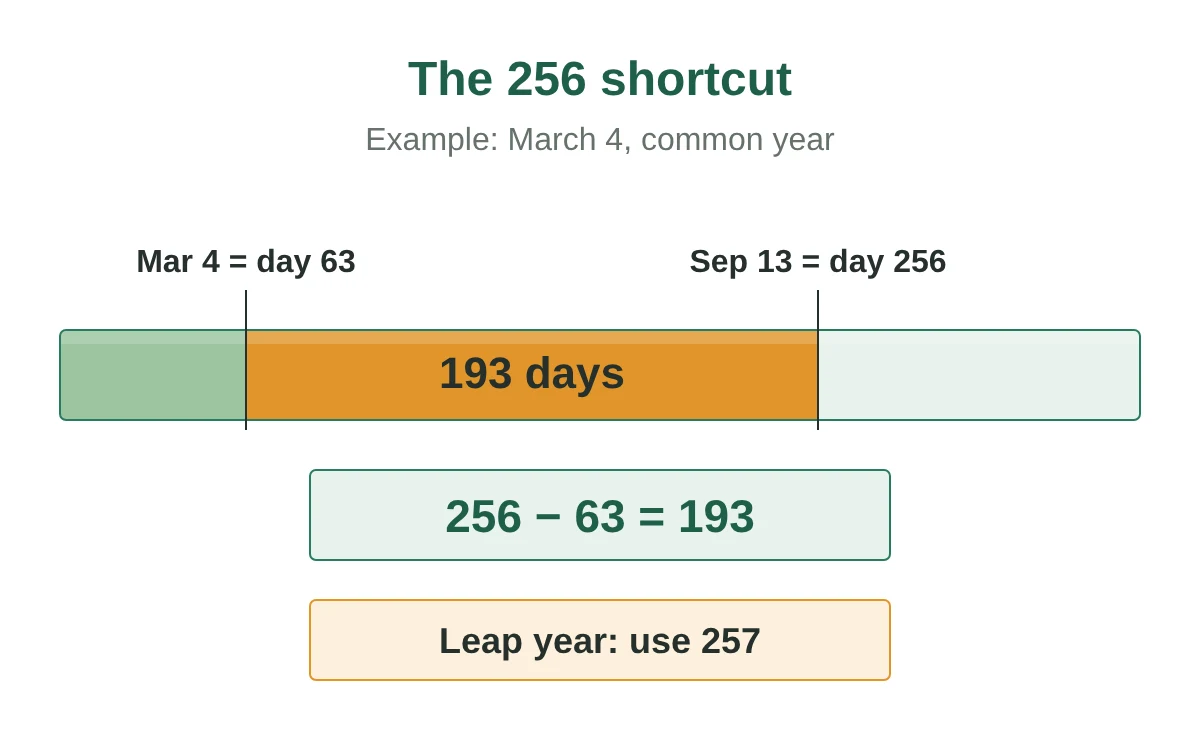
Every date has a day-of-year number. January 31 is day 31, and each month adds its length. March 4 is day 63 (31 + 28 + 4). September 13 is day 256, so the gap is 256 minus 63, which is 193. That matches the long method.
Day 256 is also why September 13 has a following among programmers: 256 is 2 to the eighth power, the number of values a byte can hold. A useful side effect is that the number 256 is easy to remember, which makes this the fastest mental route to any September 13 countdown.
Counting across New Year and leap years
If you start in one year and the target is in the next, count in two pieces. From a hypothetical start of November 20 in a common year, the days left in that year are 365 minus 324 (November 20’s day number), which is 41. Add the target’s day number, 256, and you get 297.
The edge case is the target year. If the next September 13 falls in a leap year, use 257 for the second piece, because February 29 sits before September. If the leap day falls in the starting year, it only matters when your start date is before February 29, and then the year has 366 days to subtract from.
Leap years are every fourth year, except century years not divisible by 400. For countdowns this century, the rule is simply “divisible by 4”.
Turning days into weeks and weekdays
Divide the day count by 7 and keep the remainder. The 193 days from the example is 27 weeks and 4 days. The remainder has a bonus use: it tells you how the weekdays line up. If September 13 lands on a Monday, a start date with a remainder of 4 is a Thursday, because you step back four days.
For working days, multiply the full weeks by 5, then count the weekdays in the leftover days. The leftover days are the ones directly before the target, so check which weekdays they cover. Public holidays between now and then are not removed by this method, so subtract them separately. The date calculator handles days between two dates if you would rather not do this by hand.
If your countdown is in weeks, 8 weeks is 56 days and similar conversions are quick to check.
Why two countdowns can disagree
Three causes explain nearly every mismatch.
- Inclusive or exclusive counting. Counting the start day or the end day adds one.
- Time zone. A countdown ending at midnight on September 13 ends at a different real moment for each location, so a count made in another zone can be a day off.
- Daylight saving. September 13 is still in daylight saving time in the northern hemisphere. If your start date is before the spring change, the hours between now and then are one fewer than the days multiplied by 24.
The widget uses your own device clock, so it agrees with your calendar rather than someone else’s.
What September 13 is known for
The best-known observance is Programmers’ Day, held on the 256th day of the year, so it is September 13 in common years and September 12 in leap years. Positive Thinking Day, which dates from 2003, shares the date, as does Roald Dahl Day, since the author was born on September 13, 1916.
In the United States, Uncle Sam Day marks the birthday of Samuel Wilson, born September 13, 1766, the man usually linked to the nickname. In Mexico, the date honors the Niños Héroes, the young cadets associated with the 1847 defense of Chapultepec.
National Grandparents Day, the first Sunday after Labor Day, can land on September 13 only when Labor Day falls on September 7 and September 13 is a Sunday. Rosh Hashanah also lands on or near the date in some years, since the Jewish calendar moves against the standard one.
How the weekday shifts, and Friday the 13th
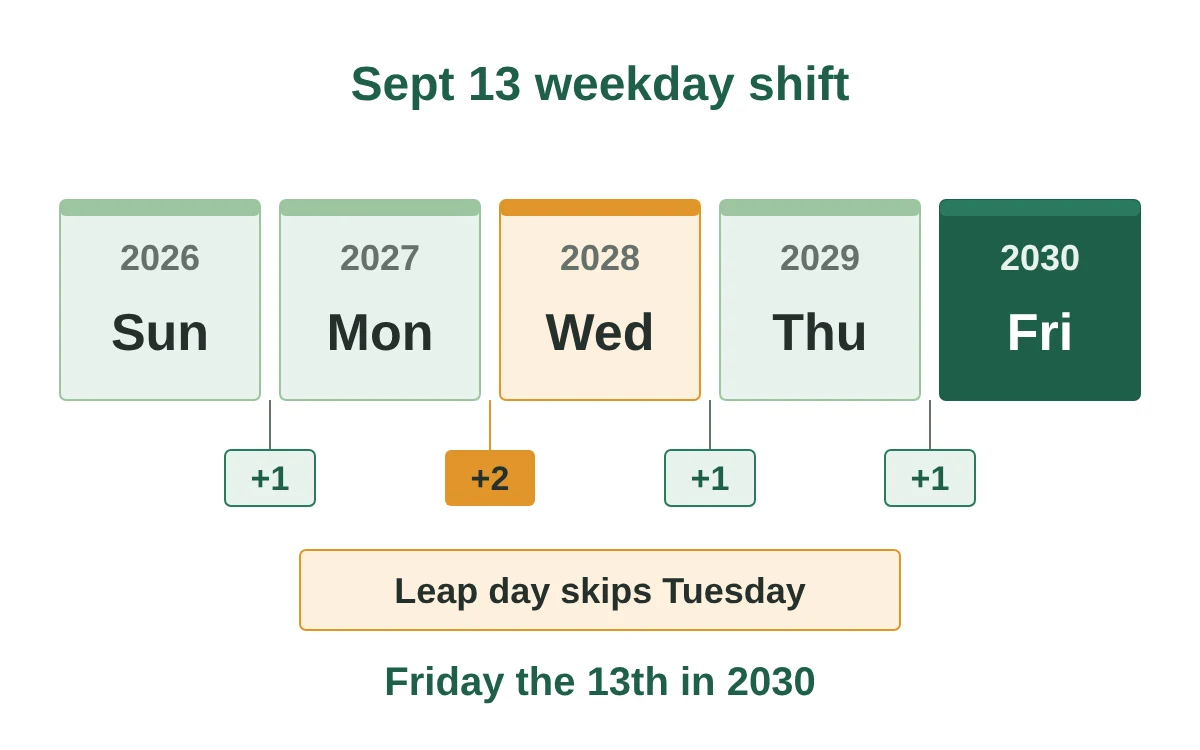
Because a common year is 52 weeks plus one day, September 13 moves forward one weekday per year, and two after a leap year. That gives Monday in 2027, Wednesday in 2028 (the skip is the leap day), Thursday in 2029 and Friday in 2030.
That makes 2030 a Friday the 13th in September, as 2024 was. If your countdown is for an event that cannot fall on a weekend, check the weekday for your target year first, because a Saturday or Sunday date can change the plan.
Planning around the date
September 13 sits in the back-to-school window in many places, and two days before the US third-quarter estimated tax payment date of September 15. That makes it a natural checkpoint for paperwork, travel bookings and project deadlines.
Milestones are easier to manage than a single long countdown. Set markers at 90 days out (the 90 days from now page shows how that date shifts), then at 30 days and at one week. For a quick look at the neighboring dates, see September 12 and September 15, or the whole month on days until September.
Try this: Write down the day-of-year number for today and for your three nearest deadlines. Subtract each from 256 to see which of them falls before September 13.
If the date is a birthday rather than a deadline, the same method works on any date. The birthday countdown does it for you.
Frequently asked questions
How many days until September 13?
The live countdown above shows the exact figure for your own clock and time zone. To check it by hand, subtract today's day-of-year number from 256 (or 257 if the target September is in a leap year).
Is September 13 always the 256th day of the year?
Only in common years. In a leap year, February 29 pushes it to day 257, and the 256th day becomes September 12. This is why Programmers' Day moves to September 12 in leap years.
Does the countdown include September 13 itself?
A standard countdown ends at the start of September 13, so the day itself is not counted. If you want to count every day you will be on the calendar through the end of September 13, add one.
What day of the week is September 13 each year?
The weekday moves forward one day each year, or two after a leap year. For example, it falls on Monday in 2027, Wednesday in 2028, Thursday in 2029 and Friday in 2030.