
How Many Months Until May?
Calendar
Countdown chart
The number of months until May is the count of whole calendar months between today and 00:00 on May 1, plus the leftover days. The live counter above works it out from your own clock and time zone, so use it for the exact figure. The rest of this page explains how that figure is built, so you can check it or reproduce it without a tool.
Most confusion comes from two choices that look trivial but aren’t: which moment counts as “May”, and what counts as a “month”. Settle those and the arithmetic is easy.
Why sites give different answers
Search for this question and you will see “about 5”, “5 months and 5 days” and “5.25” on different pages for what is effectively the same gap. They aren’t contradicting each other. One rounds to the nearest whole month, one counts complete calendar months and shows the remainder, and one divides total days by a month length.
A fourth difference is the target. Some counters aim at May 1, some at the first full month of May, and a few aim at a specific date such as the 15th. If a result looks off by a few weeks, check the target date before you check the maths.
Counting it by hand: a worked example
Take a hypothetical start of 17 December, with the target May 1 the following year. Step forward one calendar month at a time, keeping the day number at 17: Jan 17, Feb 17, Mar 17, Apr 17. That is 4 whole months. From Apr 17 to May 1 is 14 days (April has 30 days, so 30 minus 17 plus 1).
The answer is 4 months and 14 days. As a check, the total is 135 days (31 + 28 + 31 + 30 + 14 + 1 across the steps, with February at 28 days). Divide by 30.44 and you get about 4.4, which agrees with 4 months and 14 days.
If you want only the day total, the date calculator gives days between any two dates, and how many days until May 1 shows the straight day count.
Try this: Pick the 20th of any month as a pretend start date. Walk forward in whole months until you land on the 20th just before May 1, then count the days left. Compare with the live counter by changing nothing but the date in your head.
A mental shortcut using month numbers
You can skip the stepping entirely. Subtract the current month number from 5, and add 12 if the result is zero or negative. That is the month gap. If today is the 1st, you are done. On any other day, subtract 1 from the gap, because the current month is only partly used up.
For the 17 December example: 5 minus 12 is minus 7, plus 12 is 5, minus 1 gives 4 whole months. The leftover days are the length of April minus your day number plus 1, which works for any start date up to the 30th. It breaks only when the start day is the 31st, which leads to the next problem.
The month-end trap
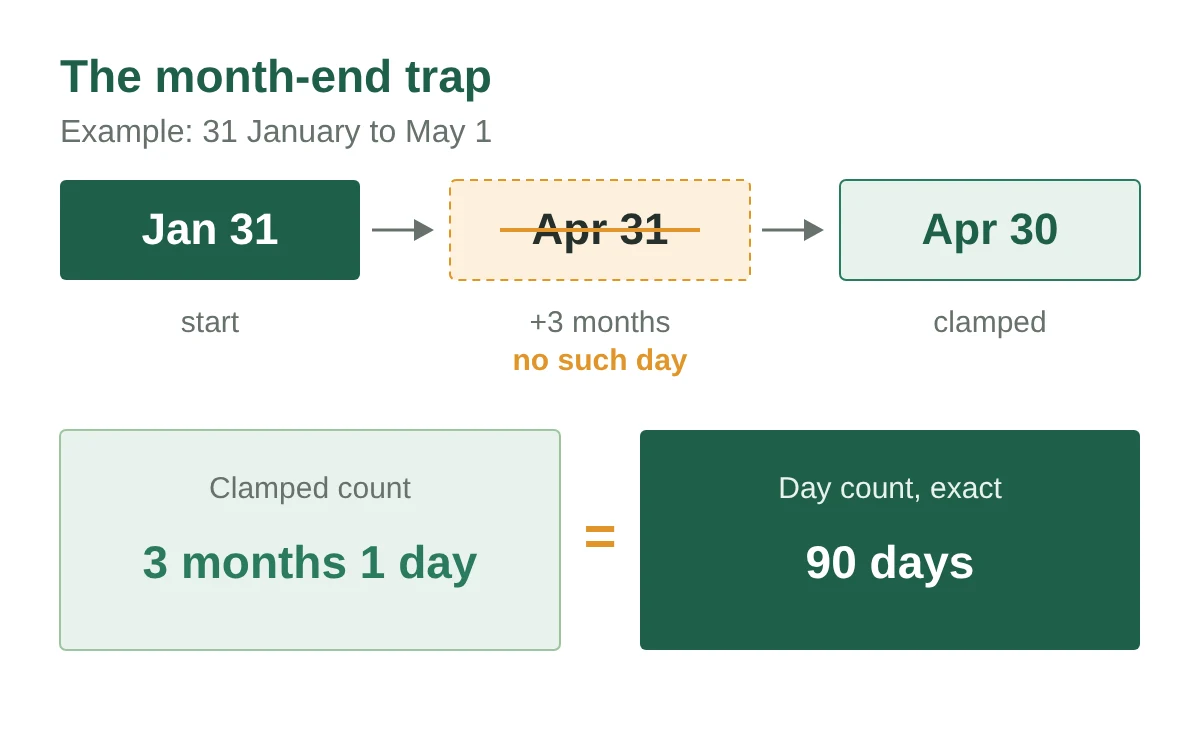
Whole-month counting has a quirk: not every month has a day 29, 30 or 31. Start on 31 January and the question “what is 3 months later?” lands on 31 April, which doesn’t exist. Calculators usually clamp to the last real day, 30 April, which makes the gap to May 1 equal to 3 months and 1 day. The real gap is 90 days.
Other tools roll the extra day forward instead, and they can show a different remainder. This is why two correct counters can disagree by a day or two for starts on the 29th, 30th or 31st. When it matters, rely on total days, which never has this ambiguity.
Whole months or decimal months
A decimal count such as 5.25 divides total days by the average month length of 30.44 days (365.2425 divided by 12). It is smooth and sorts well in a spreadsheet, but it doesn’t match how anyone talks about dates. Nobody says a deadline is “5.25 months away” and means a specific calendar day.
Use whole months plus days for planning and conversation. Use decimals only for rates, such as monthly savings targets or subscription maths. For converting a day total directly, how many months is 120 days shows why the answer is not simply days divided by 30.
When it is already May
Counters that target “the next May” behave differently once May arrives. During May, the next May 1 is the one in the following year, so the figure is just under 12 months, not zero. Zero appears only on May 1 itself.
That is why a countdown to “May” and a countdown to “the end of May” aren’t interchangeable. If you care about a deadline at the end of the month, aim at June 1 instead, which how many months until June covers. For a mid-month target, a date-specific page like how many weeks until May 21 is more useful than a month count.
Try this: Decide what “May” means for your plan: the first day, the start of a specific event, or the last day. Then pick the matching counter, since the target date alone can shift the answer by almost a month.
Choosing the right unit
Months are best for long horizons such as budgets, leases and seasonal preparation. As the gap shrinks, weeks and days carry more information, because a month can hide up to 31 days of difference. Under about 8 weeks, switch to days.
To compare other starting points or targets, the days until index lists countdowns for individual dates, and each one can be read in whole months, weeks or days.
Frequently asked questions
How many months until May?
The live counter above gives the exact figure for your date and time zone, split into whole months and leftover days. It counts to 00:00 on May 1 of the next May, so the answer is the time left until May begins.
Is it 5 months or 5.25 months?
Both can describe the same gap. A whole-month count discards the leftover days, while a decimal count divides total days by about 30.44, the average month length. Neither is wrong, they answer slightly different questions.
How many months until May if it is already May?
The target moves to May 1 of next year, so the answer is just under 12 months. Only on May 1 itself does the count read zero.
Why does the day of the month change the whole-month count?
A whole month is complete only when you reach the same day number again. From the 17th of a month, a full month has passed on the 17th of the next one, not on the 1st, so the count steps down mid-month.