
How Many Weeks Until May 21st?
Calendar
Countdown chart
The live counter above gives the exact number of weeks until May 21 for your clock and time zone, usually as whole weeks plus leftover days. By hand, count the days left and divide by 7. The quotient is the full weeks and the remainder is the extra days.
The only real source of confusion is rounding. The rest of this page covers a clean method for the arithmetic, the traps that make two countdowns disagree, and a few facts about May 21 that help with planning.
Why two answers can both be right
A countdown of 25 weeks and 4 days is 25 weeks if you round down, 26 if you round up and about 25.6 if you want a decimal. None of these is wrong. They answer different questions: “how many full weeks can I fit in before then” versus “how many weekly check-ins or paychecks fall before then.”
Pick the rounding that matches the job. For a training plan or a savings schedule, use full weeks and treat the leftover days as a short final stretch. For a deadline, round up so you do not under-plan. For a casual “about how long” answer, one decimal place is plenty.
A second source of disagreement is the starting point. A counter that reaches the start of May 21 will show one day more than a counter that reaches the end of it. If your event runs on the evening of the 21st, count to that hour, not to midnight.
A worked example you can copy
Take a hypothetical starting date of Tuesday, 2 March 2027, with the target of Friday, 21 May 2027. Count the days remaining in March after the 2nd (29), add all of April (30), then add 21 for May. That gives 80 days.
Divide 80 by 7. It goes 11 times with 3 left over, so the answer is 11 weeks and 3 days. The weekdays confirm it: three days after a Tuesday is a Friday, which is what May 21, 2027 is.
That second check catches most slips. If your remainder does not carry the starting weekday to the target weekday, one of the month lengths was miscounted. For converting whole weeks into days, the 8 weeks to days page shows the same multiplication in the other direction.
The day-of-year shortcut
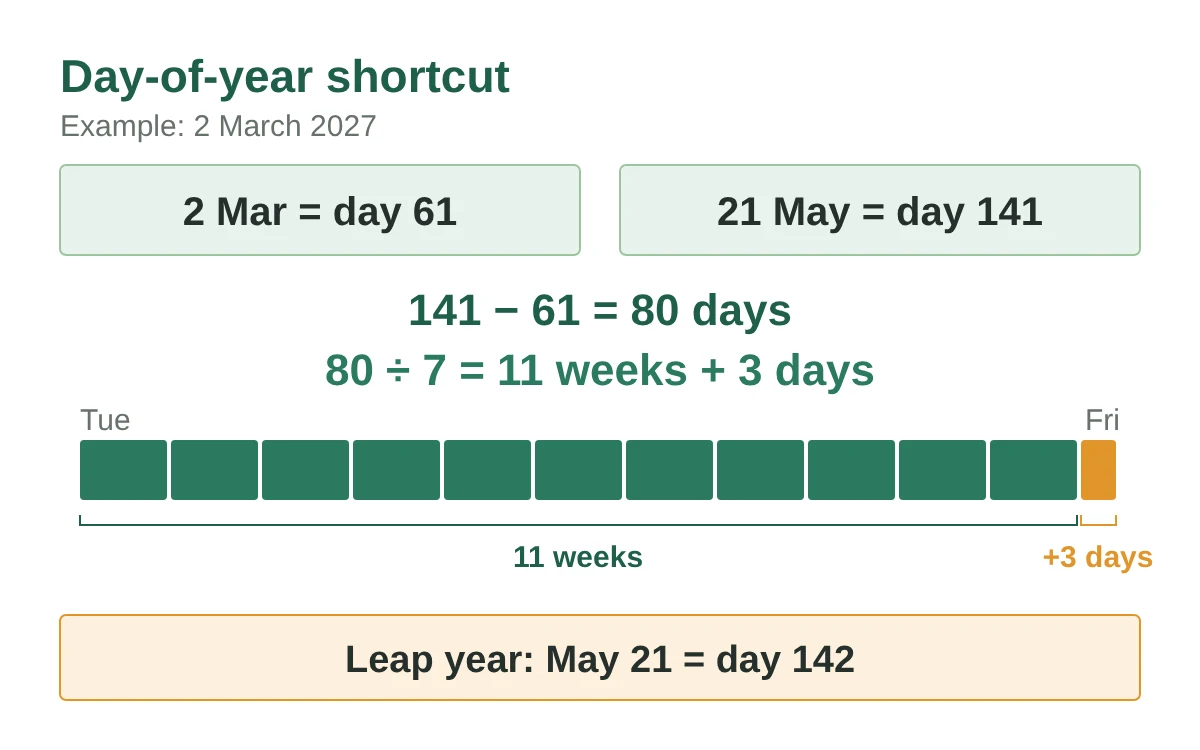
Skip the month-by-month counting. May 21 is day 141 of a common year (31 + 28 + 31 + 30 + 21), and day 142 in a leap year. Convert your start date to its day number, subtract it from 141, and divide by 7.
In the example above, 2 March is day 61 (31 + 28 + 2). Then 141 minus 61 is 80, the same result. After a few tries you will remember that March 1 is day 60 in a common year, and that anchor makes most of the sum mental.
The shortcut works only within one calendar year. If your start date is after May 21, count the days left to 31 December, then add 141 for the next year (or 142 if that next year is a leap year). The leap rule is the edge case that most often trips people up: a start in January 2028 is already past 29 February only after February, so check which side of the leap day you are on.
Try this: Pick any date next month, convert it to a day number, and subtract it from 141. Then check your answer against the date calculator. If the two differ by one, you probably counted the start day itself.
Which weekday May 21 lands on
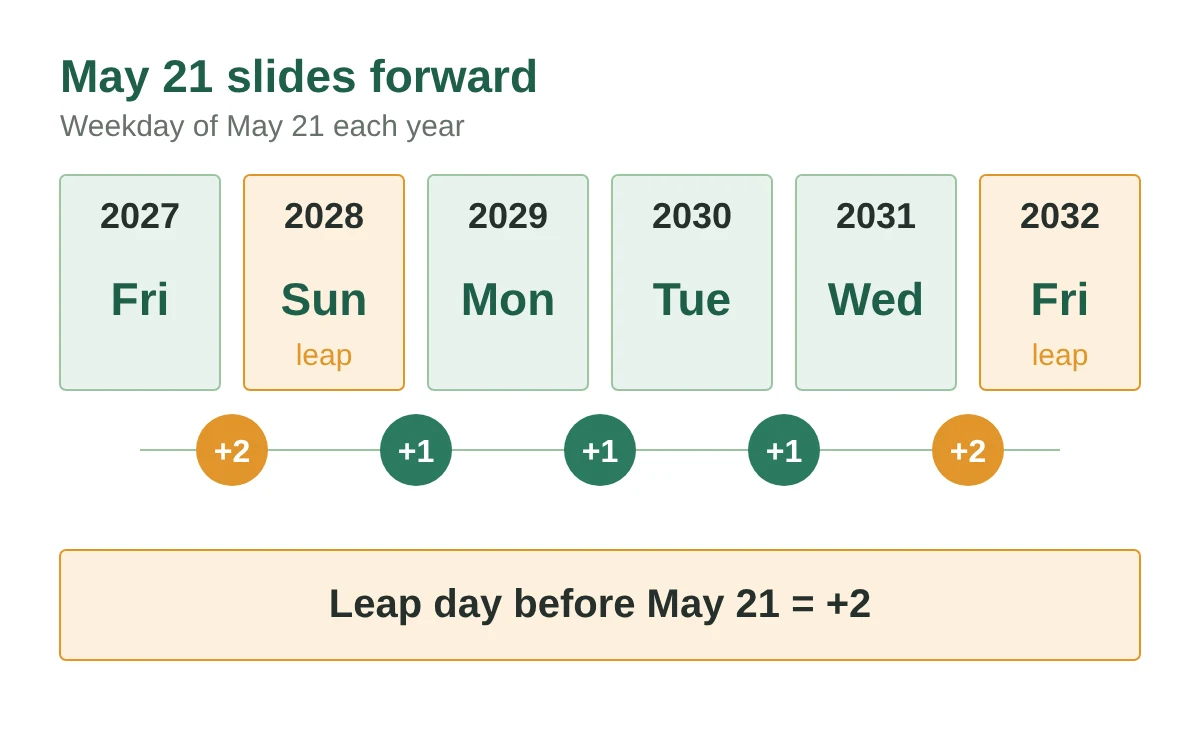
May 21 advances one weekday each year and two after a leap day. From 2027 the sequence is:
- 2027: Friday
- 2028: Sunday (leap year, so a double shift)
- 2029: Monday
- 2030: Tuesday
- 2031: Wednesday
- 2032: Friday
This matters for the weeks count in a useful way. If today shares a weekday with May 21, the answer is an exact number of whole weeks with no leftover days. If it does not, the remainder is simply how many weekdays you must step forward to reach May 21’s weekday.
It also tells you which weekly rhythm to plan on. A Friday target suits a “last day of the working week” milestone, while a Sunday target leaves the whole preceding week as your effective deadline.
Counting weekdays and working weeks
For working days, multiply the full weeks by 5, then add the weekdays among the leftover days. In the example, 11 full weeks give 55 weekdays. The three extra days are Wednesday, Thursday and Friday, so the total is 58 weekdays, counting May 21 itself and not the start day.
Leftover days are where errors hide. A remainder of 2 or 3 can add anywhere from 0 to 3 weekdays depending on where it starts, so list the actual days instead of guessing. Public holidays also come off this figure. Many countries have a holiday in May (Victoria Day in Canada, Memorial Day at the end of the month in the United States, the May bank holidays in the UK), so subtract any that fall inside your window.
What May 21 is known for
May 21 is not a public holiday in most places, but it carries several fixed observances. The United Nations marks the World Day for Cultural Diversity for Dialogue and Development on this date. The General Assembly declared it on 20 December 2002, and it was first observed in 2003. International Tea Day is also on May 21.
It is also the day Clara Barton founded the American Red Cross in 1881. In Chile it is Navy Day, a national holiday marking the Battle of Iquique. And 2027 brings a centenary: Charles Lindbergh landed in Paris on 21 May 1927, ending the first solo nonstop flight across the Atlantic.
Some “May 21” days are not fixed. Global Accessibility Awareness Day, for example, falls on the third Thursday in May, so it only lands on the 21st in some years. Shavuot follows the Hebrew calendar and also moves around the Gregorian date. Check the year before you plan around either.
Planning backward from May 21
Weeks are the best unit for backward planning because they keep your weekday constant. Pick the milestone, subtract multiples of 7 days, and every checkpoint lands on the same weekday as the final date. This is why 4, 8 and 12 weeks before are popular for reviews, fittings and payment schedules.
A practical split is to fix the hard parts first. Place the final deadline, then the point 4 weeks before as the last chance to change anything, and 12 weeks before as the real start. Anything needing bookings or deliveries belongs on the early side.
Try this: Write May 21 at the bottom of a page and count back in steps of 4 weeks to today. Label each step with one task. You will see at once whether the plan fits.
For nearby targets, the same method works with May 22, 2027 or the days count to May 21. If your date is early June instead, weeks until June 1st works the same way.
Week numbers can mislead
“Week 20” and “20 weeks away” are unrelated. ISO week numbers label calendar weeks from Monday to Sunday, and May 21, 2027 sits in week 20 of that year. They say where the date falls in the year, not how long you have to wait.
The week-number system is also inconsistent across regions. The United States often starts weeks on Sunday and counts the week containing 1 January as week 1, while ISO counts the week containing the first Thursday. The same date can carry different week numbers depending on the system, so do not use a week number for countdown arithmetic. Use dates and day counts, and keep week numbers for scheduling labels.
Frequently asked questions
How many weeks until May 21?
The live counter above gives the exact figure on your own clock, shown as whole weeks plus leftover days. To check it by hand, count the days to May 21 and divide by 7, keeping the remainder.
Is May 21 the same weekday every year?
No. It moves forward one weekday each year, or two after a leap day has passed. It falls on a Friday in 2027, a Sunday in 2028 and a Monday in 2029.
Why do different countdown sites show different week counts?
Some round down to complete weeks, some round up, and some show decimals. A countdown of 25 weeks and 4 days can honestly be called 25, 26 or 25.6 weeks.
What is the day number of May 21 in the year?
May 21 is day 141 in a common year and day 142 in a leap year. That number lets you work out the weeks remaining from any start date in the same year with one subtraction.