
What Time Will It Be in 14 Hours?
Calendar
Same span, other units
The live widget above reads your own clock and time zone, so it gives the exact answer to “what time will it be in 14 hours” down to the second. Done by hand, the answer is your current time plus 14 hours: add 12 (which flips AM and PM), then add 2 more.
Fourteen hours is 840 minutes, or 50,400 seconds, which is a little more than half a day. That is long enough that the result often lands on a different calendar date, and that is where most hand calculations go wrong.
The two-step shortcut
Adding 14 to a clock reading is awkward because the 12-hour face wraps around. Split it instead: add 12, which leaves the digits unchanged and only flips AM to PM (or PM to AM), then add 2. The day changes only when the 12 you added carries you past midnight.
Worked example with a made-up start: it is Tuesday at 9:40 PM. Adding 12 hours gives 9:40 AM, now Wednesday. Adding 2 more gives 11:40 AM on Wednesday. For a quick check, see the 12 hours from now page and add the last two hours.
A second route: subtract 10, then move a day
Fourteen hours forward equals 24 hours forward minus 10. So the clock reading 14 hours from now matches the reading 10 hours ago, but on the following day. Using the same example, 10 hours before Tuesday 9:40 PM is Tuesday 11:40 AM. Move to the next day and you get Wednesday 11:40 AM, which matches.
This is useful when subtracting feels easier than adding, or when you want to verify a result with a different path. The 10 hours ago page covers the backward direction in detail.
When 14 hours crosses midnight
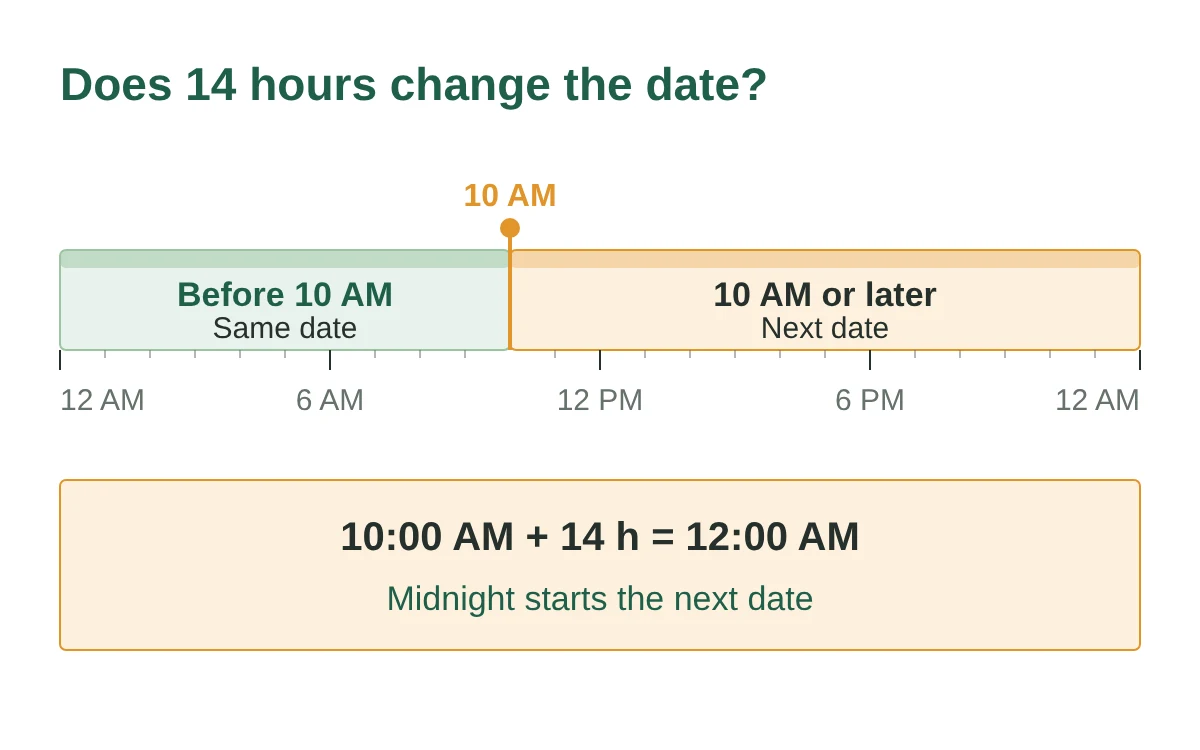
You can predict the date change before doing any arithmetic. Since 24 minus 14 is 10, any start time at or after 10:00 AM (10:00 on a 24-hour clock) ends up on the next calendar date. Any start before 10:00 AM stays on the same date.
The boundary case is worth knowing. A start at exactly 10:00 AM lands at exactly midnight, and midnight belongs to the new date. If you want the gap to the next midnight from any given moment, how long until midnight shows it live.
Try this: Pick three start times (7:15 AM, 10:00 AM, 6:45 PM). Without a calculator, decide first whether each result lands today or tomorrow, then find the clock time with the add-12-then-2 method.
Daylight saving can break the arithmetic
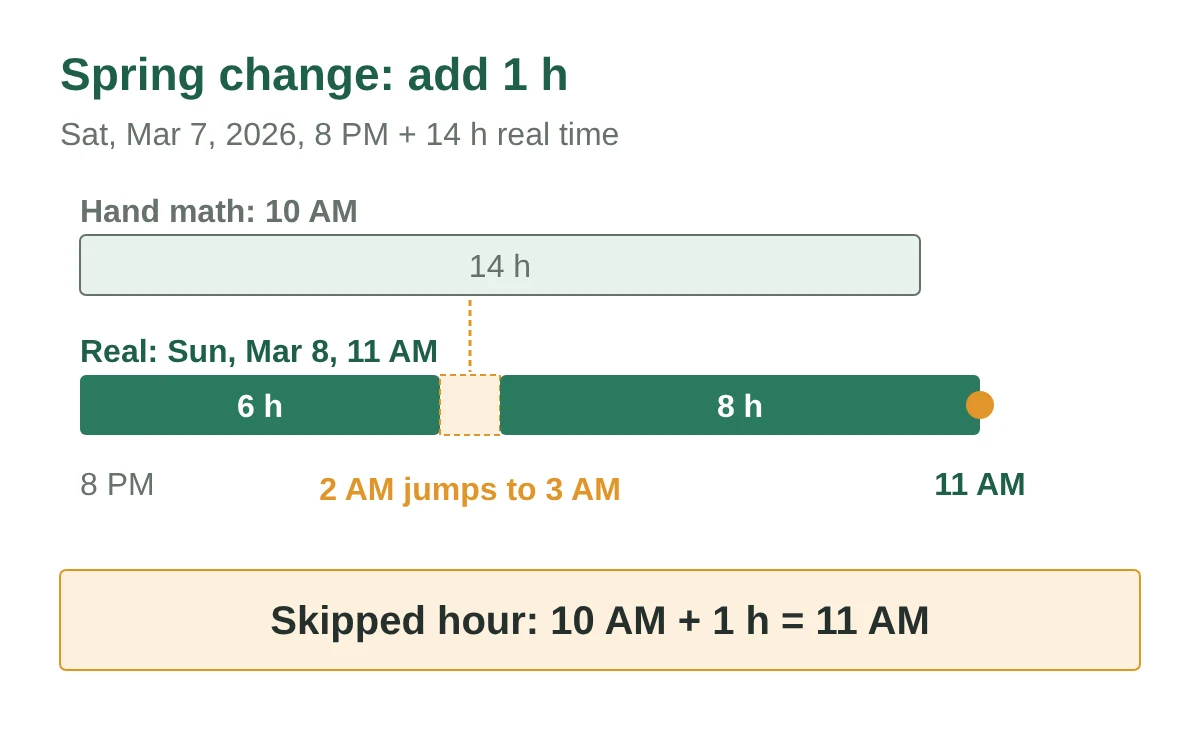
The clock-face method assumes every hour on the wall clock is a real hour. Twice a year it is not. If your 14 hours span the spring change (clocks jump forward), the wall clock shows 15 hours of movement. If they span the autumn change (clocks fall back), it shows only 13.
In the US, these changes happen on the second Sunday of March and the first Sunday of November, at 2:00 AM local time. A start time of Saturday evening is the classic trap, because 14 hours later falls on Sunday morning after the change. The live widget uses real elapsed time, so it handles this correctly. Hand math should add or subtract one hour in these windows.
Time zones: 14 hours is also a real offset
The largest offset from UTC in use is UTC+14, which applies in parts of Kiribati. That means a clock there can be exactly 14 hours ahead of UTC, so the same instant is a different calendar date on either side. If you are scheduling across zones, convert both times to UTC first, add the 14 hours there, then convert back to the local zone.
This matters because a deadline written as “in 14 hours” is a duration, but a deadline written as “by 3 PM” is a clock time in a specific zone. Mixing the two is a common source of missed cutoffs. For a countdown to a fixed clock time, the time until tools work better than a duration calculator.
Deadlines, doses, shipping and notice periods
Each use treats “14 hours” differently, so check which clock applies.
- Deadlines: if a rule says “within 14 hours,” the clock usually starts at the timestamped event, not at when you saw it. Use the timestamp’s own time zone.
- Medication windows: labels count elapsed time, so overnight gaps of 14 hours between doses are real hours even if a clock change occurs. Follow the label or a pharmacist for the actual interval.
- Shipping: carriers often count business hours, not elapsed ones, so 14 hours on a Friday evening can mean Monday. Confirm which one is meant.
- Notice periods: legal or contractual notice may count from the next full day. Read the wording before relying on a raw time calculation.
Try this: Think of a real deadline you have. Write down whether it counts elapsed hours or business hours, then compute both results and compare.
Related durations worth knowing
If 14 hours doesn’t match your window, nearby values are easy to cross-check. Two hours less is 12 hours from now, and two more is 16 hours from now. For a full working shift, see 8 hours from now, and for multi-day waits, 72 hours from now.
When you need an answer in days, or a gap between two specific dates, the date calculator handles it, and time conversions covers hours to minutes and days.
Frequently asked questions
How do I quickly calculate what time it will be in 14 hours?
Add 12 hours, which keeps the digits the same and only flips AM to PM (or PM to AM), then add 2 more hours. For example, 9:40 PM plus 12 is 9:40 AM, and plus 2 more is 11:40 AM.
Will 14 hours from now be today or tomorrow?
If the current time is 10:00 AM or later, the result lands on the next calendar date, because 24 minus 14 is 10. Before 10:00 AM, it stays on the same date, and a start of exactly 10:00 AM lands at midnight, which counts as the new day.
Does daylight saving time change what time it will be in 14 hours?
Yes, if the 14 hours span a clock change. When clocks jump forward, the wall clock moves 15 hours, and when they fall back, it moves only 13. In the US these changes occur at 2:00 AM on the second Sunday of March and the first Sunday of November, so a Saturday evening start is a common trap.
How many minutes and seconds are in 14 hours?
Fourteen hours equals 840 minutes or 50,400 seconds. That is a little more than half a day, which is why the result so often falls on a different date.