
What Is 16 Hours From Now?
Calendar
Same span, other units
16 hours from now is the current moment plus 960 minutes, and the live widget above shows it on your own clock and time zone. To check it yourself, add 24 hours and subtract 8: take the same clock time tomorrow, then step back 8 hours.
Sixteen hours sits in an awkward spot. It is too long to count on your fingers and too short to feel like “tomorrow”. The sections below cover the shortcut, the edge cases that produce wrong answers, and the situations where the exact figure matters.
The add 24, subtract 8 shortcut
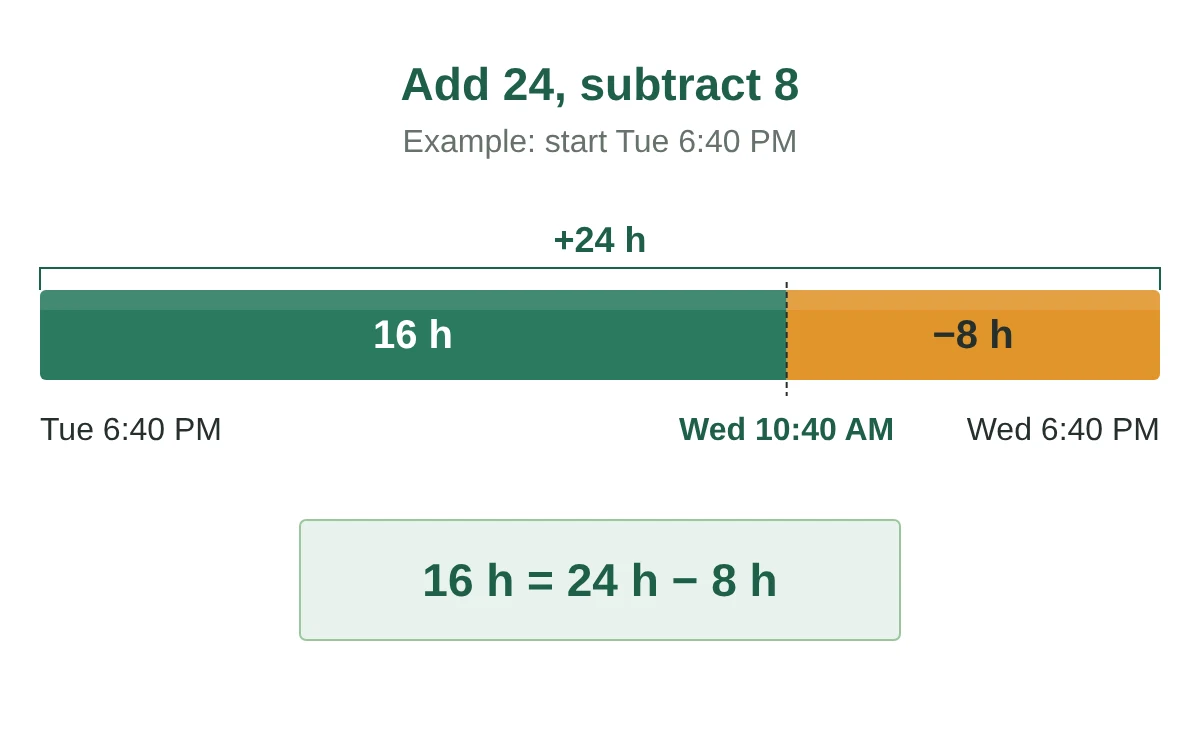
Adding 16 directly means crossing noon or midnight, and that is where most slips happen. Going through 24 avoids it. Sixteen is 24 minus 8, so the answer is the same clock time tomorrow, shifted 8 hours earlier. Subtracting 8 is easier because it rarely crosses more than one boundary.
A second pattern: 16 hours moves you from AM to PM or PM to AM exactly once, and the day number changes whenever you start at 8:00 AM or later. Before 8:00 AM, you stay on the same date. That single threshold, 8 o’clock, is all you need to remember about the date.
Minutes never change. Only the hour needs work, which makes the shortcut safe even at 6:47 or 11:13.
A worked example with a hypothetical date
Say the start is Tuesday at 6:40 PM. Same time tomorrow is Wednesday at 6:40 PM. Subtract 8 hours: 10:40 AM on Wednesday. That is the answer.
Check it the long way. From 6:40 PM, 5 hours and 20 minutes reaches midnight. That leaves 10 hours 40 minutes of the 16, which brings you to 10:40 AM. The two methods agree, and running both is a cheap way to catch a slip.
For a 24-hour clock, the same sum is 18:40 plus 16, which is 34:40. Subtract 24 and you get 10:40 on the following day. Anything above 24 means you passed midnight.
Try this: Pick the time you plan to wake up tomorrow and work out what the time was 16 hours earlier. Then check it against the live widget. Doing it twice with different start times builds the habit fast.
When daylight saving changes the answer
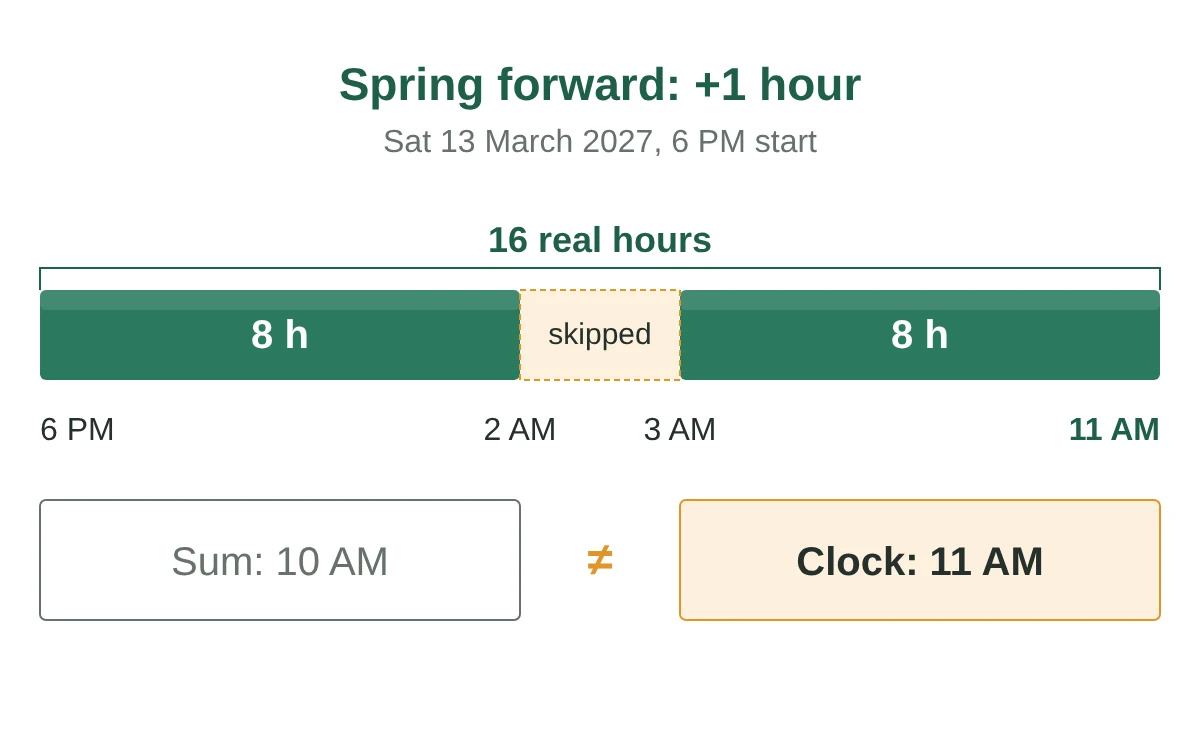
A clock reading and elapsed time are not the same thing on a clock-change night. Take a US start of Saturday 13 March 2027 at 6:00 PM. Wall-clock arithmetic says 10:00 AM Sunday. But clocks jump forward at 2:00 AM on 14 March, so 16 real hours later the clock reads 11:00 AM.
In autumn the error runs the other way. The clocks fall back, that night has 25 hours, and 16 hours from a Saturday evening start lands an hour earlier on the clock than your sum suggests.
The rule is simple. If a clock change falls inside the span, adjust the result by one hour: later on the clock in spring, earlier in autumn. Not every region changes on the same date, so the gap between two cities can also shift by an hour for a few weeks each year. If you want the longer-span version, 72 hours from now is more likely to straddle a change.
Deadlines, shipping and notice periods
When a rule says “within 16 hours”, read whether it means clock hours or business hours. Calendar hours run through nights and weekends. Business hours do not, so 16 business hours is typically two working days, not the next morning. A promise of “16 hours” from a courier or support desk should be checked for that distinction.
For notices and deadlines, the starting point matters as much as the length. Some terms count from the moment a message is sent. Others count from receipt, or from the next business day. A message sent at 11:50 PM can start its clock a full day later under the second reading.
Time zones add the last twist. A deadline that runs 16 hours from a timestamp in UTC will fall on a different calendar date for someone far east or west of Greenwich. Convert the deadline to your own zone first, then count. If the cutoff is a fixed time of day instead, how long until midnight gives that countdown directly.
Medication and fasting windows
Most dose schedules use whole divisors of 24 (every 6, 8 or 12 hours), so a 16-hour gap shows up mainly in two places. One is the long overnight gap between a late evening dose and a morning one. The other is time-restricted eating, where a 16-hour fast is paired with an 8-hour eating window.
For fasting, the same shortcut works. Note the time of your last meal, add 24, subtract 8, and the result is when the window opens. For medicines, follow the label or your pharmacist, and treat a calculator as a way to set an alarm, not to decide a dose. If you need to compare with a shorter interval, 8 hours from now and 12 hours from now cover the standard rhythms.
Try this: Set a phone alarm for the exact time the widget shows, then label it with the purpose. A named alarm survives a busy day better than a number in your head.
Counting backwards and nearby offsets
The mirror question, what time it was 16 hours ago, uses the same trick reversed: subtract 24 and add 8. The date goes back a day whenever the current time is before 4:00 PM… more precisely, whenever you are at or before 8:00 AM the answer falls on the previous day, and after 8:00 AM it falls on the same date.
For other offsets, shift by one hour at a time. 17 hours from now is the same sum with 7 subtracted instead of 8. For short gaps in the other direction, 10 hours ago is a quick reference.
Checking the result
A good habit is to sanity check the AM or PM label. Because 16 is more than 12 and less than 24, the label always flips relative to your start time. If you start at 3:00 PM, the answer must be an AM time. If your answer keeps the same label, an hour was dropped.
To convert the duration into other units or add a date to a time, the date calculator handles days and dates, and the time conversions hub covers minutes, seconds and hours in both directions.
Frequently asked questions
What is 16 hours from now?
It is the current moment plus 960 minutes, shown in your own time zone by the live widget at the top of this page. By hand, add 24 hours and subtract 8: same clock time tomorrow, then back up 8 hours.
Will 16 hours from now be today or tomorrow?
It lands on tomorrow if your current time is 8:00 AM or later. Before 8:00 AM, 16 hours later is still today.
How many minutes and seconds are in 16 hours?
16 hours is 960 minutes or 57,600 seconds. That is two thirds of a 24-hour day.
Does daylight saving time change what time it is 16 hours from now?
It can. If a clock change falls inside the 16-hour span, the clock reading shifts by an hour even though exactly 16 hours of real time pass. The live widget handles this automatically, but mental arithmetic does not.