
How Long Until 10:30 PM?
Around the world
The time left until 10:30 PM is 22:30 minus the current time on a 24-hour clock. The live countdown above does this on your own device clock, so the answer is exact to the second. This page covers how to check it by hand, and the situations where a hand calculation quietly goes wrong.
Most people only need a rough figure, and a rough figure takes about five seconds once you know the right shortcut.
The 1,350 minute shortcut
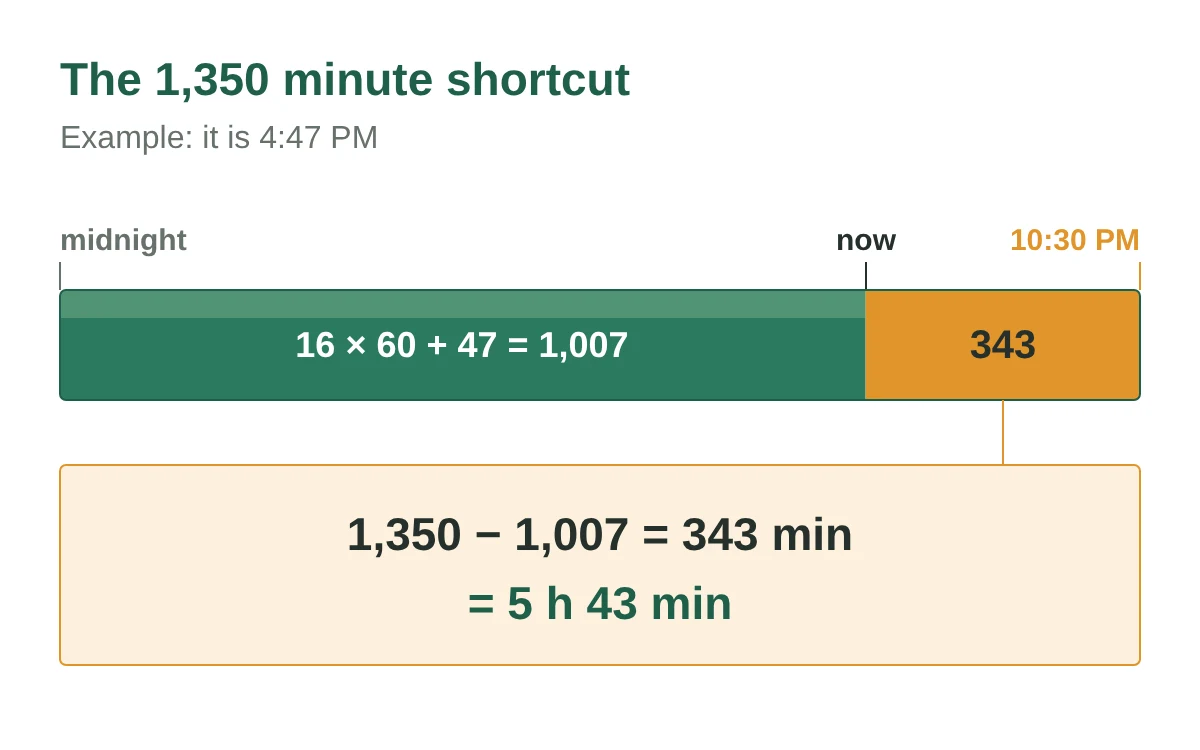
10:30 PM is 22 hours and 30 minutes after midnight, which makes 1,350 minutes. Turn the current time into minutes since midnight, subtract, and you have the answer with no borrowing across hours. Take a hypothetical 4:47 PM: that is 16 x 60 + 47 = 1,007 minutes, and 1,350 minus 1,007 is 343 minutes, or 5 hours 43 minutes.
If you prefer to stay on the clock face, use the stepping-stone method. Count to the next full hour, then whole hours to 10:00 PM, then add the final 30 minutes. From 4:47 PM that is 13 minutes, plus 5 hours, plus 30 minutes, which lands on the same 5 hours 43 minutes. Stepping stones are harder to get wrong than column subtraction because you never borrow.
Try this: Pick any time on a clock, such as 3:12 PM, and work out the time left to 10:30 PM twice: once with minutes since midnight, once with stepping stones. If the answers differ, one of them has a slip, and it is usually the borrowing.
What happens after 10:30 PM passes
Once 10:30 PM has gone, the next 10:30 PM is tomorrow. Do not subtract the other way round and try to read a negative result. Work out how long ago 10:30 PM passed, then take that away from 24 hours.
At a hypothetical 11:15 PM, 45 minutes have passed since 10:30 PM. So 24 hours minus 45 minutes leaves 23 hours 15 minutes. The shortcut also works in minutes: 1,440 minus the minutes already past, plus 1,350, then take away the current minutes since midnight and you get the same answer. If your widget suddenly shows a figure close to 24 hours, that is the rollover, not an error.
Why people count down to 10:30 PM
The time is a common marker for the end of an evening shift, a late class, a restaurant’s last seating, or a curfew. It is also a standard bedtime anchor, and a popular slot for late-night releases and live events. Each of these has a different cost of being wrong. For a shift end, a few minutes does not matter. For a booking or a hard deadline, you want the seconds, which is why a live count beats mental arithmetic.
Markets are a special case. A 10:30 PM close or cutoff only means something with its time zone attached. At 10:30 PM US Eastern, it is already late morning the next day in Tokyo, so an overnight market action there may already be under way or finished. Always ask which clock a 10:30 PM refers to before you plan around it.
Time zones change the answer
“10:30 PM” is a label, not a moment. When it is 10:30 PM in New York, it is 7:30 PM in Los Angeles, and the same instant is 3:30 AM the next day in London (in winter, when both are on standard time). A countdown to 10:30 PM in your zone and a countdown to 10:30 PM in a friend’s zone are two different durations.
For an event pinned to another zone, convert that zone’s 10:30 PM into your local time first, then count down to the converted time. Half-hour zones, such as India at UTC+5:30, are where mental conversion most often drifts by 30 minutes, because the minutes no longer line up. The time conversions page helps with unit changes, and central time now is handy if the deadline is set in Central.
Clock changes can shift it by an hour
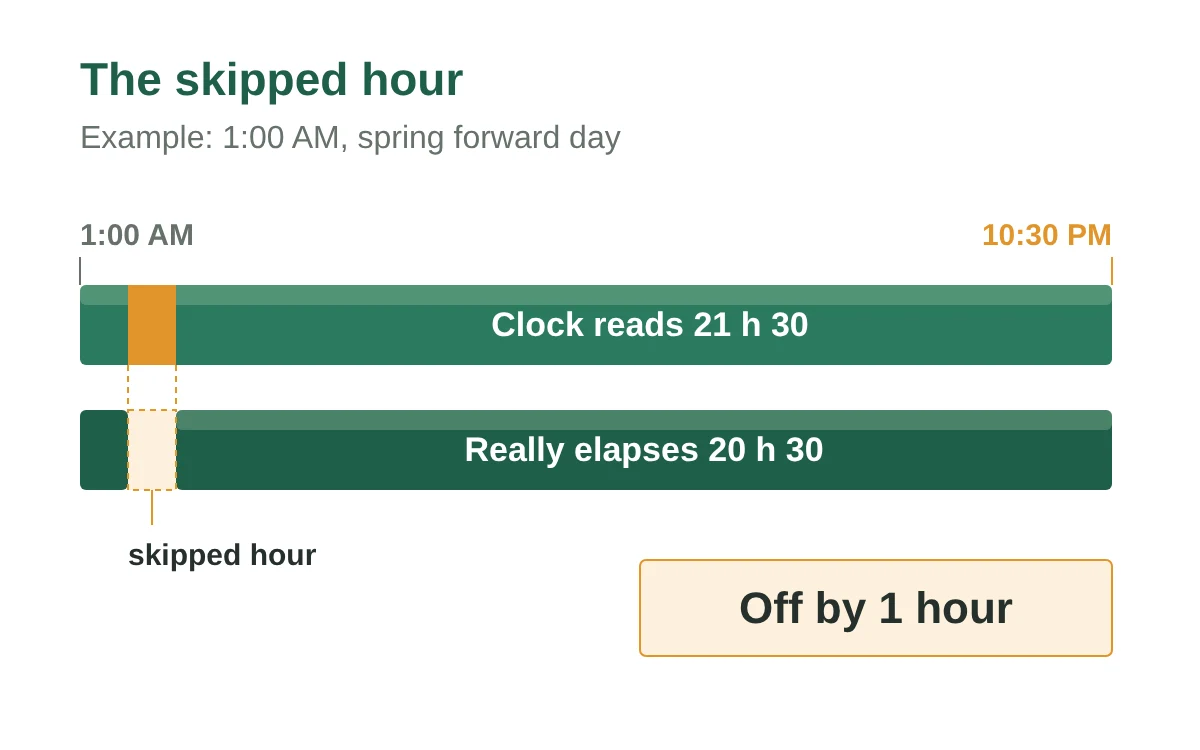
The time on the clock face and the time that actually passes are not always the same. If a daylight saving change falls between now and 10:30 PM, a hand subtraction is out by exactly one hour. At 1:00 AM on a US spring-forward morning, the clocks read 21 hours 30 minutes apart, but only 20 hours 30 minutes really elapse, because the 2:00 AM hour is skipped.
In autumn the error runs the other way: the repeated hour adds 60 minutes to the real wait. A live widget handles this correctly because it uses real elapsed time from your device. Hand maths does not, so treat any change-over night as a case to check on the widget. This only matters when you count across the early-morning change itself, not for an ordinary evening check.
Mistakes that cause an hour or 12-hour error
The most common slip is dropping the PM. Subtracting 4:47 from 10:30 gives 5:43 by luck here, but at 11:20 AM the same habit gives a nonsense answer. Convert to 24-hour time first: 10:30 PM is 22:30, and 10:30 AM is 10:30. In 24-hour logs, “10:30” alone is the morning one.
A second trap is 12:xx. 12:15 PM is 12:15 on the 24-hour clock, but 12:15 AM is 00:15. Treating noon as 0 or midnight as 12 pushes the whole result 12 hours out. If your answer exceeds 22 hours 30 minutes when it is clearly daytime, check you have not reversed AM and PM. For neighbouring targets, compare with 10 PM or 11 PM, which share the same pitfalls.
Planning backwards from 10:30 PM
A countdown is also useful in reverse. Sleep cycles run roughly 90 minutes, and most people take around 15 minutes to fall asleep. Lights out at 10:30 PM plus 15 minutes puts sleep onset at 10:45 PM, and five cycles later is 6:15 AM, while six cycles is 7:45 AM. Check the wake-up against how long until 7 AM to see the actual sleep window.
The same backward logic works for deadlines. To finish something by 10:30 PM after a 45-minute task, start by 9:45 PM, and add buffer. For short offsets, 30 minutes from now and 8 hours from now cover the common cases.
Try this: Choose something you want done by 10:30 PM tonight. Subtract its duration and a 15-minute buffer from 22:30, and write down that start time. Then set one reminder for it, not for 10:30 PM itself.
Other times of day to count down to
If 10:30 PM is not quite the time you need, the full list of time-of-day countdowns covers the rest of the clock. For longer ranges, how long until midnight is the natural next step, since the rollover after 10:30 PM works the same way.
Frequently asked questions
What is 10:30 PM in 24-hour time?
10:30 PM is 22:30, often written 2230 in military style. It sits 1,350 minutes after midnight, which is the number to use for quick subtraction.
How many minutes are there until 10:30 PM?
Convert the current time to minutes since midnight and subtract that from 1,350. At 4:47 PM that is 1,007 minutes, so 343 minutes remain.
What if it is already past 10:30 PM?
The countdown moves to 10:30 PM tomorrow. Subtract how long ago 10:30 PM passed from 24 hours: at 11:15 PM, 45 minutes have passed, so 23 hours 15 minutes remain.
Does the countdown use my time zone?
Yes. The live widget reads your device clock and time zone, so it counts to 10:30 PM where you are. For someone in another zone, convert their 10:30 PM to your local time first.