
How Long Till 10 PM?
Around the world
The time left until 10 PM is 22:00 minus the current time, and the live countdown above works it out on your own clock and time zone, down to the second. If you want the answer by hand, you only need one subtraction and one small trick for the minutes.
The sections below cover that trick, plus the cases that catch people out: mornings, the moment after 10 PM, clock changes and travel across zones.
The two-step shortcut
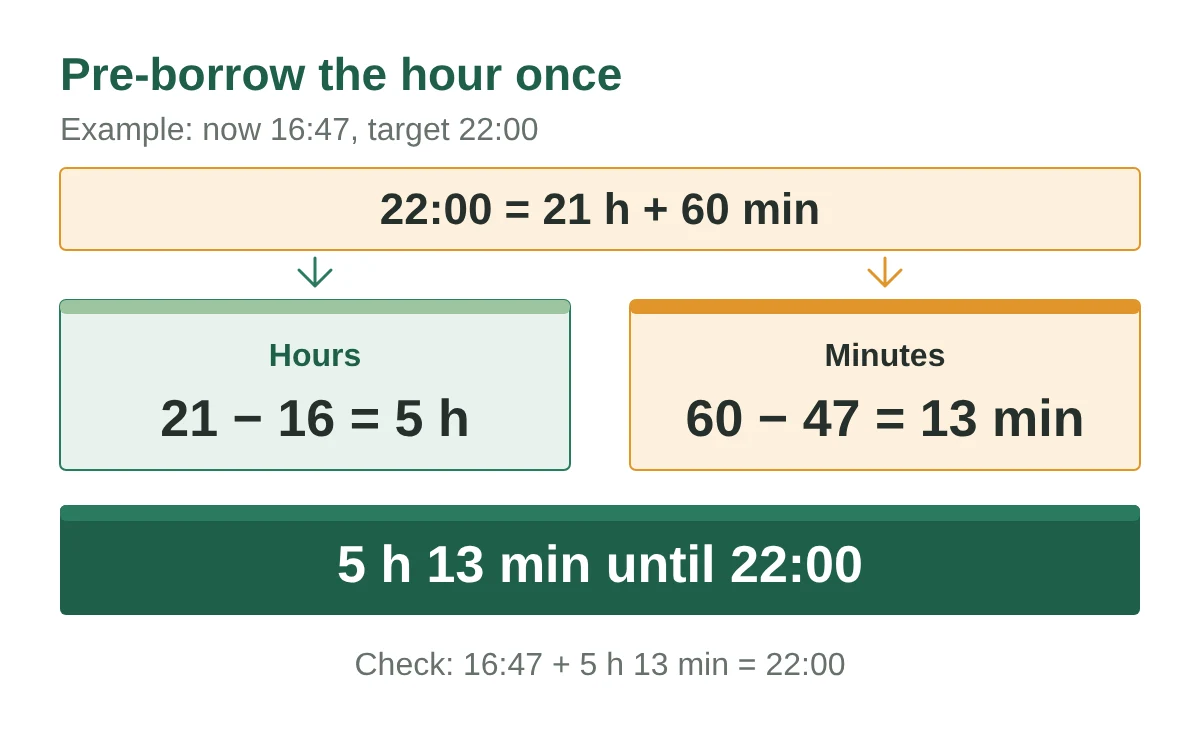
Convert 10 PM to 22:00 and think of it as 21 hours plus 60 minutes. Take the current time on a 24-hour clock. Subtract the hour from 21, then subtract the minutes from 60. This avoids borrowing, which is where most slips happen.
Take a hypothetical time of 4:47 PM (16:47). The hours part is 21 minus 16, which is 5. The minutes part is 60 minus 47, which is 13. The answer is 5 hours 13 minutes. Check it by adding: 16:47 plus 5:13 lands exactly on 22:00. If the minutes are exactly zero, skip the minute step and use 22 minus the hour.
The same logic gives you a total in minutes. Since 22:00 sits 1,320 minutes after midnight, subtract your current minutes-since-midnight from 1,320. For 16:47 that is 1,007, so 313 minutes remain, which matches 5 hours 13 minutes.
Try this: Glance at any clock right now and do the 21 minus hour, 60 minus minutes version in your head. Then compare it with the live countdown above. After three or four tries it takes about two seconds.
The 12-hour trap in the morning
The most common error is treating 10 AM and 10 PM as the same thing. They are exactly 12 hours apart, so at 10 AM you have 12 hours to go, not zero.
For any morning time, work out how long until noon, then add 10. At 7:20 AM, noon is 4 hours 40 minutes away, so 10 PM is 14 hours 40 minutes away. If you work in 24-hour time, this problem disappears because 07:20 is simply subtracted from 22:00.
Midnight causes a similar mix-up. 12:30 AM is early in the day, so 10 PM is almost 21.5 hours off. People often read “12” as “late” and undershoot.
After 10 PM has passed
Once the clock passes 22:00, “until 10 PM today” no longer exists. The sensible answer becomes the next 10 PM, which is tomorrow. By hand, that is 24 hours minus the time that has passed since 22:00.
At 23:15, you are 1 hour 15 minutes past 10 PM, so the next one is 22 hours 45 minutes away. A quick check: 22:45 added to 23:15 reaches 22:00 the next day. A tool that shows a negative number or “0” after 10 PM is counting to a moment that has gone, so look for one that rolls forward.
When daylight saving changes the answer
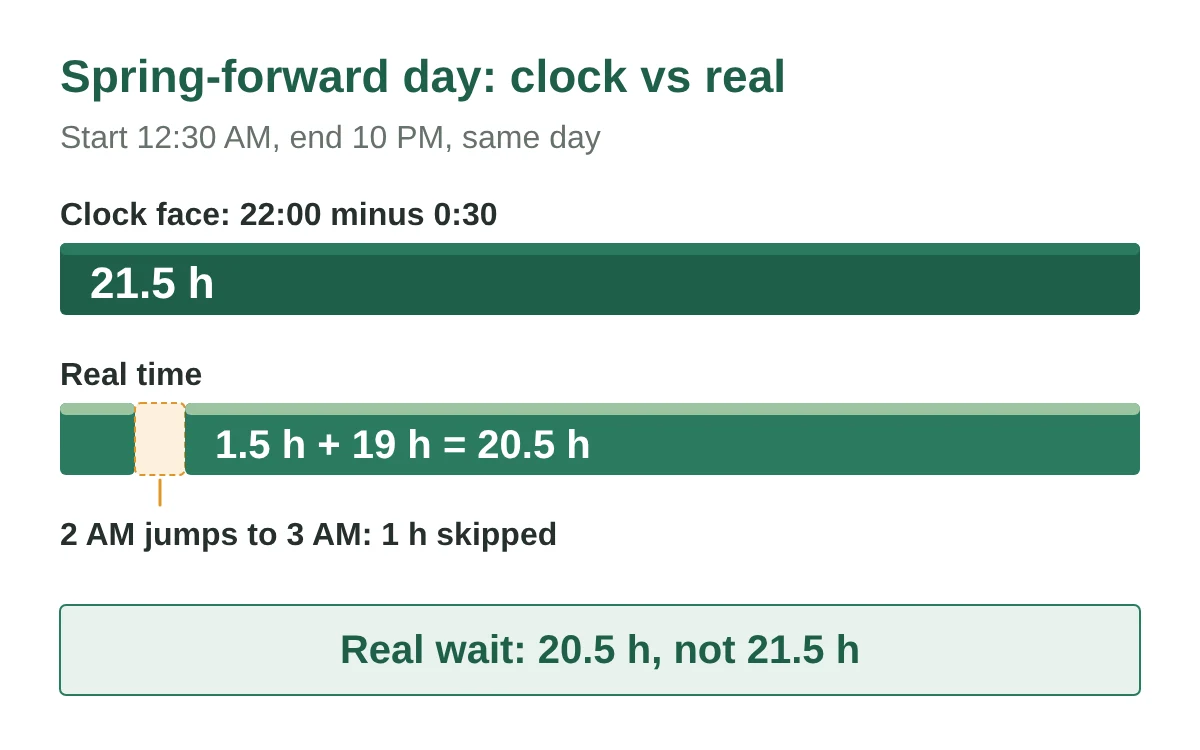
Subtracting clock times assumes every hour between now and 10 PM is a normal hour. On a clock-change day that can be wrong, but only if the change falls between now and 10 PM. A change typically happens around 2 AM, so checking at 6 PM changes nothing.
If you check at 12:30 AM on a spring-forward day, the clock face says 21.5 hours remain, but only 20.5 real hours will pass, because one hour is skipped. On a fall-back day, the real wait is an hour longer than the face suggests. Anyone timing a shift, a flight or a delivery across the change should count elapsed time, not clock difference.
The US switches on the second Sunday of March and the first Sunday of November. Most of Europe switches on the last Sunday of March and October. For roughly two to three weeks a year those two regions are out of step with each other, which shifts every cross-Atlantic gap by an hour.
Time zones and travel
The live countdown uses the time zone set on your device. If you have just landed somewhere new and the phone has not updated, the countdown will be for your old zone. Check the device clock first before trusting any result.
To find 10 PM somewhere else, convert first, then subtract. Useful anchors:
- 10 PM US Eastern is 03:00 UTC the next day in winter (UTC-5).
- 10 PM US Pacific is 06:00 UTC the next day in winter (UTC-8).
- 22:00 UTC is 11 PM in central Europe in winter.
For a quick local reference, the page on Central time now shows what the clock reads there. A call set for “10 PM” with no zone named is ambiguous, so always state the zone in the invitation.
Try this: Pick one person in another zone you talk to often. Write down what 10 PM your time is for them, in winter and in summer. If the two answers differ, you have found your own clock-change gap.
Why people count down to 10 PM
The target is common because 22:00 is a natural boundary in many places. Typical reasons include:
- The end of a late shift or on-call window, where the last hours feel longest.
- Quiet hours in apartment buildings, campsites and some residential areas.
- School night routines and bedtimes, when 10 PM is the hard stop.
- Evening appointments, online classes and live events that start late.
Markets add a twist. The New York Stock Exchange closes at 4 PM Eastern, which falls at 10 PM in much of central Europe, so European traders often watch that exact time. For London the same close is 9 PM, and for Asia it falls in the early hours of the next day.
Minutes and seconds in one step
If you need the count in other units, multiply once. Ten hours is 600 minutes or 36,000 seconds, and the full day to 22:00 is 79,200 seconds from midnight. For a shortfall under an hour, the minute number is the answer, for example 40 minutes at 9:20 PM.
For rough planning, round to the nearest quarter hour. At 5:52 PM, call it “about four hours” and you will be off by 8 minutes. Rounding down feels safer than rounding up when you are heading for a deadline.
Nearby countdowns
If 10 PM is not quite your target, the neighbouring pages run the same live maths: 9 PM, 10:30 PM, 11 PM and midnight. For a repeating gap rather than a clock time, 8 hours from now shows the clock time after a fixed wait. The full set of clock-time countdowns is on the time until hub.
FAQ
Short answers are in the FAQ section below the article.
Frequently asked questions
How do I work out how long until 10 PM in my head?
Use a 24-hour clock, subtract the current hour from 21, then subtract the current minutes from 60. At 16:47 that gives 5 hours and 13 minutes. If the minutes are exactly zero, just subtract the hour from 22.
What happens to a 10 PM countdown once 10 PM has passed?
The next 10 PM is tomorrow, so the wait is 24 hours minus the time elapsed since 22:00. At 23:15 that leaves 22 hours 45 minutes. A countdown that shows zero or a negative number is pointing at a moment that has already gone.
Does daylight saving time change how long until 10 PM?
Only if the clock change falls between now and 10 PM, and changes usually happen around 2 AM. On a spring-forward day, a check at 12:30 AM shows 21.5 hours on the clock but only 20.5 real hours remain. On a fall-back day the real wait is an hour longer than the clock difference.
Why is a 10 PM countdown wrong after I travel?
Countdowns use the time zone set on the device, so a phone that has not updated still counts to 10 PM in the old zone. Check that the device clock shows the local time before trusting the result.