
How Many Hours Until 9 PM Today?
Around the world
The number of hours until 9 PM today is simply 21:00 minus the current time, and the live countdown above does that on your own clock and time zone, down to the second. For a quick answer without the widget, subtract the hour from 9, then take one hour off if the minutes are not zero and replace them with 60 minus the minutes.
That method is faster than it sounds, and it avoids the borrowing errors most people make when subtracting times. The rest of this page covers the shortcuts, the edge cases and the few situations where the clock face can mislead you.
The fast mental method
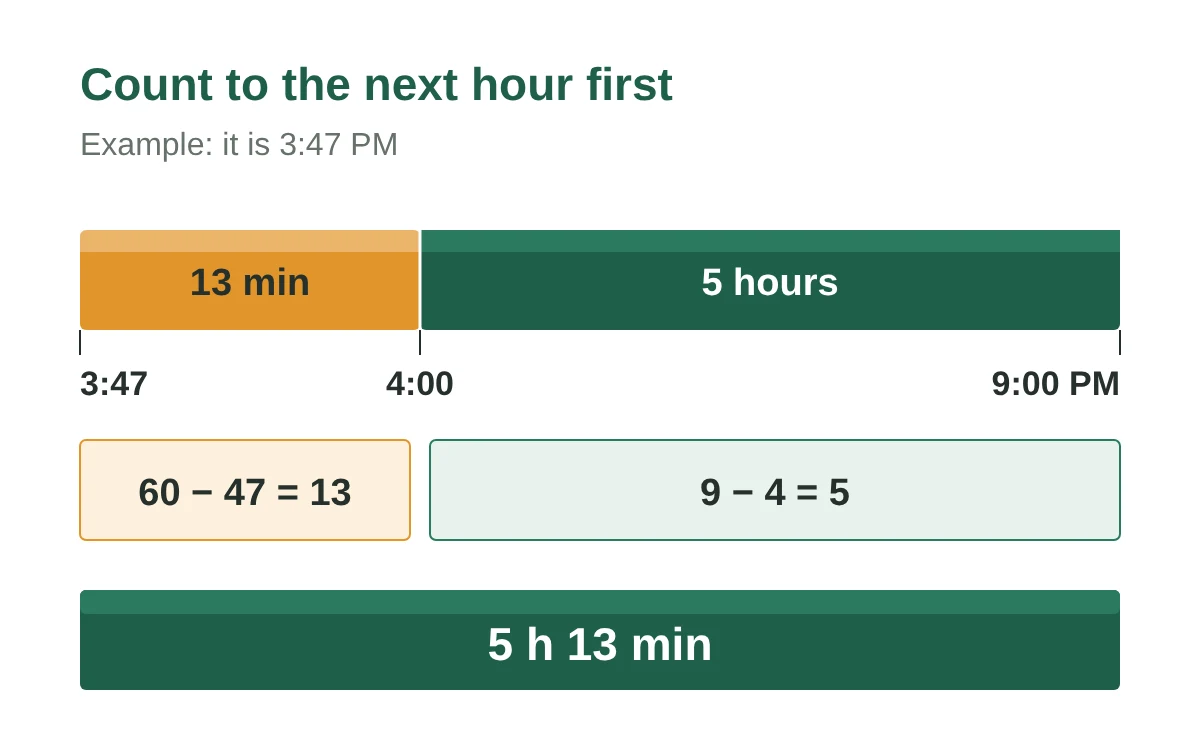
Work in 12-hour time and count to 9. Take a hypothetical start of 3:47 PM. Nine minus three is six, but the minutes are not zero, so the hour count drops to five. Then the minutes are 60 minus 47, which is 13. The answer is 5 hours 13 minutes.
The reason it works: you are really counting to the next whole hour (4:00 PM, 13 minutes away) and then adding the whole hours from 4 to 9. Nobody has to borrow anything, because “minutes to the next hour” is always 60 minus the minutes showing.
Another route is the 24-hour check. Convert to 15:47, then compute 21:00 minus 15:47 by borrowing: 20:60 minus 15:47 is 5:13. Both routes should agree, which makes a cheap self-check.
Try this: Pick any time on your clock right now, work out the gap to 9 PM using the “9 minus hour, minus one, 60 minus minutes” method, then compare it with the live countdown above.
Hours and minutes versus decimal hours
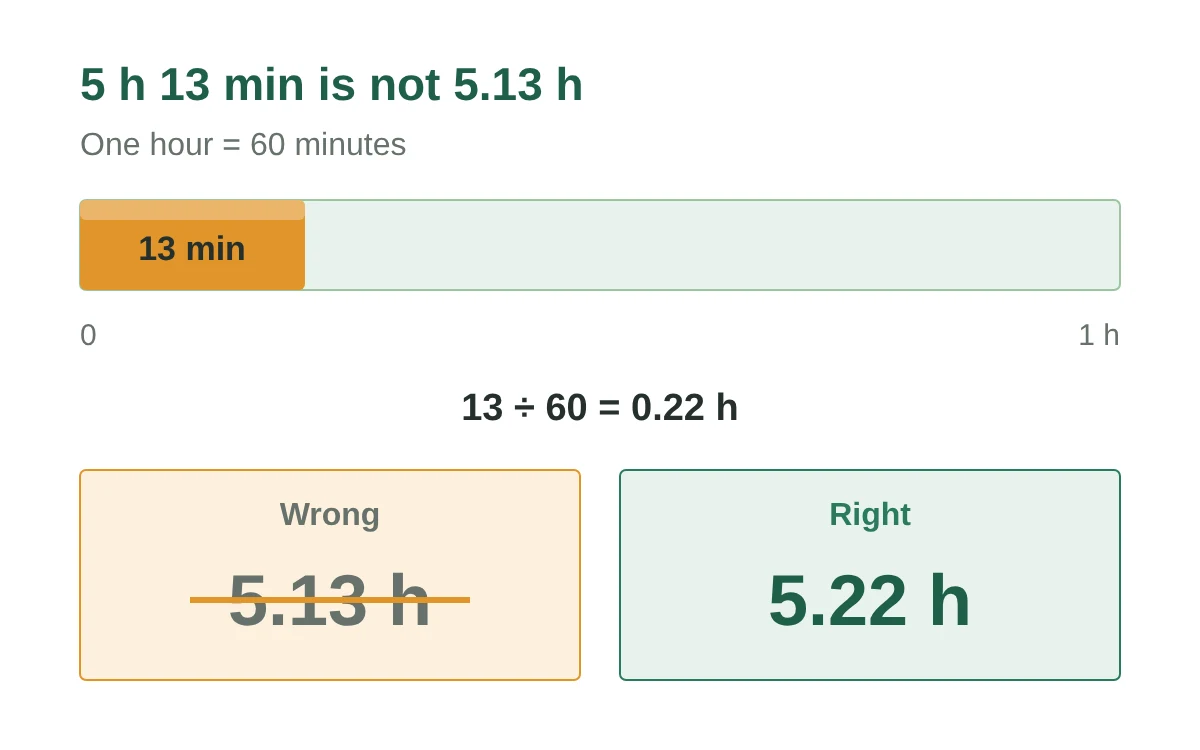
“How many hours” can mean two different things: 5 hours 13 minutes, or 5.22 hours. They are the same quantity written differently, and mixing them is the classic error. 5 hours 13 minutes is not 5.13 hours. The digits after a decimal point are fractions of 60 minutes, not minutes themselves.
To convert minutes to a decimal hour, divide by 60. A shortcut: divide by 6 and shift the decimal point. Thirteen minutes becomes 2.17, so 0.22 hours. The clean ones worth memorising are 15 minutes (0.25), 20 (0.33), 30 (0.5), 40 (0.67) and 45 (0.75). If you need other conversions, the time conversions page covers them, and 100 minutes in hours is a good worked case.
Timesheets and billing software nearly always want decimals, while people nearly always say hours and minutes. Check which one the form expects before you type.
When 9 PM has already passed
Once the clock passes 21:00, “until 9 PM today” has no meaningful answer, because that moment is in the past. A well-built countdown jumps to the next occurrence, which is tomorrow. Immediately after 9 PM it will read just under 24 hours, then fall steadily.
The mirror case is early morning. Just after midnight the gap is nearly 21 hours, and at exactly 9 AM it is exactly 12. Those two anchor points give a sanity check: any reading above 21 hours means you are looking at tomorrow’s 9 PM, and any reading of 12 hours or so at breakfast time is normal.
If you want the neighbouring evening targets, how long until 8 PM and how long until 10 PM use the same logic.
Time zones and the meaning of “today”
“Today” belongs to a place, not to the world. When it is 9 PM on a Friday in New York, it is already Saturday in Sydney, so someone there asking about 9 PM today is asking about a time that has gone, or about the evening that is still ahead on their own Saturday. The widget uses your device time zone, so check that your phone or laptop is set to where you actually are, especially after travelling or when using a VPN.
When you are coordinating with someone elsewhere, convert 9 PM into their zone first, then count. As an example, 9 PM US Eastern Standard Time is 02:00 UTC the next day, and 6 PM on the US west coast. If one side is in Central Time, the Central Time page shows what its clock reads right now.
The daylight saving trap
On the two days a year when clocks change, subtracting clock faces gives the wrong answer. If you check at noon on the day clocks go back, the true time to 9 PM is one hour longer than 21:00 minus 12:00 suggests, because the 1 AM to 2 AM hour happened twice. On the day clocks go forward, it is one hour shorter.
The change usually occurs overnight (in the US at 2 AM local time), so the error only bites if you check before the switch. Anything you check after it, including that same evening, is back to simple subtraction. A countdown that works from real elapsed time, as the live widget above does, handles this automatically. Mental maths does not, so add or subtract the hour yourself when the switch falls between now and 9 PM.
Why people check 9 PM
Common reasons are the end of a late shift, a store or restaurant closing, a class or livestream start, a medication or call scheduled for the evening, and market activity. For markets, the regular US stock session closes at 4 PM Eastern and extended sessions generally finish by 8 PM Eastern, so 9 PM there is after every normal trading window.
Shift workers have a quirk worth knowing. A shift that ends at 9 PM and started at 1 PM is eight hours, but you should subtract any unpaid break before comparing it with a target. For rolling windows such as 8 hours from now, you work forward from the clock rather than back from 9 PM.
Common mistakes
Most wrong answers come from a short list of slips:
- Reading 9 as AM, which flips the answer by 12 hours.
- Subtracting 9 minus 3:47 as if the minutes were decimals.
- Forgetting that 12 PM is noon and 12 AM is midnight, so the hour arithmetic restarts around them.
- Using a device whose time zone is stale.
The most reliable defence is converting to 24-hour time first, where 9 PM is always 21:00 and there is no AM or PM to misread.
For the last stretch of the day, how long until midnight works the same way, with 24:00 as the target. All of the countdowns to a time of day are collected on the time until page.
Try this: Next time you set an alarm for 9 PM, say the gap out loud in both forms (for example, “5 hours 13 minutes” and “about 5.2 hours”) so you notice the difference between them.
Frequently asked questions
How many hours until 9 PM today?
The live countdown above reads your device clock and time zone, so it shows the exact hours, minutes and seconds left. By hand, subtract the current time from 21:00, borrowing 60 minutes from the hour when needed.
What is 9 PM in 24-hour time?
9 PM is 21:00, written 2100 in military style. It sits 1,260 minutes after midnight, which is a handy number if you prefer to subtract in minutes.
What does the countdown show after 9 PM has passed?
It rolls forward to the next 9 PM, which is tomorrow. Right after 9 PM the figure will be just under 24 hours, so it is not an error.
Can the answer be an hour off because of daylight saving?
Yes, but only on the day clocks change. If the switch happens between now and 9 PM, the real time left differs from the clock face difference by one hour.