
How Long Until 8:30 PM?
Around the world
The live countdown above gives the exact time left until 8:30 PM (20:30) on your own device clock, down to the second. If 8:30 PM has already passed where you are, it switches to tomorrow’s 8:30 PM, so a large number late in the evening is normal, not a bug.
The rest of this page covers what the widget cannot show you: how to work the answer out in your head, why the number can be off by an hour on certain nights, and how to read 8:30 PM across time zones.
The 1230-minute shortcut
8:30 PM is 1230 minutes after midnight. That single number turns the whole problem into one subtraction. Convert the current time to minutes after midnight, then subtract it from 1230.
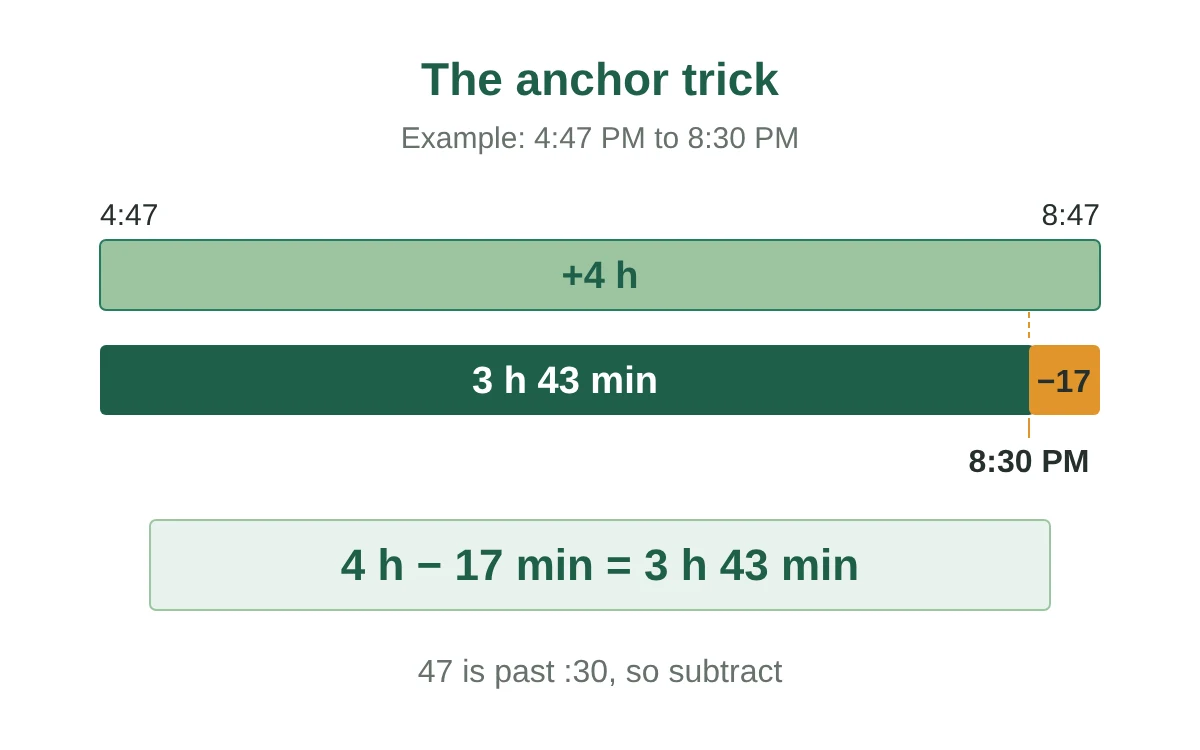
Take a hypothetical start of 4:47 PM. That is 16:47, or 16 × 60 + 47 = 1007 minutes. Then 1230 − 1007 = 223 minutes, which is 3 hours 43 minutes. You can check it another way: 4:47 PM to 8:47 PM is 4 hours, and 8:30 is 17 minutes earlier than 8:47, so 4 hours minus 17 minutes also gives 3 hours 43 minutes.
The second method is the one to use in your head. Anchor on the same minute past the hour as the target, count the whole hours, then correct by the difference in minutes. If your minutes are below 30, you add the gap. If they are above 30, you subtract it.
Try this: Glance at any clock right now and work out the time to 8:30 PM using the anchor method before you look at the widget. Do it three times a day for a week and the half-hour correction becomes automatic.
What happens after 8:30 PM passes
Once the clock reads 8:31 PM, the next 8:30 PM is 23 hours 59 minutes away. A countdown that jumps from near zero to nearly a full day is behaving correctly. The target is always the next occurrence of 8:30 PM, not a fixed moment.
Rounding is another small trap. A display of “8 minutes” can mean 8 minutes and 59 seconds if the tool truncates, or 7 minutes and 1 second if it rounds up. The seconds in the widget remove the ambiguity, which matters when you are timing something tight like a ticket release or a bus.
If you were really after the same clock time in the morning, that is 12 hours earlier on the dial. 8:30 AM and 8:30 PM are the most commonly mixed-up pair on 12-hour clocks, so double-check an invitation that only says “8:30.”
Why people check this time
8:30 PM sits at an awkward and useful spot in the day. It is a common end for evening classes and second-shift meetings, a typical late dinner reservation, and a popular start for films and live events. It is also three and a half hours before midnight, which makes it a handy marker for bedtime planning. For that horizon, see how long until midnight.
Traders often watch it too. US extended-hours stock trading generally runs until 8:00 PM Eastern, so 8:30 PM falls just after that session closes. If you are timing an order or a data release, check whose clock the 8:30 belongs to before trusting any countdown.
For neighbouring targets, 8 PM and 9 PM have their own live counters, and the time until hub lists every time of day.
Time zones and half-hour offsets
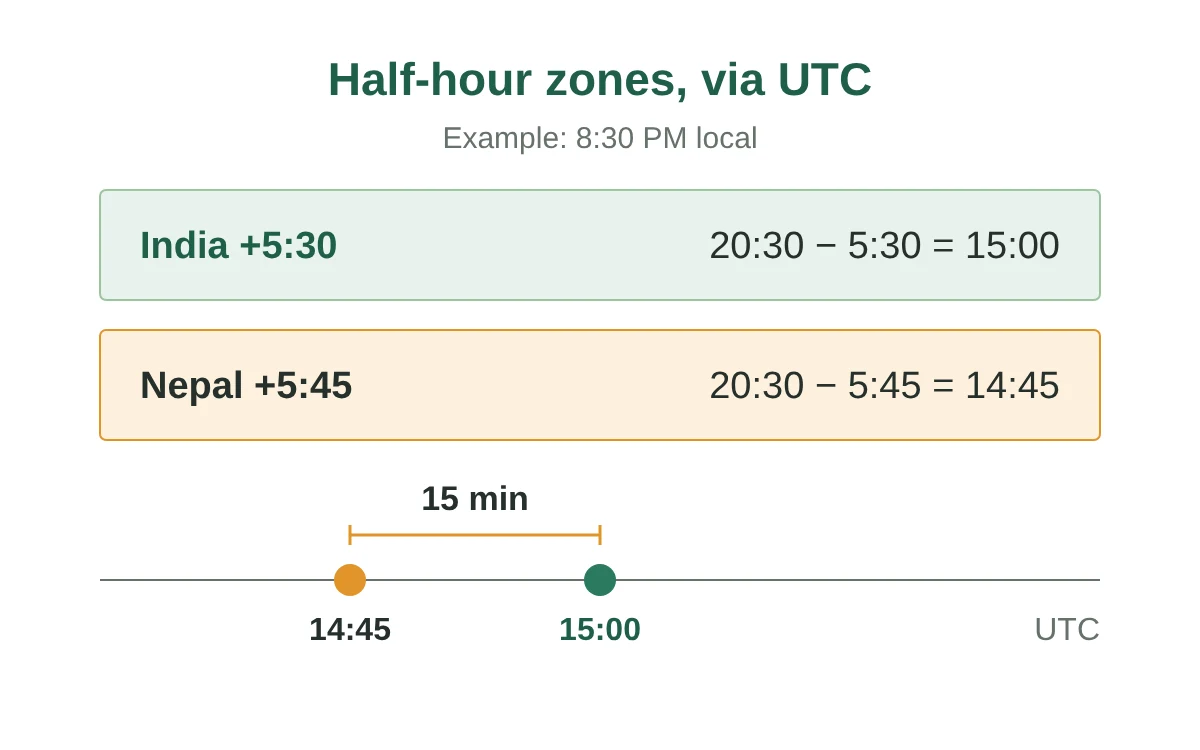
The widget uses your device’s zone, so it answers “how long until 8:30 PM where I am.” If a colleague says 8:30 PM, the answer depends on whose 8:30 it is. Always convert through UTC rather than zone to zone, because it avoids slips.
Half-hour zones are where mental conversion goes wrong. India is UTC+5:30, so 8:30 PM there is 20:30 − 5:30 = 15:00 UTC, which is 3:00 PM. Nepal is UTC+5:45, so the same local time lands at 14:45 UTC. For a Central US check, the Central time now page shows the current offset.
Also note that countries switch clocks on different dates. For a few weeks each year the gap between, say, New York and London is an hour different from the usual one.
Try this: Pick one person you regularly schedule with, write down their UTC offset, and calculate what 8:30 PM your time is for them. Save the result in your calendar notes.
When clock changes bend the answer
On a night when clocks change, the time on the dial and the time that actually elapses stop agreeing. If the clocks change between now and then, the real time left differs from the clock-face difference by the size of the change. So a countdown to tomorrow’s 8:30 PM can be 23 or 25 hours long instead of 24.
A subtraction by hand will not catch this, because it works on the clock face. A browser-based widget that counts real elapsed time will. If your hand calculation and the widget disagree by exactly one hour, a clock change in between is the first thing to check.
Turning the answer into other units
Total minutes are the most useful form for planning, since they map onto timers and alarms. Multiply by 60 for seconds. For a fraction of an hour, divide the extra minutes by 60, so 3 hours 43 minutes is about 3.72 hours, which matters if you are billing or logging time in decimals.
If you want to land on 8:30 PM from a known interval instead, work backwards. A task that takes 45 minutes must start at 7:45 PM, and 45 minutes from now or 30 minutes from now will show the finish time if you start immediately. For longer spans, 8 hours from now is useful for shifts that end at 8:30 PM.
For general conversions between minutes, hours and days, the time conversions section covers the rest.
Frequently asked questions
How do I work out how many minutes are left until 8:30 PM?
Convert the current time to minutes after midnight and subtract it from 1230, since 8:30 PM (20:30) is 1230 minutes after midnight. For example, 4:47 PM is 1007 minutes, so 1230 minus 1007 leaves 223 minutes, or 3 hours 43 minutes.
Why does a countdown to 8:30 PM show almost a full day right after 8:30 PM?
Once the clock passes 8:30 PM, the countdown switches to the next occurrence of 8:30 PM, which is tomorrow. At 8:31 PM that is 23 hours 59 minutes away, so a large number is correct behavior.
What is 8:30 PM in India in UTC?
India is UTC+5:30, so 8:30 PM there equals 15:00 UTC (3:00 PM). Half-hour and 45-minute zones such as Nepal (UTC+5:45, giving 14:45 UTC) are easiest to convert by going through UTC rather than zone to zone.
Why can my hand calculation differ from the countdown by exactly one hour?
A clock change between now and 8:30 PM is the usual cause. Hand subtraction uses the clock face, while a countdown that tracks real elapsed time can show 23 or 25 hours until tomorrow's 8:30 PM instead of 24.