
How Long Until 11 AM?
Around the world
The time left until 11 AM is the gap between your current clock time and 11:00 in your own time zone. The live widget above reads your device clock and gives that gap to the second, so use it for the exact figure. If 11:00 has already passed today, it counts toward tomorrow’s 11 AM instead.
The rest of this page covers what the widget cannot show you: how to get the answer in your head in a few seconds, and the odd cases where the obvious subtraction gives the wrong result.
The 35 rule for afternoons and evenings
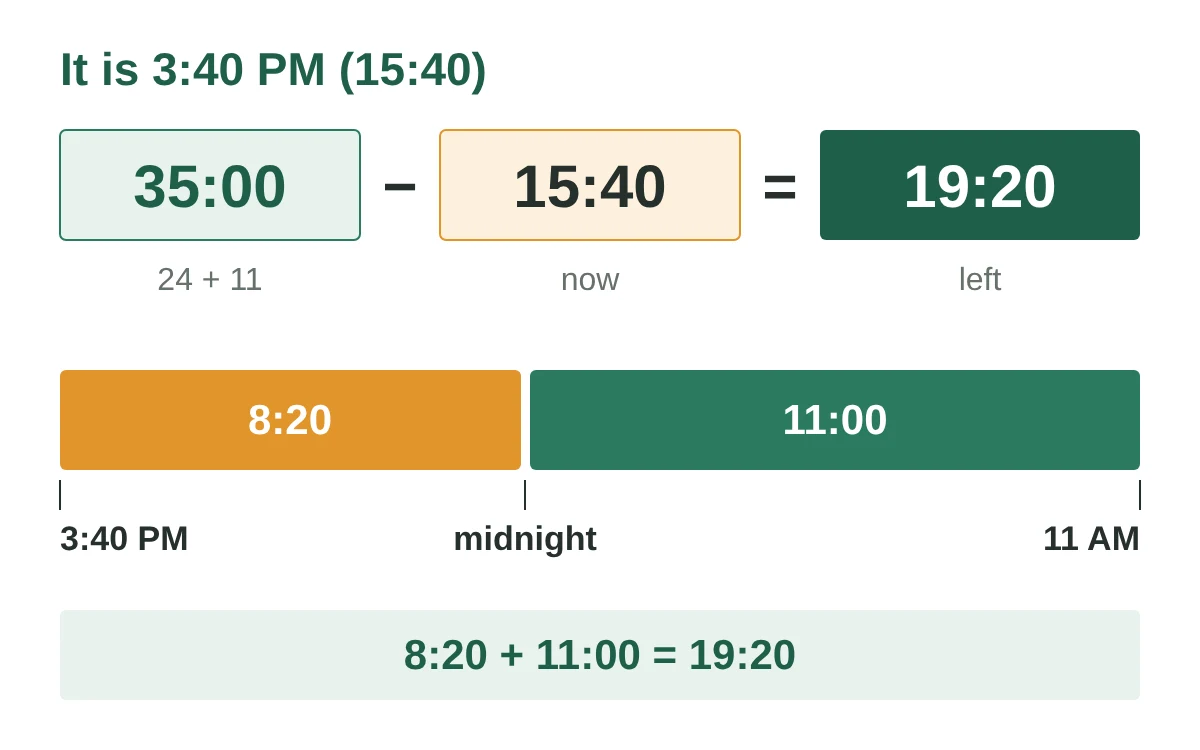
Before 11 AM, the answer is simple subtraction. After 11 AM, most people count hours to midnight and then add 11, which works but takes two steps. On the 24-hour clock there is a one-step version: subtract your time from 35:00.
The logic is that tomorrow’s 11 AM sits at 24 + 11 = 35 hours on a running clock that started at today’s midnight. Worked example, with a hypothetical start of 3:40 PM, which is 15:40. Then 35:00 minus 15:40 is 19:20, so 19 hours and 20 minutes remain. Check it the long way: 3:40 PM to midnight is 8:20, plus 11 hours is 19:20.
The same rule works for any target time. Replace 11 with the target hour and add 24. For a 10 o’clock target the number is 34, and for noon it is 36.
Borrowing from the hour
Most mistakes in time subtraction come from treating minutes as if they run to 100. Suppose it is 8:20 AM and you subtract 8:20 from 11:00 digit by digit. You get 3:-20, and the habit of fixing that gives people “2:80”, which is wrong.
The clean fix is to rewrite 11:00 as 10:60 before subtracting. Then 10:60 minus 8:20 is 2:40. You borrow one hour and turn it into 60 minutes, exactly as you would borrow a ten in ordinary subtraction.
There is also a faster trick for the last hour. When the clock reads 10:xx, the minutes left are 60 minus xx. At 10:47 that is 13 minutes. No other arithmetic is needed.
Try this: Glance at the clock and, without looking at the widget, say the time left until 11 AM out loud using the 10:60 rewrite. Then check yourself against the countdown. Three or four rounds and the borrowing becomes automatic.
When 11 AM is not 24 hours away
Between one 11 AM and the next there are 24 hours on almost every day. On the day clocks change for daylight saving time, that breaks. Most regions switch in the small hours (commonly 1 or 2 AM), so 11 AM itself is never skipped. But any countdown that crosses the switch moves by an hour.
Take a hypothetical spring-forward night, with the clocks jumping at 2 AM on Sunday. From 9 PM Saturday to 11 AM Sunday, the clock face says 14 hours. The real elapsed time is 13, because one hour was deleted. On a fall-back night the same trip takes 15 real hours.
A good countdown tool handles this because it works from absolute timestamps, not from clock-face subtraction. Doing it by hand, adjust by one hour whenever a clock change falls inside your window. A few regions change at midnight instead, so check the local rule if you are counting across a weekend change.
Which 11 AM do you mean?
A bare “11 AM” in an invitation or announcement is ambiguous when people sit in different zones. The widget uses your device’s zone, so it answers “how long until 11 AM where I am.” If the event is anchored elsewhere, you need that zone’s offset first.
A few useful anchors: 11 AM in New York is 8 AM in Los Angeles, and 4 PM UTC in winter (3 PM UTC in summer, when US daylight time is in force). Europe and the US change clocks on different dates, so the gap between London and New York is briefly different in March and again in late October or early November. Those few weeks are where scheduling errors cluster. For a quick Central Time check, the Central Time now page shows the current offset.
Also watch for abbreviations. “CT” and “ET” cover both standard and daylight time, whereas “CST” and “EST” name only the standard one, and people often write them loosely all year.
Why people check the time until 11 AM
11 AM is a common cut-off for more than meetings. Many hotels set checkout at 11, pharmacies and couriers publish late-morning pickup deadlines, and brunch bookings often start then. Schools frequently schedule a break or an exam block around it, and clinics sometimes release or cancel appointment slots a set time before.
For markets, 11 AM Eastern lands about 90 minutes after the New York Stock Exchange opens at 9:30 AM. In London it is 4 PM in winter, so US-based events at that hour arrive late in the European afternoon. If you trade or follow announcements, count to the exchange’s own zone, not yours.
In each case the useful number is often not the time left to 11:00 itself but the time left to the point you must act. Subtract your travel, boarding or setup time from 11:00 first, then count down to that earlier moment. For a half-hour earlier target, the 11:30 AM countdown and the 10 AM countdown are handy neighbours.
Minute maths for 11 AM
Because 11 AM is 660 minutes after midnight, you can do the whole calculation in minutes. Convert now to minutes after midnight and subtract from 660. If the result is negative, add 1,440 (minutes in a day).
Using the same hypothetical 3:40 PM: that is 940 minutes after midnight. 660 minus 940 is -280, and adding 1,440 gives 1,160 minutes. Divide by 60 and you get 19 with 20 left over, so 19 hours 20 minutes, matching the 35 rule.
For seconds, multiply minutes by 60. Nine hundred and sixty-eight… in practice nobody needs that by hand, but it is useful to know that 1,160 minutes is 69,600 seconds. If you often convert awkward totals, the time conversions page covers the rest, and 100 minutes to hours shows a typical case.
Common slips that change the answer
The biggest one is 12 AM versus 12 PM. 12 AM is midnight and 12 PM is noon, so “12 AM to 11 AM” is 11 hours, not 23. If a start time reads 12:30 AM, treat it as 00:30 before subtracting.
The second is mixing up 11 AM and 11 PM. They are exactly 12 hours apart, and the evening one has its own page: how long until 11 PM. Rounding is the third. Treating 10:47 as “about 11” hides the 13 minutes that decide whether you catch a bus or a call.
Try this: Pick any time on a clock, convert it to 24-hour format, and subtract it from 35:00. Then do the same by counting to midnight and adding 11. If the two answers differ, one step has a borrowing error.
Related countdowns
If your deadline is a different hour, the countdowns to a time of day page lists every clock-time target on the site. The 30 minutes from now page helps when you want a time offset from the present moment instead of a fixed clock time.
Frequently asked questions
How many minutes after midnight is 11 AM?
11 AM is 660 minutes after midnight (11 x 60). Convert your current time to minutes after midnight and subtract it from 660 to get the minutes left, or add 1,440 first if 11 AM has already passed.
What does the countdown show at exactly 11:00 AM?
It depends on the tool. Some show zero, others jump straight to the next 11 AM, which is 24 hours away on most days. If you need the moment itself, treat 11:00:00 as the boundary and plan around the second it rolls over.
Is 11 AM the same as 1100 in military time?
Yes. 11 AM is 11:00 on the 24-hour clock, usually written 1100. Times from 1 PM onward add 12, so 11 PM becomes 2300.
Can daylight saving time change how long until 11 AM?
Yes, but only if the clock change falls between now and 11 AM. A countdown started before a spring-forward change is one hour shorter than the clock difference, and one started before a fall-back change is one hour longer.