
How Long Until 12 PM?
Around the world
The time left until 12 PM is 12:00 minus your current time if you are before noon. If noon has passed, it is 36:00 minus the 24-hour clock time, because the next noon is tomorrow’s. The live countdown above does this on your own clock and time zone, so use it for the exact figure.
The rest of this page covers what the widget cannot show you: quick mental maths, the mistakes that catch people out, and the cases where simple subtraction gives a wrong answer.
The two-formula shortcut
Convert your time to the 24-hour clock first. Before noon, the answer is 12:00 minus that time. After noon, the answer is 36:00 minus that time. The number 36 is just 24 (to reach midnight) plus 12 (to reach the next noon), so you only subtract once instead of chaining two steps.
A worked example with a made-up starting point: it is 3:20 PM, which is 15:20. Then 36:00 minus 15:20 is 20 hours and 40 minutes. Check it the long way: 15:20 to midnight is 8:40, plus 12 hours gives 20:40. Same answer, one step fewer.
The 11:60 borrow trick
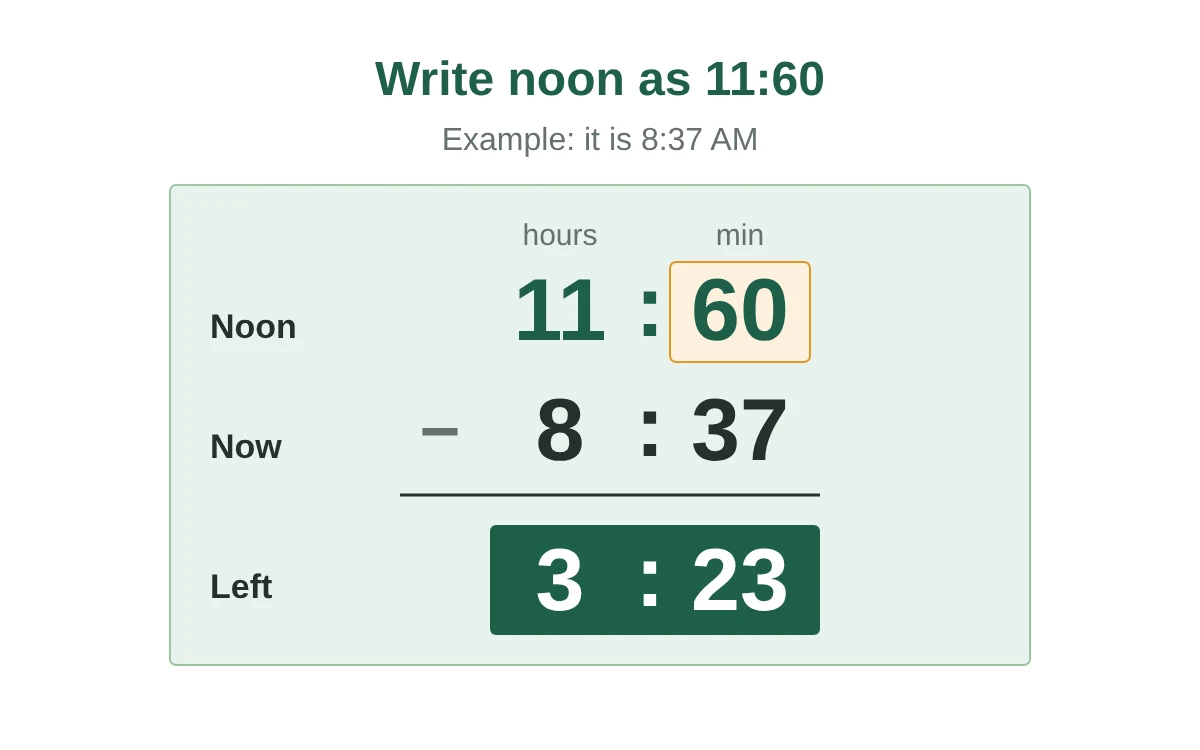
Subtracting minutes is where most mistakes happen. The fix is to write noon as 11:60 whenever your current time has minutes in it. Then you subtract hours from 11 and minutes from 60 separately, with no borrowing in your head.
Say it is 8:37 AM. Hours: 11 minus 8 is 3. Minutes: 60 minus 37 is 23. The answer is 3 hours 23 minutes. Cross-check in minutes: 8:37 is 517 minutes after midnight, and 720 minus 517 is 203, which is 3 hours 23 minutes.
Try this: Pick any time on your clock that has minutes in it. Work out the gap to noon with the 11:60 method, then confirm it with 720 minus minutes since midnight. If the two answers disagree, you slipped on the hour, not the minutes.
12 PM versus 12 AM
Noon is 12 PM and midnight is 12 AM, which feels backwards because 12 is the largest number on the dial. The logic is that AM and PM mean before and after midday, and noon itself is neither. Different systems settle that edge differently, which is why 12:00 PM is the usual label but not a universal one.
The real trap is midnight. “12 AM Friday” can mean the start of Friday (Thursday night) or the end of it, depending on who wrote it. For deadlines, tickets and shared calendars, use “12:00 noon” or the 24-hour 12:00. Noon is the safe case, but it is also the one people mislabel when they type 12:00 AM by habit.
The same flip applies to half-hours. 12:30 PM is 30 minutes after noon. 12:30 AM is 30 minutes after midnight. If you need the half-hour version of this countdown, How Long Until 12:30 PM? covers it.
Time zones and noon
A countdown to 12 PM normally means noon wherever your device is. If you travel, use a VPN or change a device clock, the target moves with it. For noon somewhere else, you need the other city’s clock. Convert your current time into theirs first, then subtract.
Abbreviations cause quiet errors. A deadline of “noon EST” strictly means Eastern Standard Time, which is one hour behind Eastern Daylight Time in the summer months. Many people write EST when they mean whatever the local Eastern time is. When a deadline matters, ask for a city name rather than an abbreviation. To check what a zone’s clock says right now, try Central Time now.
Noon on the clock is also not the sun’s noon. Solar noon, when the sun is highest, shifts with your longitude within the zone and runs about an hour later under daylight saving time. Clock noon is a convention, not an astronomical event.
When the clocks change
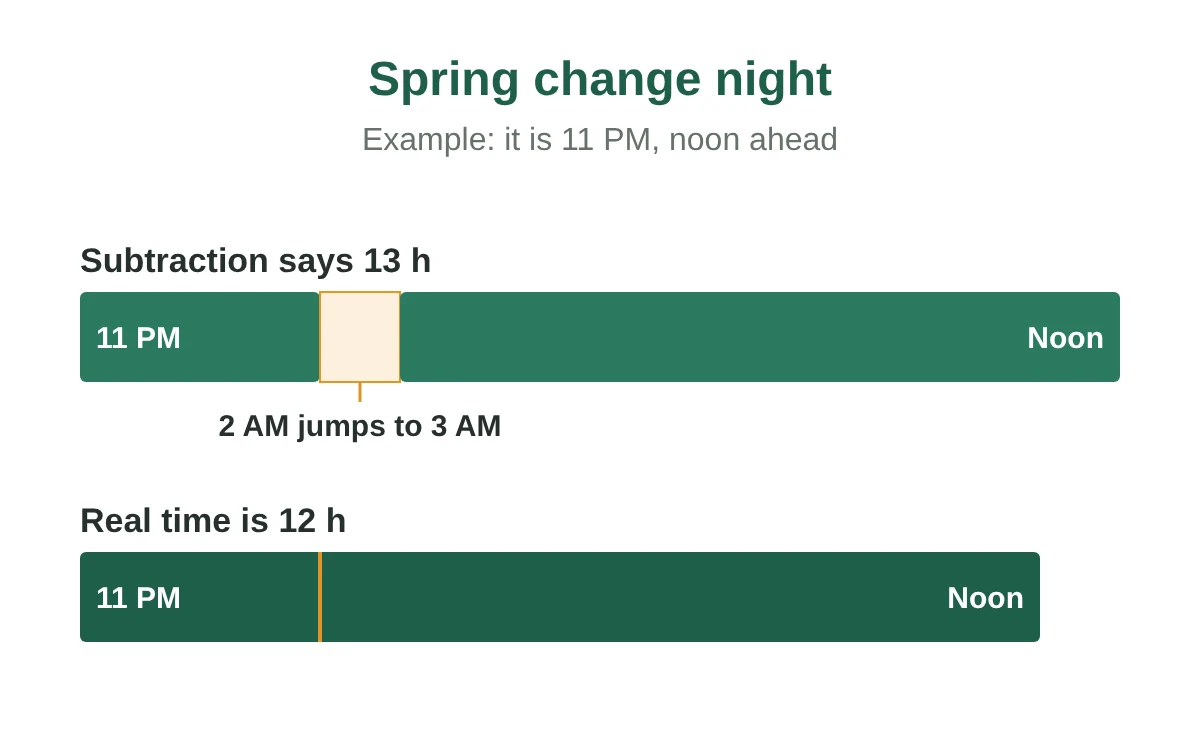
Simple subtraction assumes every day has 24 hours. On a daylight saving change day it does not. In regions that change at 2 AM, the clocks jump forward in spring and the night is an hour shorter. In autumn they fall back and the night is an hour longer.
So if it is 11 PM the evening before a spring change, clock subtraction says noon is 13 hours away. In real elapsed time it is 12 hours away. In autumn it flips the other way, and noon is 14 real hours away. The next US spring change is on 14 March 2027, so see How Many Days Until March 14th? if you plan around it. The live widget counts real elapsed time, so it handles this. Your own mental subtraction will not.
Try this: Next time a clock change is coming, look at a countdown to noon the evening before. Compare it with your own subtraction. The one-hour gap shows you exactly how the change affects your night.
Why people check noon
Noon is a common cutoff because it splits the working day into two clean halves. Typical uses include:
- Courier and same-day order cutoffs, which often close before or at midday
- Hotel check-out times, which are often 11 AM or noon
- Half-day school or work finishes
- Noon deadlines for forms, bids and registrations
- Lunch meetings, product drops and ticket releases
Markets are a special case. US stock exchanges open at 9:30 AM Eastern and close at 4 PM. Noon is not an official boundary, but it is the midpoint many traders watch for a volume lull. Half-day sessions, such as the day after US Thanksgiving, close early at 1 PM Eastern, so check the exchange calendar before assuming.
Minutes and seconds to noon
For a figure in minutes, use 720 minus minutes since midnight. For seconds, multiply the hours remaining by 3,600 and the minutes by 60, then add them. A fast pattern: when it is anywhere in the 11 o’clock hour, the minutes left are simply 60 minus the minutes showing. At 11:42 you have 18 minutes, with no hour maths at all.
For longer conversions, time unit conversions lists the standard factors. If you are working toward a different clock time, the same formulas apply to 11 AM or 3 PM, and the pattern with midnight as the target is on How Long Until Midnight?. For other times of day, the time-of-day countdowns page has the full set.
Counting forward from noon
Sometimes the question is the reverse: what time is it a set number of hours after noon? Adding hours to 12:00 gives 8 PM for 8 hours, and 12 hours lands on midnight. Past noon, the shortcut still works. Anything you add beyond 12 hours rolls into the next day, so write the date as well as the time.
Frequently asked questions
How long until 12 PM if it is 12:00 PM right now?
The countdown is zero at that exact second. One second later, the next noon is 23 hours, 59 minutes and 59 seconds away. Some tools show tomorrow's noon from the start, so a 24:00:00 reading is normal.
Is 12 PM noon or midnight?
12 PM is noon and 12 AM is midnight. To avoid any doubt in messages or bookings, write 12:00 noon or use the 24-hour form 12:00.
How many minutes until 12 PM?
Take 720 minus the minutes that have passed since midnight. The live countdown above gives the figure for your clock. By hand, 9:45 AM is 585 minutes past midnight, so 135 minutes remain.
Why does the countdown sometimes differ by an hour from simple subtraction?
A daylight saving change between now and noon adds or removes an hour. The clocks jump overnight, so subtracting clock readings gives the wrong gap. The live widget uses real elapsed time, so it stays correct.